

The Complete Guide to Desiccant Resin Dryers: From Micro and Mini Dryers to High-Volume Central Drying Systems
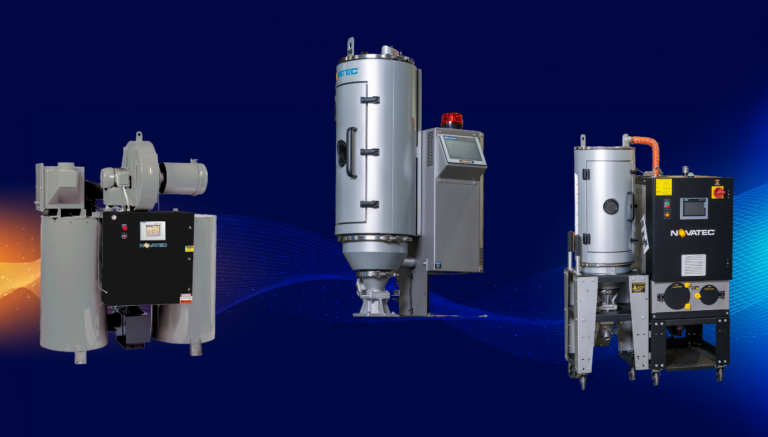
For plastics processors, resin drying isn’t optional…it’s the foundation everything else is built on. Get it wrong and the consequences show up at the machine: splay, brittleness, inconsistent melt, rejected parts, and production time you can’t get back. Get it right and it disappears into the background, quietly doing its job while you focus on everything else.
The challenge is that desiccant drying technology has evolved significantly, and not all desiccant dryers are the same category of thing anymore. There are systems that require desiccant bead replacement every few years, systems with desiccant wheels that last a decade or more, and now a fundamentally different approach: a permanently sealed Lifetime Desiccating Cartridge that never degrades and never needs replacing — guaranteed for the life of the dryer. And critically, the right technology depends heavily on your throughput range and application. A micro molder running 5–10 lbs/hr has completely different requirements than a central drying system processing thousands of pounds per hour — and the industry now has purpose-built solutions for every point on that spectrum, including medical device manufacturers, cleanroom molders, laboratory applications, and micro and mini injection molding operations where contamination control and near-zero maintenance aren’t just nice-to-have — they’re non-negotiable.
This guide breaks down every major desiccant resin drying technology on the market today, what makes each one work, where each one excels, and how to match the right technology to your operation’s specific throughput and maintenance requirements.
Twin-Tower Desiccant Dryers: The Classic Workhorse
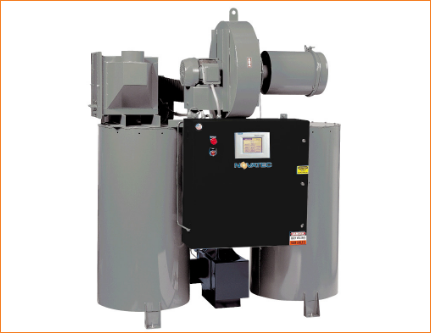
The twin-tower desiccant dryer — also known as a dual bed dryer — has been a workhorse of the plastics industry for decades. The operating principle is straightforward: two towers packed with desiccant beads alternate between drying and regeneration cycles, ensuring a continuous supply of dry process air. It works. And for operations already running these systems with established maintenance routines, it continues to get the job done. But twin-tower technology comes with real trade-offs that have driven many processors toward newer alternatives over time.
The most significant is desiccant bead degradation. Beads break down over time — typically requiring full replacement every two to five years — and as they degrade, they generate desiccant dust that can contaminate resin. For standard molding operations this is manageable. For medical device manufacturers, cleanroom environments, or any application where contamination is a critical concern, desiccant dust is a serious problem. The regeneration cycle also consumes significant energy, and the switching between towers creates periodic process interruptions that more continuous technologies avoid.
Pros:
- Familiar technology
- Can achieve low dew points
- Widely available
Cons:
- Regular desiccant replacement is needed
- Potential for desiccant dust contamination
- Higher energy consumption due to regeneration cycles
Bottom Line: Twin-tower desiccant dryers are proven, widely available, and capable of achieving the dew points serious resin drying requires. But between periodic desiccant bead replacement, dust contamination risk, and higher energy consumption from regeneration cycling, they represent the highest long-term maintenance burden of any desiccant technology on the market today. For operations evaluating a new dryer purchase, the technologies that follow offer meaningful advantages.
Carousel Desiccant Dryers: An Outdated Approach

The carousel desiccant dryer represented an early attempt to improve on the twin-tower design by rotating chambers of desiccant material continuously through drying, regeneration, and cooling phases — eliminating the abrupt tower-switching interruptions of twin-tower systems. It was a meaningful step forward at the time. However, the carousel’s rotating chamber design introduced mechanical complexity that created its own maintenance challenges — more moving parts, more wear points, and higher long-term operational costs than the technology it was meant to improve upon.
Desiccant wheel technology arrived shortly after and rendered the carousel largely obsolete, delivering the continuous drying benefits the carousel attempted to achieve with far greater efficiency and reliability. Carousel dryers are rarely specified for new installations today.

Pros:
- Continuous drying process without the need for tower switching
- Potentially lower energy consumption than twin-tower dryers
- Consistent, stable performance
Cons:
- Complex system with more moving parts
- Higher maintenance requirements
- Less energy efficient than newer alternatives like desiccant wheel and Desiccating Cartridge Dryers
- Higher long-term operational costs
Bottom Line: Carousel dryers served their purpose in the industry’s evolution but have been superseded by more efficient and reliable technologies. If you’re evaluating desiccant drying options today, desiccant wheel technology or Desiccating Cartridge technology will deliver meaningfully better long-term results.
Desiccant Wheel Dryers: Continuous Desiccant Technology at Scale

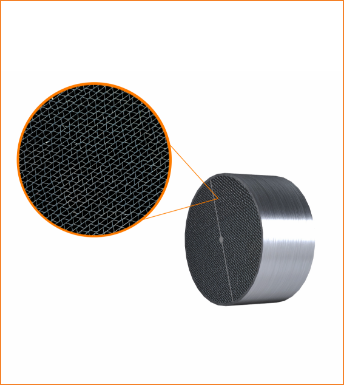
Desiccant wheel dryers — also known as rotary desiccant dryers — represent a significant leap forward from both twin-tower and carousel designs. Instead of switching between towers or rotating chambers of loose desiccant, a desiccant wheel rotates continuously through dedicated drying, regeneration, and cooling zones. The result is a truly continuous drying process with stable, consistent dew point control and none of the process interruptions that tower switching creates.
What makes wheel technology distinctly superior to bead-based systems is how the desiccant is integrated into the wheel itself. Rather than loose beads that degrade and generate dust, the desiccant material in a wheel dryer is fused directly into the wheel’s surface structure — a woven desiccant medium that exposes significantly more desiccant surface area per minute than dual bed designs. That means faster, more effective moisture removal with no desiccant dust contamination risk. As the wheel rotates, it continuously regenerates…there are no complete changeover cycles, no towers switching, just steady, uniform drying.
But here’s the catch — not all desiccant wheel dryers are created equal. The quality of components, especially the desiccant wheel itself, can vary greatly. In higher-quality models, the wheel is designed to absorb and release moisture efficiently while lasting longer without degrading. On the other hand, some manufacturers use lower-quality wheels that wear down quickly, resulting in inefficient drying and more frequent replacements.
Energy efficiency is another critical factor. High-end desiccant wheel dryers are optimized to use less energy over time, ensuring that the dryer runs efficiently. However, cheaper versions may lack the advanced features needed to minimize energy consumption, resulting in higher operating costs in the long run.
Novatec’s NovaWheel is a purpose-built expression of what desiccant wheel technology can achieve at its best. The NovaWheel uses a premium woven desiccant wheel that absorbs and releases moisture more effectively than standard wheel designs, maintaining peak drying performance consistently over a remarkably long service life — up to 15 years or more. Compare that to the two-to-five-year replacement cycle of traditional desiccant beads and the long-term operational savings become substantial. And because the desiccant is woven into the wheel structure rather than loose beads, there is zero desiccant dust — a critical advantage for any operation running engineered resins or sensitive applications.
The NovaWheel also features Intelligent Regeneration technology, which continuously monitors the regeneration process and adjusts heater output in real time to use only the energy actually required. This precision delivers meaningful energy savings over time compared to fixed-cycle regeneration systems. Critically, desiccant wheel technology scales. The NovaWheel handles throughputs from modest production volumes all the way up to 5,000 lbs/hr, making it the right technology for central drying systems, high-volume production environments, and any application where throughput requirements exceed what a portable or machine-side dryer can deliver.
Pros:
- Minimal maintenance with long-lasting desiccant material
- Energy-efficient, continuous drying process
- Reliable and stable dew point control
- Exposes 3x more desiccant per minute than dual bed dryers
Cons:
• Minimum throughput starts at 25 lbs/hr — not ideal for micro molding, small lab applications, or machine-side drying at lower throughputs where a compact Desiccating Cartridge Dryer is the better fit.
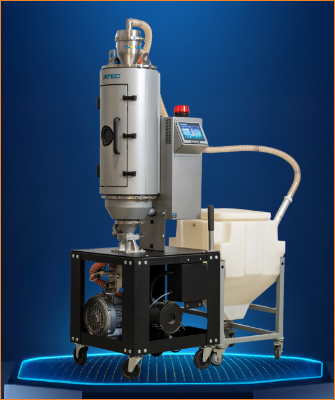
Bottom Line: For high-throughput drying applications — particularly central drying systems or operations running above 100 lbs/hr — the NovaWheel desiccant wheel dryer is the clear step forward from twin-tower and bead-based technologies. A 15-year-plus wheel life, zero desiccant dust, and Intelligent Regeneration technology make it one of the most efficient and lowest-maintenance desiccant wheel systems available. For operations that need to scale, the NovaWheel is built for it.
Desiccating Cartridge Dryers: Maximum Performance, Minimal Maintenance
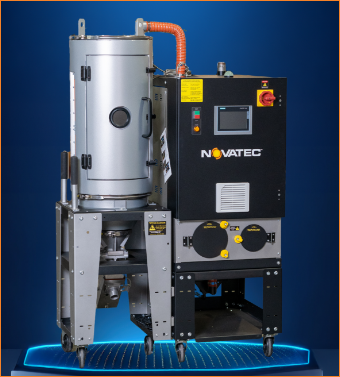
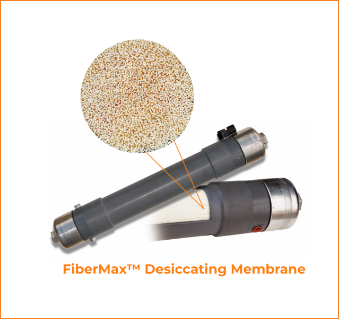
Every desiccant technology discussed so far uses a desiccant medium that eventually degrades: beads that break down and need replacement or wheels that last 15 years or more before requiring attention. Novatec’s NovaDrier takes a fundamentally different approach — and earns a category of its own: the Desiccating Cartridge Dryer. The desiccant-free desiccant dryer. A permanently sealed FiberMax™ Lifetime Desiccating Cartridge that never degrades, never needs replacing, and is guaranteed for the life of the dryer. No loose desiccant anywhere in the system. Full stop.
This isn’t a new claim that still needs proving. Novatec has FiberMax™ Lifetime Desiccating Cartridges that have been running in production environments since 1999…still delivering -60°F dew points on demand, day after day, performing identically to the day they were installed. That’s not a marketing claim. That’s a documented track record spanning over 25 years.
The FiberMax™ Lifetime Desiccating Cartridge works by passing compressed air through a densely packed network of permanently potted hollow fibers — a desiccating medium engineered to separate water vapor from the air stream with exceptional efficiency. Because the fibers are permanently potted, they never move, never wear against each other, and never degrade. Competing designs use looser fiber arrangements that flex under pressure, creating friction, wear, and eventual performance degradation. NovaDrier’s FiberMax™ eliminates that failure mode entirely…which is why the lifetime warranty is genuine rather than aspirational.
The FiberMax™ Lifetime Desiccating Cartridge consistently delivers -60°F dew points or lower regardless of ambient humidity, compressor condition, or service interval — automatically compensating for compressor fluctuations that cause ordinary membrane systems to drift. Your resin dries to spec every run without monitoring, adjusting, or second-guessing.
Dual Drying Zones: The Breakthrough That Completes the Picture
A Lifetime Desiccating Cartridge alone would make NovaDrier exceptional. But NovaDrier adds something no other resin dryer of any kind — compressed air or desiccant — has ever offered: patented Dual Drying Zones.
Every other resin dryer delivers heated dry air from a single point at the bottom of the hopper. That air does its work at the base of the resin bed, but by the time it fights its way up through the dense pellet mass, it has lost most of its heat. The upper half of the hopper stays cool. Pellets in that upper zone never receive the sustained heat needed for moisture to migrate from the core of the pellet to the surface — the trapped internal moisture that causes splay, brittleness, and inconsistent melt stays put, invisible until it shows up as bad parts at the machine.
NovaDrier solves this with two simultaneously active drying zones powered by two dedicated heaters — one for each zone — rather than the single large heater that other dryer designs rely on. Two smaller, targeted heaters deliver more uniform heat distribution throughout the hopper while consuming less total energy than one oversized heater trying to compensate for a single-point air inlet. The lower zone delivers ultra-low dew point air from the FiberMax™ Lifetime Desiccating Cartridge, polishing every pellet to final spec as it exits the hopper. Simultaneously, NovaDrier captures the warm, partially dry return air from the top of the hopper, amplifies it five times using a venturi air amplifier, reheats it with the upper zone heater, and delivers it back into the middle of the hopper — creating a powerful upper drying zone that keeps the entire upper resin bed hot, dry, and actively drying from the moment pellets enter.
Think of it this way: one heating source in a large room leaves the far corners cold. Two heating sources create uniform temperature throughout. That’s the principle behind Dual Drying Zones…and the reason NovaDrier removes approximately 75–80% of moisture in the upper zone before the resin ever reaches the lower finishing zone. Every pellet — top to bottom, surface to core — exits perfectly to spec. Not most pellets. Every pellet.
The engineering decision that makes all of this possible is elegant in its simplicity: NovaDrier uses a small amount of plant compressed air to power the venturi air amplifier that drives the upper drying zone — a deliberate design choice that eliminates every mechanical moving part from the drying process entirely. Rather than an electric blower motor or rotary components, a venturi does the work.
No electric blowers to power. No motor. No belt. No rotary component of any kind. That’s what makes two filter changes per year the complete maintenance requirement — there is simply nothing else in the system that wears, degrades, or requires service.
The venturi runs on a fraction of the air a conventional compressed air dryer consumes — delivering significant energy savings compared to the designs it replaces. The trade-off is straightforward: a venturi that runs on a fraction of the air a conventional compressed air dryer consumes, in exchange for zero mechanical maintenance for the life of the machine.
Zero Desiccant Dust. Near-Zero Maintenance.
Because NovaDrier’s desiccant is permanently sealed in the FiberMax™ Lifetime Desiccating Cartridge, there is absolutely zero desiccant dust — no degrading beads, no contamination risk, no concern about desiccant particles reaching your resin or your parts. For medical device manufacturers, cleanroom molders, optical component producers, or any application where contamination is a critical concern, this is a decisive advantage no bead-based or wheel-based system can match.
The maintenance story is backed by real-world proof. One customer replaced their entire resin drying operation with 75 NovaDriers — and reduced their maintenance team to a single person. Not because there was nothing to do. Because NovaDrier had nothing that needed doing. NovaDrier carries the lowest warranty rate of any product in the entire Novatec product line — backed by a 5-year machine warranty and a lifetime warranty on the FiberMax™ Lifetime Desiccating Cartridge itself.
NovaDrier for Micro and Mini Dryer Applications: The Ideal Match
NovaDrier’s throughput range — from 5 lbs/hr all the way to 100 lbs/hr — makes it purpose-built for the micro and mini resin dryer category. That’s precisely the range where machine-side drying, cellular manufacturing setups, micro injection molding, and small-batch precision applications live. For processors in this throughput class, NovaDrier’s combination of a Lifetime Desiccating Cartridge, Dual Drying Zones, and zero desiccant dust isn’t just convenient — it’s the only desiccant drying technology that checks every box simultaneously.
For micro molders and small-run injection molders running engineering resins at low throughputs, NovaDrier delivers guaranteed -60°F or lower dew points and uniform pellet-to-core drying in a compact machine-side footprint — with no desiccant change-outs, no blower maintenance, and no service requirements beyond two filter changes per year. The same drying performance that large central systems promise, in the smallest possible package.
For medical device manufacturers and cleanroom molders, NovaDrier’s FiberMax™ Lifetime Desiccating Cartridge delivers a decisive advantage that no other dryer in this throughput class can match: absolutely zero desiccant dust. Because the FiberMax™ desiccating cartridge is permanently sealed, there is no degradation, no particle generation, and no contamination pathway of any kind between the drying system and your resin or finished parts. Bead-based desiccant dryers generate dust as beads degrade. Even desiccant wheel systems carry a residual contamination risk that sealed Desiccating Cartridge technology eliminates entirely. For ISO-certified medical molding environments, Class 7 and Class 8 cleanrooms, optical component producers, pharmaceutical packaging manufacturers, and any application where contamination control is mission-critical, NovaDrier is the only resin dryer that removes the risk completely.
For laboratory applications and R&D environments, NovaDrier’s Dual Drying Zones ensure uniform pellet rheology — consistent moisture content and temperature throughout every pellet — which is essential when you’re running small batches for material testing, process development, or quality validation. Inconsistent drying in a lab environment corrupts your data. NovaDrier removes that variable entirely.
For extrusion operations requiring precise, consistent moisture control at lower throughputs — film extrusion, profile extrusion, optical lens production, and specialty compound extrusion — the rheological uniformity that Dual Drying Zones deliver translates directly to consistent melt behavior, consistent output dimensions, and consistent part quality across every production run.
From 5 lbs/hr to 100 lbs/hr, across micro molding, medical device manufacturing, cleanroom production, laboratory use, and precision extrusion — NovaDrier is the only dryer in this throughput class with a Lifetime Desiccating Cartridge guarantee, patented Dual Drying Zones, and completely dust-free, contamination-free drying.
Pros:
- FiberMax™ Lifetime Desiccating Cartridge — guaranteed forever, never degrades, never needs replacing
- Patented Dual Drying Zones — the only resin dryer with two simultaneous active drying zones
- Zero desiccant dust — ideal for medical, cleanroom, and contamination-sensitive applications
- Near-zero maintenance — two filter changes per year, no other service requirements
- No moving parts — no wear, no mechanical failure points
- Venturi-powered — runs on a fraction of the air a conventional compressed air dryer consumes. No blowers, no motors, no rotary components.
- 5-year machine warranty, lifetime FiberMax™ Desiccating Cartridge warranty
- 25+ years proven in production environments worldwide
Cons:
- Uses a minimal amount of plant compressed air to power the venturi — not a compressed air dryer, but plant air is required
- Initial purchase price may be slightly higher than entry-level desiccant dryers — though for most operations this difference is recovered within the first few months through reduced energy consumption and near-zero service requirements
- Maximum throughput of 100 lbs/hr — for higher volume central drying applications, the NovaWheel desiccant wheel dryer is the appropriate technology
Bottom Line: For machine-side and portable drying applications up to 100 lbs/hr, NovaDrier is the most advanced desiccant resin dryer available. A Lifetime Desiccating Cartridge that never degrades, patented Dual Drying Zones that no other dryer can claim, zero desiccant dust, and near-zero maintenance make it the logical endpoint of desiccant drying technology for its throughput class. If your operation runs sensitive materials, has contamination concerns, or simply wants a dryer that requires as close to zero attention as possible — NovaDrier is the answer.
So, Which One Is Right for Your Operation?

The right desiccant dryer comes down to two primary factors: throughput requirements and maintenance tolerance. Here’s the honest framework: If you’re running above 100 lbs/hr or operating a central drying system, the NovaWheel desiccant wheel dryer is the technology built for your scale. A 15-year-plus wheel life, zero desiccant dust, Intelligent Regeneration, and throughput capacity up to 5,000 lbs/hr make it the clear upgrade from twin-tower and bead-based systems for high-volume production environments.
If you’re running machine-side or portable drying up to 100 lbs/hr — including micro molders, mini dryer applications, medical device manufacturers, cleanroom operations, laboratory environments, or any precision application where contamination control is non-negotiable — NovaDrier is in a category by itself. The FiberMax™ Lifetime Desiccating Cartridge never degrades and never needs replacing. Patented Dual Drying Zones ensure every pellet is dried surface to core. Zero desiccant dust means zero contamination risk. Two filter changes a year is your entire maintenance commitment. There is no other resin dryer in this throughput class that can make all four of those claims simultaneously.
If you’re currently running twin-tower or carousel equipment, both the NovaWheel and NovaDrier represent meaningful improvements in long-term cost of operation, drying performance, and maintenance burden — the right choice between them depends entirely on your throughput.
Ready to figure out which technology fits your specific operation? Use the form below to connect with our drying experts. No sales pitch — just a straightforward conversation about what’s right for your process.
Ask The Expert
"*" indicates required fields
Ask the Expert