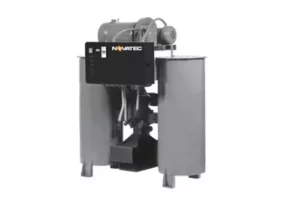
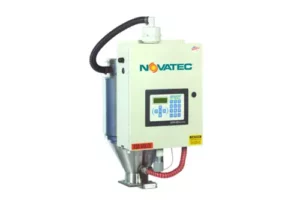
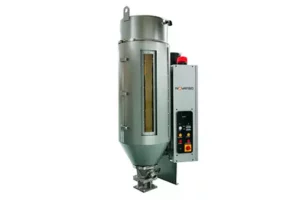
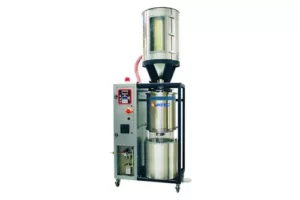
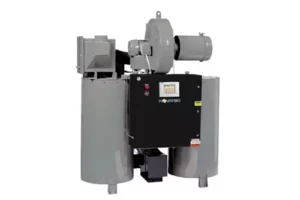
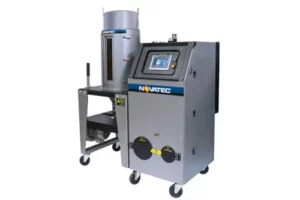
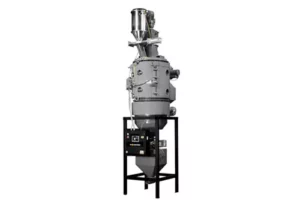
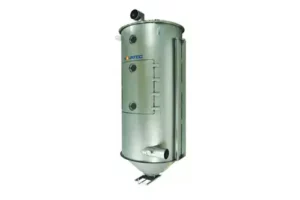
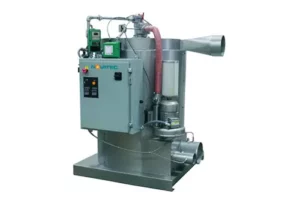
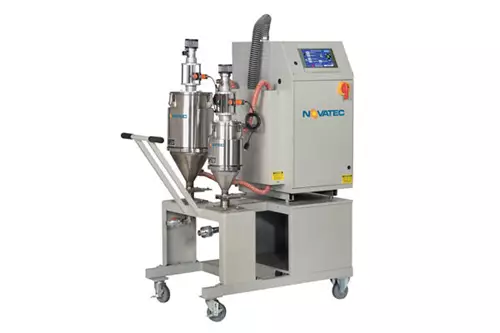
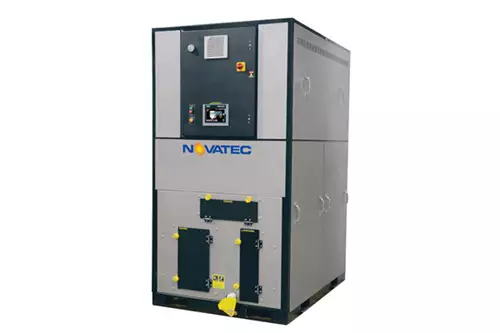
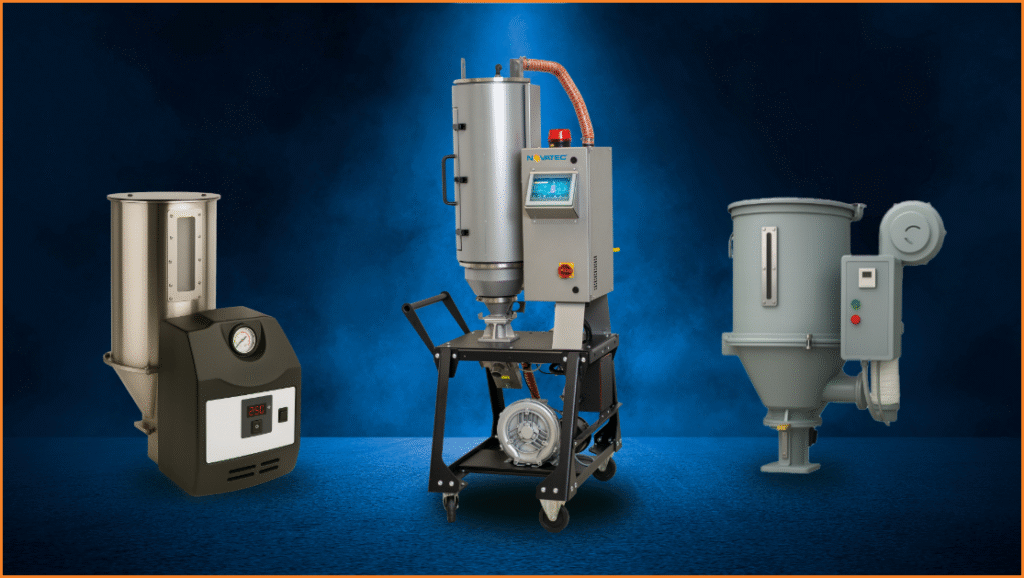
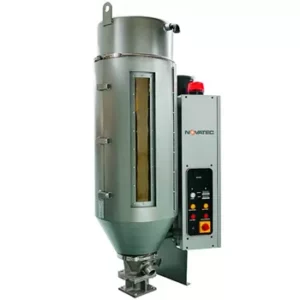
A compressed air resin dryer uses plant compressed air and heat to dry resin. When compressed air returns to atmospheric pressure, it holds less moisture than before compression, with its dew point reduced by about 40 to 50 degrees, usually to between -10°F and +10°F. That air is heated and circulated through the resin in a hopper to remove moisture.
The principle of compressing air in factories for power tools and other high-pressure uses has a side benefit for the world of resin drying.
A compressed air resin dryer is a type of dryer used to remove moisture from plastic resin using compressed air. The dryer uses a combination of heat and compressed air to dry the resin, which is important for maintaining the quality of the resin and preventing defects in the final product.
The compressed air resin dryer typically consists of a hopper, a heater, and a blower. The resin is loaded into the hopper, where it is heated to a specified temperature. The heated air is then circulated through the resin by the blower, removing any moisture present in the resin.
Compressed air, once “decompressed,” re-enters atmospheric pressure with less moisture than it contained prior to compression. By ‘less moisture’, we mean that the moisture level (dew point) of the decompressed air is reduced by about 40-50 degrees, usually to a level of between -10˚ to +10˚ F
Considerations for Investment in a Compressed Air Resin Dryer
Compressed air dryers are simple and relatively maintenance-free but they have some big drawbacks for several reasons:
The process air NEVER attains a -40˚ dew point (-10˚ to +10˚ F. is typical)
The dew point varies with the weather (rising in hot humid conditions)
Lack of uniform drying results in rejected parts and taking the dryer offline
Typical throughputs range up to only about 50 lb. /hr.
The energy usage of a compressed air dryer is very high compared to most other resin dryer types.
Dual Bed (also called Twin Tower) dryers used to be the most commonly purchased type of resin dryer. A look at why, and where the technology has progressed.
Resin drying machines that can be moved from machine to machine within a plastics processing plant have advantages and disadvantages over a central drying system.
Learn about the keys to drying PET efficiently while saving space and energy.
Frequently Asked Questions
What dew point does a compressed air resin dryer reach?
Decompressed air typically reaches a dew point between -10°F and +10°F. A compressed air dryer does not reach -40°F dew point process air, and its dew point varies with the weather, rising in hot, humid conditions. That variation can lead to uneven drying, rejected parts and time with the dryer offline.
What are the drawbacks of a compressed air resin dryer?
The process air does not reach -40°F dew point, the dew point varies with the weather, and uneven drying can lead to rejected parts and taking the dryer offline. Typical throughputs only reach about 50 lb/hr, and energy use is very high compared with most other resin dryer types.
Is a compressed air resin dryer low maintenance?
Compressed air dryers are simple and relatively maintenance-free, which is part of their appeal. The trade-offs are in performance: dew point typically between -10°F and +10°F that shifts with the weather, throughput up to about 50 lb/hr, and high energy use compared with most other resin dryer types.
Vice President of Moisture & Drying Technologies, Novatec
Mark Haynie has designed and installed resin drying systems for more than 40 years, working in thousands of plastics plants across the industry. As Novatec’s Vice President of Moisture & Drying Technologies, he leads the company’s drying technology group, including its work on moisture measurement and predictive drying. He also serves as a technical reviewer for Novatec’s Drying Knowledge Center and has authored numerous technical articles and whitepapers on resin drying and moisture. Mark earned a Bachelor of Science in Chemical Engineering from Virginia Tech. Through Novatec’s Ask the Expert program, Mark regularly helps processors troubleshoot drying performance and resin-moisture challenges.
Joshua Belisle is Technology Manager at Novatec, where his work focuses on simulation and technology development for resin drying. He earned a B.S. in Mechanical Engineering with a minor in Engineering Business from the University of Virginia in 2023 and joined Novatec that same year. Joshua uses simulation tools to investigate previously difficult-to-measure aspects of the drying process, helping Novatec better understand airflow, heat transfer and other variables that influence resin-drying performance.
Mark Haynie, Vice President, Moisture & Drying, Novatec, Inc.
Author Profile:
Mark Haynie has designed and installed resin drying systems for more than 40 years, working in thousands of plastics plants across the industry. As Novatec’s Vice President of Moisture & Drying Technologies, he leads the company’s drying technology group, including its work on moisture measurement and predictive drying. He also serves as a technical reviewer for Novatec’s Drying Knowledge Center and has authored numerous technical articles and whitepapers on resin drying and moisture.
Mark earned a Bachelor of Science in Chemical Engineering from Virginia Tech. Through Novatec’s Ask the Expert program, Mark regularly helps processors troubleshoot drying performance and resin-moisture challenges.