

The Hidden Dangers of Desiccant Dust in Resin Processing
By Mark Haynie and Joshua Belisle · Edited by Dana Gardner
Published January 9, 2025 · Reviewed by Mark Haynie · June 11, 2026

Summary
Can desiccant dust from my dryer contaminate resin?
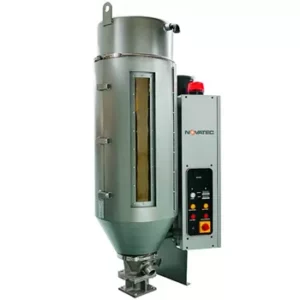
Yes. In twin-tower and dual-bed dryers, desiccant beads become brittle as they absorb and release moisture, and eventually break apart into fine dust. That dust can reach the resin and lead to contamination, rework, or scrapped batches, and in cleanroom environments even small particles are a serious problem. Regular maintenance can delay bead breakdown, but after a few years it is often unavoidable.
If you’ve been in the resin processing game for a while, you’ve likely encountered an issue that’s more than just a nuisance—desiccant dust. While traditional twin-tower or dual-bed dryers have been reliable workhorses for drying resin, they come with a major downside: as the desiccant beads age and degrade, they begin to break down, producing fine particles of dust. This dust can find its way into your resin, leading to contamination, rework, or even scrapping entire batches. And in cleanroom environments, even the smallest particles can spell disaster.
But how big of a problem is desiccant dust, really? Let’s break it down.
What Causes Desiccant Dust?

Desiccant beads, used in twin-tower and dual-bed dryers, gradually lose their efficiency over time. As they absorb and release moisture during the drying process, the beads wear out, becoming more brittle. Eventually, they break apart and produce dust. While regular maintenance can delay this, it’s often unavoidable after a few years of operation. For high-demand environments, this means you might be dealing with desiccant dust and the need to replace beads as frequently as every other year.
Desiccant beads, used in twin-tower and dual-bed dryers, gradually lose their efficiency over time. As they absorb and release moisture during the drying process, the beads wear out, becoming more brittle. Eventually, they break apart and produce dust. While regular maintenance can delay this, it’s often unavoidable after a few years of operation. For high-demand environments, this means you might be dealing with desiccant dust and the need to replace beads as frequently as every other year.

Why Desiccant Dust Is a Growing Concern

Desiccant beads, used in twin-tower and dual-bed dryers, gradually lose their efficiency over time. As they absorb and release moisture during the drying process, the beads wear out, becoming more brittle. Eventually, they break apart and produce dust. While regular maintenance can delay this, it’s often unavoidable after a few years of operation. For high-demand environments, this means you might be dealing with desiccant dust and the need to replace beads as frequently as every other year.
And this isn’t even factoring in the long-term cost of constantly replacing desiccant beads, filters, and performing maintenance. The more often you need to shut down your dryer to deal with these issues, the more it affects your bottom line.

The Solution: A Dryer Without Desiccant Beads

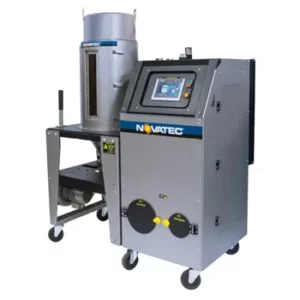
Fortunately, there’s a way to sidestep the issue of desiccant dust entirely. Desiccating membrane dryers, like Novatec’s NovaDrier series of dryers, offer a new approach to resin drying without the need for desiccant beads. Instead, they use a high-tech membrane to filter moisture from the air—no beads, no dust, no contamination risk.
Unlike compressed air dryers, which only drop the dew point by 30-40°F, the NovaDrier can achieve consistent -40°F dew points or lower, making it reliable in any environment. This consistency ensures that your resin is properly dried, without the need to constantly monitor and replace desiccant materials.

Why the NovaDrier Stands Out

The NovaDrier doesn’t just address the issue of desiccant dust—it redefines what a resin dryer should be. Powered by its advanced FiberMax™ membrane technology, the NovaDrier packs significantly more semipermeable fibers than other membrane dryers, delivering unmatched moisture filtration with minimal maintenance.
With its innovative design featuring no moving parts and a patented lifetime desiccating membrane, the NovaDrier is the only resin dryer on the market backed by a true lifetime desiccating warranty.


Unlike compressed air dryers, which only drop the dew point by 30-40°F, the NovaDrier can achieve consistent -40°F dew points or lower, making it reliable in any environment. This consistency ensures that your resin is properly dried, without the need to constantly monitor and replace desiccant materials.
Conclusion: A Dust-Free, Low-Maintenance Future
If you’re dealing with desiccant dust in your current operation, it may be time to consider a more advanced solution. Novatec’s NovaDrier offers not only a dust-free drying process but also long-term reliability with minimal maintenance. For cleanroom environments, where cleanliness is non-negotiable, or for any operation looking to cut down on downtime, the NovaDrier provides a clear path forward.
Frequently Asked Questions
What causes desiccant beads to break down?
Desiccant beads wear out as they repeatedly absorb and release moisture during drying. Over time they lose efficiency and become more brittle, and eventually they break apart and produce dust. Regular maintenance can delay this, but after a few years of operation it is often unavoidable.
How often do desiccant beads need to be replaced?
It depends on how hard the dryer works. In high-demand environments, beads may need replacing as often as every other year. On top of the beads, processors carry the ongoing cost of replacing filters and shutting the dryer down for maintenance, and each shutdown affects the bottom line.
Is there a resin dryer that does not use desiccant beads?
Yes. The Novatec NovaDrier dries resin without desiccant beads, so there are no degrading beads to shed dust into the material. It achieves consistent dew points of -40°F or lower and has no moving parts, which keeps maintenance low for cleanroom work and general production.
About the Authors

Vice President of Moisture & Drying Technologies, Novatec
Mark Haynie has designed and installed resin drying systems for more than 40 years, working in thousands of plastics plants across the industry. As Novatec’s Vice President of Moisture & Drying Technologies, he leads the company’s drying technology group, including its work on moisture measurement and predictive drying. He also serves as a technical reviewer for Novatec’s Drying Knowledge Center and has authored numerous technical articles and whitepapers on resin drying and moisture.
Mark earned a Bachelor of Science in Chemical Engineering from Virginia Tech.
Through Novatec’s Ask the Expert program, Mark regularly helps processors troubleshoot drying performance and resin-moisture challenges.

Technology Manager, Novatec
Joshua Belisle is Technology Manager at Novatec, where his work focuses on simulation and technology development for resin drying. He earned a B.S. in Mechanical Engineering with a minor in Engineering Business from the University of Virginia in 2023 and joined Novatec that same year. Joshua uses simulation tools to investigate previously difficult-to-measure aspects of the drying process, helping Novatec better understand airflow, heat transfer and other variables that influence resin-drying performance.
Related Articles
See how bonded wheel desiccant differs from beads and how drying, regeneration and cooling work.
Learn how polymer membranes remove water vapor from compressed air to produce low-dew-point process air.

Review heater, airflow, filter and desiccant maintenance to keep resin drying equipment working properly.
Ask the Plastic Drying Expert

Author Profile:
Mark Haynie has designed and installed resin drying systems for more than 40 years, working in thousands of plastics plants across the industry. As Novatec’s Vice President of Moisture & Drying Technologies, he leads the company’s drying technology group, including its work on moisture measurement and predictive drying. He also serves as a technical reviewer for Novatec’s Drying Knowledge Center and has authored numerous technical articles and whitepapers on resin drying and moisture.
Mark earned a Bachelor of Science in Chemical Engineering from Virginia Tech.
Through Novatec’s Ask the Expert program, Mark regularly helps processors troubleshoot drying performance and resin-moisture challenges.