
Dewpoint Is a Dryer Output, Not a Resin Readiness Score
The dewpoint reading tells you the air in your dryer is dry. It has never once told you whether your resin is. Here is the physics of the difference — and what to measure instead.
1 · What does a dewpoint reading actually measure?
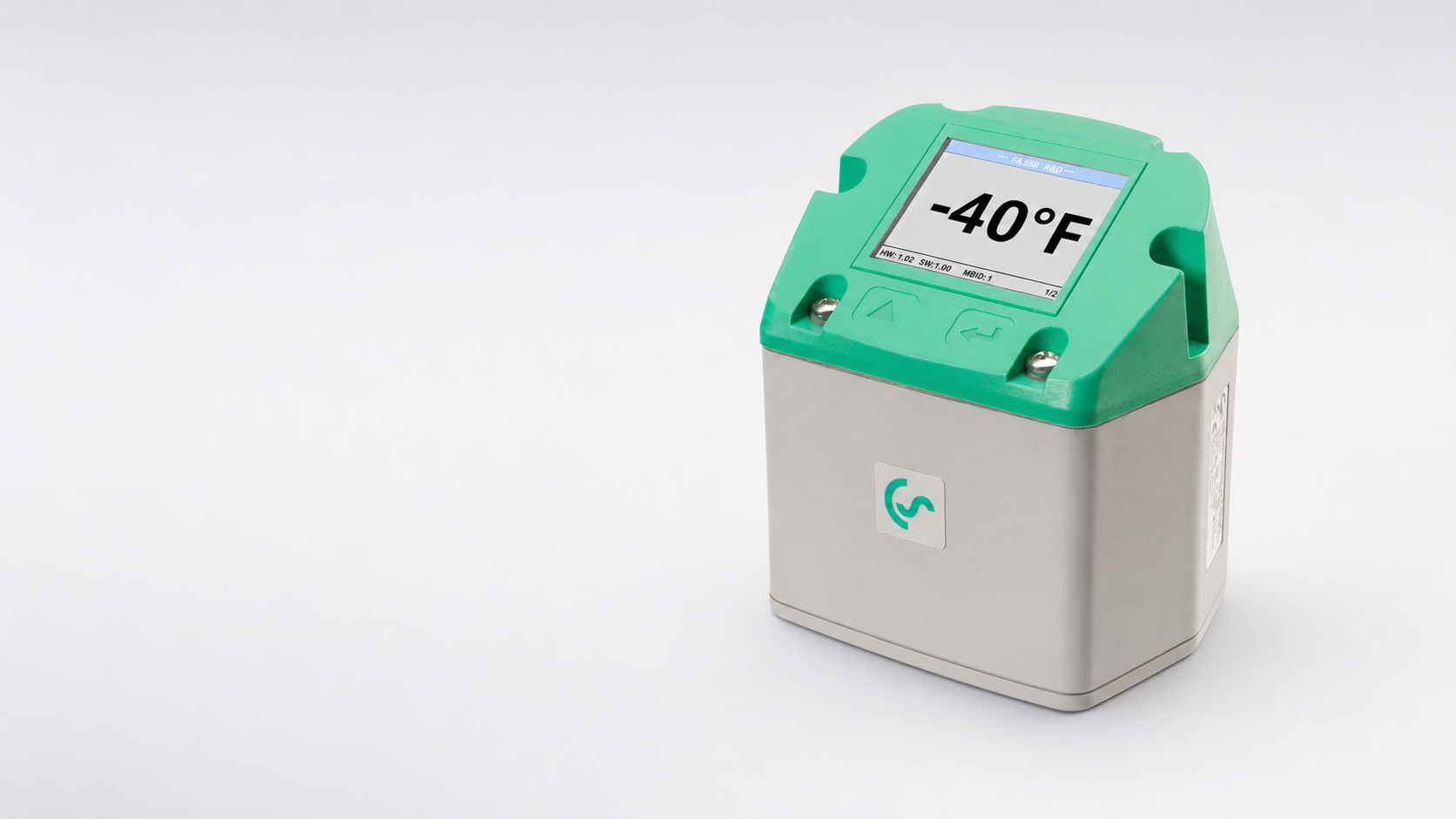
Dewpoint is the temperature at which the water vapor in a gas begins to condense. In a desiccant dryer, the dewpoint sensor sits in the process-air circuit and reports how thoroughly the desiccant has stripped moisture from the air before that air enters the hopper. A reading of −40°F means the air is very dry — dry enough to accept moisture from any pellet surface it touches.
That is the entire content of the measurement. It is a health report on the air system: the desiccant beds, the regeneration cycle, the filters, the seals. When those components work, the dewpoint is low and steady. When desiccant saturates or regeneration lags, the dewpoint drifts up. This makes dewpoint a genuinely useful instrument — for the one thing it measures.
What it does not measure, and cannot, is the water bound inside the polymer. The pellet leaving the bottom of the hopper may be at 35 ppm or 1,800 ppm; the dewpoint gauge reads the same either way. It is measuring the air. It has never seen a pellet.
2 · Is dewpoint a good measure of resin dryness?
No — and the reason is physics, not instrumentation quality.
Moisture leaves a pellet by diffusion. Water molecules are bound to the polymer chains and must be liberated by heat, then physically migrate to the pellet surface before the surrounding air can carry them away. Plastic conducts heat poorly, so this migration is slow, and its rate is governed by two variables: temperature (how much energy is available to free and move the water) and time (how long the pellet spends at that temperature). The air’s dryness only determines whether moisture that has already reached the surface has somewhere to go. Dry air is permission to dry. It is not drying.
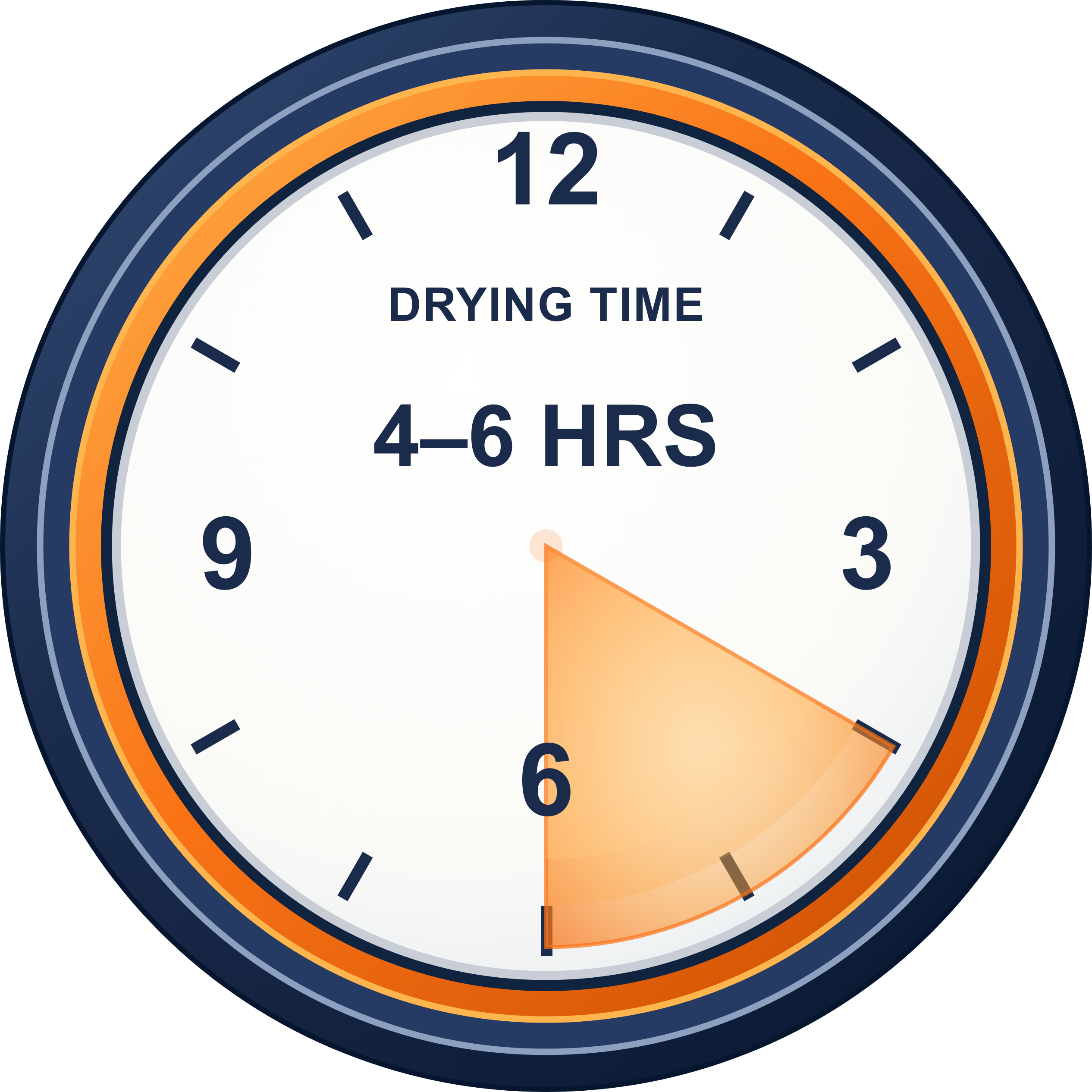
This is why the industry’s specification habits are backwards. The dewpoint is specified and displayed to single-degree resolution, alarmed and trended. Drying time — the variable that actually determines final ppm — is specified as “four to six hours,” a ±50% tolerance on the most important input to the result.
THEATER
REALITY
A process is not precise because one convenient variable is measured precisely. It is precise because the variable that controls the outcome is controlled precisely.
3 · The data: constant dewpoint, falling moisture
A real PET drying curve makes the separation unmistakable. The run below held a rock-steady −40°F dewpoint for six hours; resin moisture was measured directly by Karl Fischer titration at intervals.
| TIME AT TEMPERATURE | DEWPOINT | MOISTURE (%) | MOISTURE (PPM) |
|---|---|---|---|
| 0 (start) | −40°F | 0.1823% | 1,823 |
| 60 min | −40°F | 0.040% | 400 |
| 120 min | −40°F | 0.015% | 150 |
| 240 min | −40°F | 0.0053% | 53 |
| 360 min | −40°F | 0.0035% | 35 |
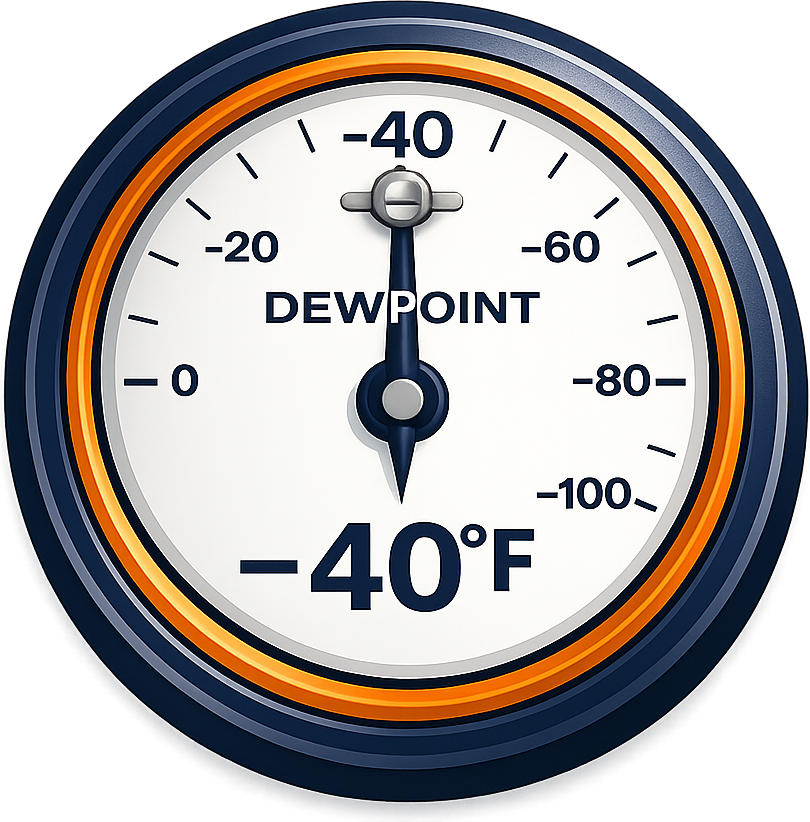
The dewpoint never moved. The moisture fell 50×. Every bit of that change was produced by time at temperature — the variable specified in hour-wide ranges — while the precisely displayed variable contributed nothing further after the first minutes. If dewpoint were a resin readiness score, the reading would have changed as the resin dried. It cannot, because it is not measuring the resin.
There is nothing wrong with a steady dewpoint — it is simply the signature of a healthy dryer doing its job. The interesting question is the one the steady reading cannot answer: what determines how long the job takes?
4 · Two loads, same dewpoint — why did one take twice as long?
Consider the same dryer running the same resin on two different days, both at a rock-steady −40°F dewpoint, both dried to the same target moisture.
The resin arrives at low starting moisture — polycarbonate can come in under 500 ppm in winter. It reaches target in roughly two hours.
The same resin arrives saturated — over 3,000 ppm is realistic for polycarbonate in humid months. Same dryer, same setpoints, same −40°F on the gauge. It takes four hours or more to reach the same target.
Same dewpoint. Same ending moisture. Twice the drying time. The only variable that changed was the one nobody measured: the moisture the resin walked in with.why?
This is the physics behind the industry’s strangest specification habit. Recall the “four to six hours” drying spec — a range wide enough to drive a truck through. That window is not engineering tolerance. It is an admission: drying time is written as a range because the starting moisture is unknown, and an unknown input forces a padded output. Measure what goes in, and the window collapses to a number. Guess, and the range is the guess — with the penalty paid either in scrap (pulled too early on a wet lot) or in wasted energy and degraded resin (a dry lot cooked for hours it did not need).
The dewpoint gauge, meanwhile, read −40°F through all of it — Case A, Case B, the fast lot, the slow lot — reporting with perfect accuracy that the air was dry, and saying nothing about the question that decided the schedule.
5 · Why do parts still show splay when the dewpoint is fine?
This is the question that brings most processors to this page, and it has three answers — the starting-moisture problem above, and two more. All three operate under a perfect dewpoint reading.
Not enough time at temperature. If material is pulled through faster than the diffusion process completes — a rate increase, a shortened pre-dry, an underfilled hopper — the pellets leave wet. The dewpoint gauge does not flinch, because the air was dry the whole time.
Non-uniform treatment in the hopper. “Four hours of drying” assumes every pellet gets the same four hours at the same temperature. Unless the hopper delivers true mass flow — first-in, first-out, every pellet descending together through a uniform temperature profile — it delivers funnel flow instead: a fast channel down the center and stagnant material at the walls. Bulk-solids engineering names the failure modes: ratholing races material through in a fraction of the intended residence time, while low airflow leaves cold zones where pellets never reach drying temperature at all — and residence time only counts when it is spent at temperature. What reaches the feed throat is a blend: a mean ppm that can look acceptable while individual pellets are wildly out of specification. Splay from that blend is intermittent, which is exactly what makes it so hard to diagnose.
Unknown incoming moisture. The two-case scenario above, operating on a recipe that never adjusted. Incoming resin moisture is not a constant: beyond the seasonal swing, a sealed bag is no guarantee — polyethylene packaging is porous to water vapor — and nylon can absorb 2% to 9.5% of its own weight in water, invisibly. A fixed-time, fixed-temperature recipe applied to a variable input produces a variable output — sometimes over-dried, sometimes wet — under an unchanging, reassuring dewpoint reading.
6 · Is a lower dewpoint better? −40°F vs. −60, −80, −100
Lower dewpoint numbers are marketed as premium performance. The physics says otherwise: below approximately −40°F there is little measurable drying benefit for the vast majority of resins, because at that point the air’s capacity to accept surface moisture is no longer the limiting factor — diffusion inside the pellet is. Meanwhile, every additional degree of dryness costs regeneration energy. Past −40°F, the buyer is largely purchasing a larger electric bill presented as a feature.
There are legitimate niche exceptions at the margins of the resin spectrum, which is why the honest phrasing is “little benefit,” not “no benefit.” But as a general specification habit, chasing ever-lower dewpoint is spending money on the variable that was already sufficient while the variables that decide the outcome — time, uniformity, incoming moisture — go unmeasured.
7 · What dewpoint is actually good for
Demoting dewpoint from a performance score does not mean discarding it. It means using it for what it truly reports: the health of the desiccant system. For that job, the useful information content is three states, not a decimal readout:
It is the oil-pressure light of drying: essential as a warning, meaningless as a performance meter. One more instrument reality reinforces the point: most in-process dewpoint sensors are capacitive types that respond sluggishly at the very low humidity a dryer runs at, and after a wet excursion they can take 15–30 minutes to recover an accurate reading. The instrument reports where the air was, not where it is — a fine property for a health monitor, a poor one for a control variable.
8 · What to measure instead
If the goal is dry resin rather than dry air, the measurement priorities invert:
Measure the resin. The only direct measures of polymer moisture are laboratory methods — Karl Fischer titration and loss-on-drying analysis. Every serious process industry gates its moisture-critical inputs this way: concrete plants measure aggregate moisture and correct batch water daily; pharmaceutical plants quarantine and moisture-test every incoming lot; dairy producers spray-dry to a verified moisture endpoint; cocoa and grain buyers reject entire lots over a point or two. Plastics measures resin moisture far less often — and there are two good reasons why, neither of them a lack of diligence.

The measurement wasn’t available. Instruments that could read pellet moisture accurately were expensive, and they were laboratory-designed, not process-designed. There was no practical way to put that measurement next to a running machine — so the industry did the sensible thing and controlled what it could see.
And plastics set itself the harder problem. The industries that transitioned early work in gross percentages of moisture — the kind a simple sensor reads. Resin has to be verified to parts per million, a measurement orders of magnitude finer. Being among the last to get there is not a lapse in diligence; it is what happens when your version of the problem is the most demanding one.
Which makes those other industries precedent rather than reproach. Each of them measured the input as soon as measuring it became practical, and every one of them got a more predictable process for it. That threshold has now been crossed for resin — and it is finally plastics’ turn.
Specify time in minutes, not hour-wide ranges. Insist on controlled, verified residence time. Treat “four to six hours” as an admission that the vendor cannot control the variable that counts.
Interrogate uniformity. Mass flow versus funnel flow, cone geometry, top-to-bottom temperature profile, airflow that reaches every pellet. A hopper that cannot promise every pellet the same treatment cannot promise a ppm.
Know the incoming moisture. Assume nothing is dry on arrival, control storage, and know the starting moisture the way a concrete plant knows its aggregate.
If that list reads like a heavy lift for a molding floor, that is the correct reading — and it is not the processor’s lift to carry. Every variable above is knowable, measurable, and controllable by the drying equipment itself: machine-side moisture awareness, verified residence time, engineered uniformity. The burden of the science belongs on the dryer, not the operator. The processor’s job is simply to demand equipment that carries it — and to stop accepting a dry-air reading as the answer to a dry-resin question.

Frequently asked questions
Is dewpoint a good measure of resin dryness?
No. Dewpoint measures the moisture content of the drying air, not the polymer. Resin dryness can only be measured directly — by Karl Fischer titration or loss-on-drying — or assured indirectly by controlling time at temperature, treatment uniformity, and incoming moisture.
What is the difference between dewpoint and moisture content?
Dewpoint describes the air in the drying circuit: the temperature at which its water vapor would condense. Moisture content describes the resin: parts per million of water bound in the polymer. The first is an input condition; the second is the outcome your process depends on. They are measured by different instruments in different places and can move independently — the data above shows moisture falling 50× under an unmoving dewpoint.
Why does my part still have splay when the dewpoint reads −40°F?
Because dewpoint cannot see the three failure modes that produce wet pellets under dry air: insufficient time at temperature, non-uniform hopper flow (channeling, ratholing, cold wall zones), and higher-than-assumed incoming moisture. Any of the three delivers out-of-spec pellets while the air-side reading stays perfect.
Do I need a −80°F or −100°F dewpoint dryer?
For the vast majority of resins, no. Below roughly −40°F there is little measurable improvement in drying, because internal diffusion — not air capacity — is the limiting step. Lower setpoints primarily add regeneration energy cost.
Should I stop monitoring dewpoint?
No — repurpose it. Dewpoint is a reliable health indicator for the desiccant system. Treat it as a green/yellow/red status, alarm on drift, and stop reading it as a proxy for resin readiness.
Prefer the polemic version of this argument? Read the manifesto: Break the Dewpoint Addiction →