

RESIN DRYING
The Moisture Rebound Test: How to Verify Resin Is Dry Before It Reaches the Machine
By Mark Haynie and Joshua Belisle · Edited by Dana Gardner · Published October 8, 2026 · Technically reviewed by Mark Haynie, October 2026 · 8 min read
Short answer. Pull a sample at the dryer discharge and measure it. Seal a second sample for at least 20 to 30 minutes, then measure that one. If the second reading settles close to the first and both meet the resin supplier’s specification, the moisture inside the pellet has reached equilibrium and the resin is dry through. If the second reading is higher, the dryer dried the surface over a wet core. The test works on any dryer, with any moisture method validated for that polymer.
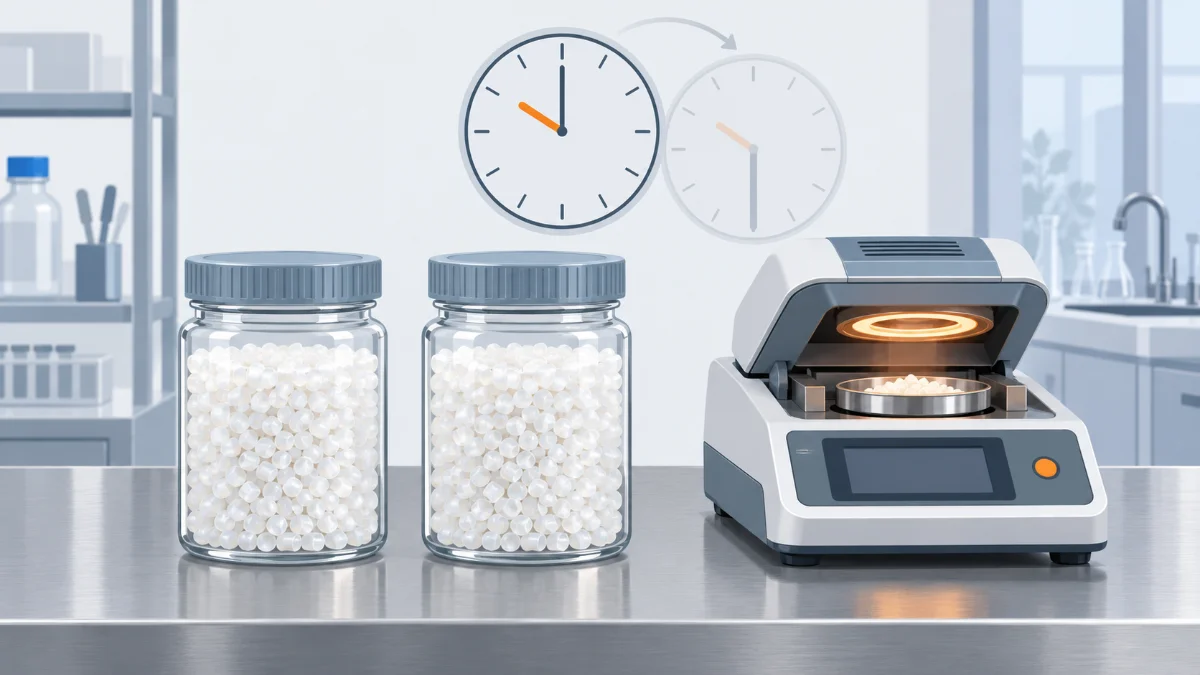
The sample at the dryer discharge read in spec. Forty minutes later the parts coming off the machine are splaying, and the dryer’s dew point gauge has not moved. Nothing on the control panel explains it, because nothing on the control panel measures the pellet. The dew point describes the air. The analyzer reading described the pellet as it was the moment it left the hopper, which, for a hygroscopic resin, may not be what it will be ten minutes later.
The moisture rebound test closes that gap. It costs two samples and half an hour, it needs no equipment beyond the moisture analyzer you already use, and it is the one check that works the same way no matter what kind of dryer produced the resin. This article describes how to run it, how to read the result, and the mistakes that make it lie. It supports The Science of Vacuum and Desiccant Drying for Engineering Plastics, which uses this test as the standard for comparing drying methods.
Why an immediate reading can mislead
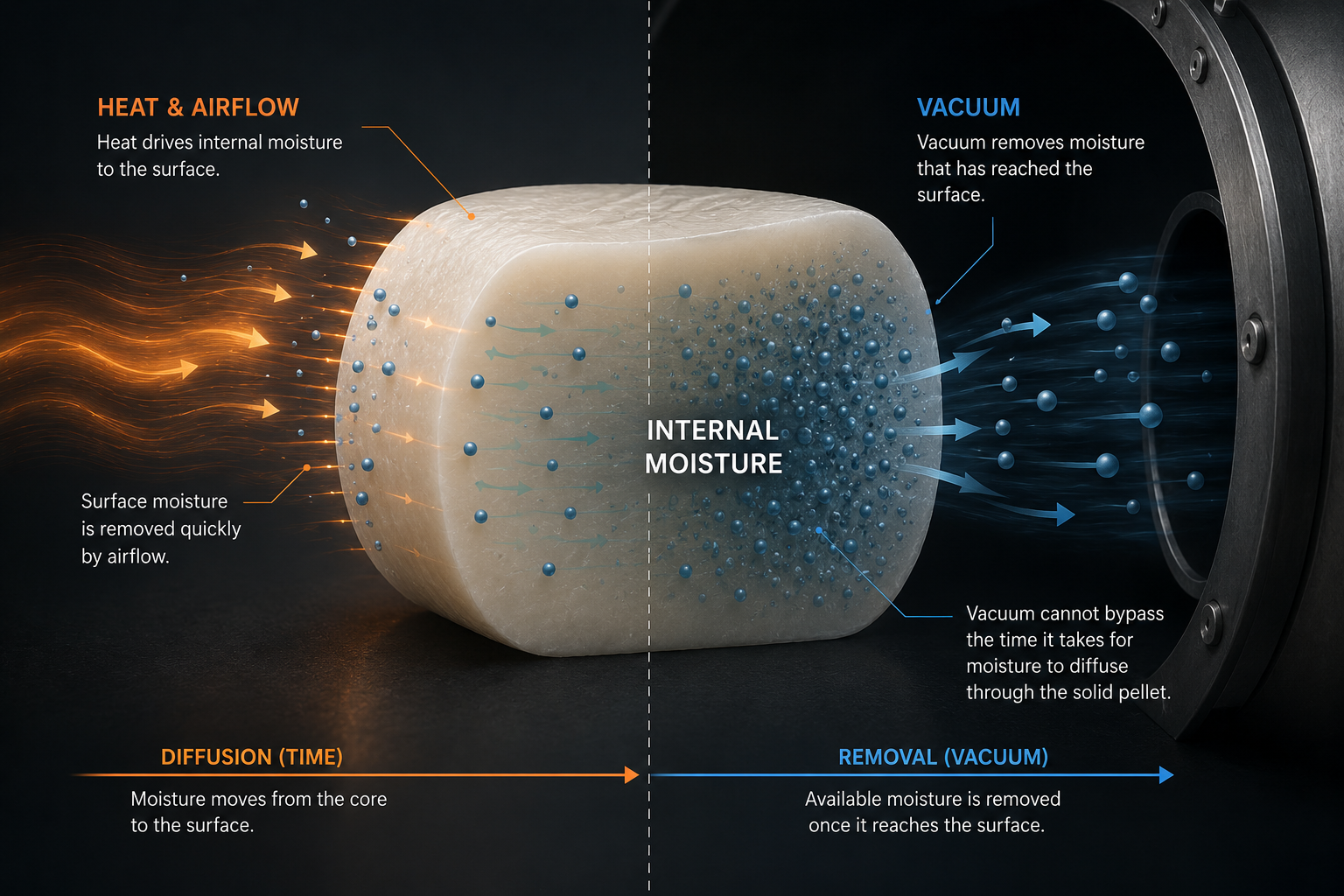
A hygroscopic pellet holds water two ways. Surface water sits on the outside and comes off quickly. Absorbed water is bound inside the polymer, and it has to diffuse to the surface before a dryer can remove it. At the temperatures most engineering resins are dried at, that diffusion is slow, which is the subject of its own article. When the heat stage is too short, the bed is uneven, or the resin arrived wetter than the recipe assumed, a dryer can deliver a pellet with a dry shell and a wet core.
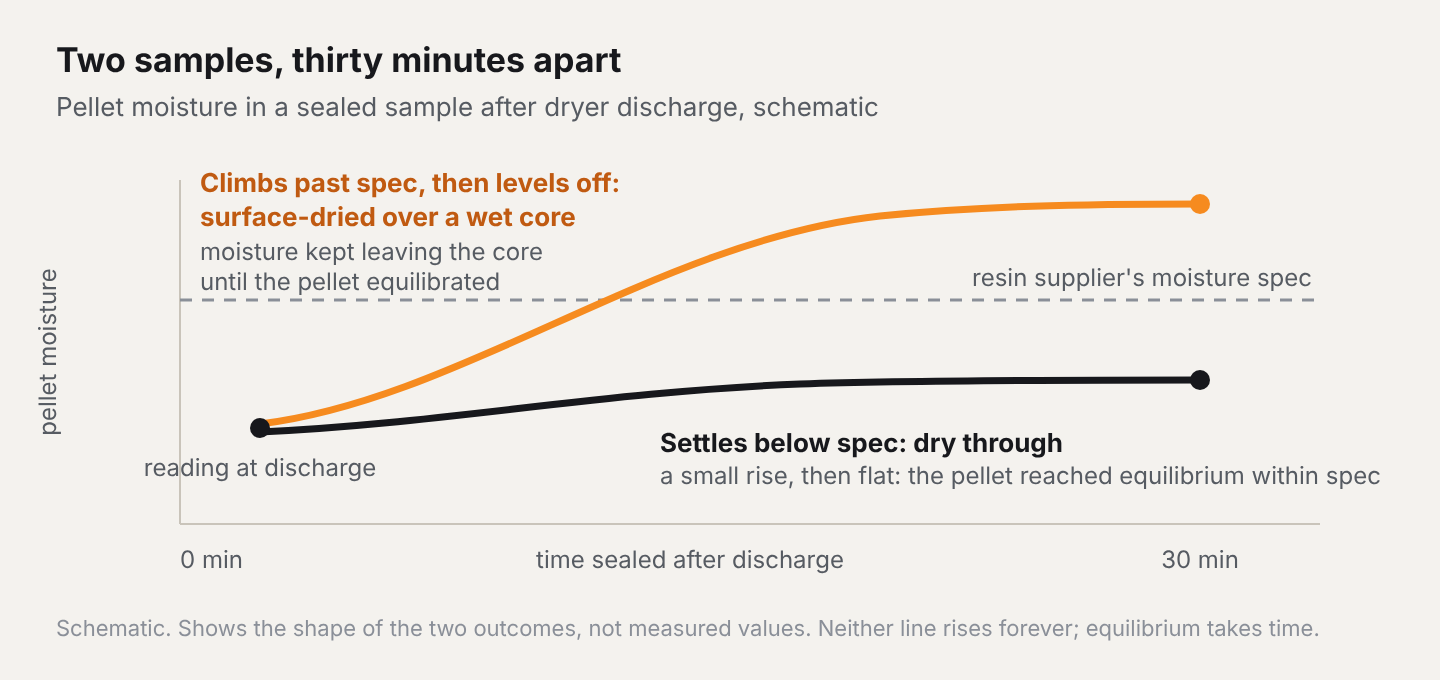
The moment that pellet leaves the dryer, two things happen. Water in the core keeps diffusing outward, now toward a surface that is no longer swept by dry air, so the surface moisture climbs. And a hot pellet with a moisture-starved surface sits in plant air with a steep gradient pointing inward, so it picks up ambient humidity faster than virgin resin would. A reading taken at the discharge partially sees the shell. Thirty minutes later the same pellet, now at equilibrium, reads what the machine will actually see.
Laboratory moisture specialists describe the same problem from the analytical side. Water held inside a solid releases slowly in a Karl Fischer titration, and samples that do not release their water completely and quickly give results that are low and not reproducible. Metrohm’s guidance for the Karl Fischer oven method is to run the oven as hot as the sample allows, short of decomposition, and to find the temperature range where the result is reproducible before trusting it. A plant-floor reading on a surface-dried pellet fails the same way, for the same reason: the water you are not measuring is still inside.
How to run the moisture rebound test
- Sample at the dryer discharge during normal production, at full throughput. Draw enough resin for two tests from the same point in the flow. A sample from the top of the hopper, or from a dryer that has been idling at temperature with no material moving, describes a different process.
- Use clean, dry containers that seal, and fill them nearly full. Headspace is air the hot pellets can exchange moisture with. Room air at 73°F and 50% RH holds about 10 mg of water per liter, so a full one-liter jar of pellets can pick up only about 10 ppm from its own headspace, while a small sample in a large, mostly empty jar can pick up hundreds. Fill the vial, or flush it with nitrogen, so nobody can dismiss the result as moisture from the jar. Do not drop hot pellets into a cold jar from an air-conditioned lab; condensation on the inside wall reads as pellet moisture.
- Measure sample one right away, with the method you have validated for that polymer. Karl Fischer titration is the reference method. Moisture-specific analyzers measure water rather than total weight loss; a loss-on-drying balance also reports other volatiles, which overstates moisture on some materials; if that is the analyzer you have, Teknor Apex recommends having the analyzer manufacturer characterize the resin first so volatiles are not counted as water. Whichever method you use, run the oven or extraction temperature you established for that resin. Too low or too short, and the water inside the pellet stays there and the reading comes in low.
- Leave sample two sealed for at least 20 to 30 minutes at room temperature. Do not chill it and do not open it. Equilibrium takes time; cutting the hold short reads the shell again.
- Measure sample two the same way.
- Compare. Judge both readings against the resin supplier’s moisture specification for that grade, not a generic number. Then compare them with each other.
- Repeat when something changes: a new resin lot, a change in throughput, a different dryer, and at least once in the most humid season your plant runs through.
Reading the result

Result
What it means
What to do
Both readings in spec, and the second within the method’s repeatability of the first
Dry through. A pellet is almost never at full equilibrium the moment it leaves the dryer, so a second reading that settles this close to the first means the interior had nothing left to give up.
Log it with the date, lot, throughput and season. This is your baseline.
Second reading higher, but still in spec
Moisture migrated from the core. The dryer finished the surface ahead of the interior and is running near its margin.
Allow more time before analyzing the second sample, or reduce throughput; check bed uniformity and incoming moisture, and retest.
Second reading higher, and out of spec
Surface-dried over a wet core. The resin will arrive at the machine out of spec.
Do not run on it. Look at time at temperature, airflow uniformity, the dryer’s dew point through the whole cycle, and the incoming moisture of the lot.
First reading already out of spec
The dryer is not reaching target at all.
Check temperature, dew point, airflow and residence time against the recipe, then measure the incoming moisture.
Second reading lower than the first
Something in the sampling or the method moved, not the resin.
Suspect condensation in the container, an unsealed lid, or inconsistent analyzer conditions. Repeat the test.
The numbers to judge against come from the resin supplier, and they vary a great deal by material. The Madison Group’s guidance is that resins dried to prevent hydrolysis typically need to be below 0.02% moisture, while resins dried only for cosmetic reasons can often run at 0.05% to 0.10%. Teknor Apex gives unfilled nylon a processing window of 0.02% to 0.20%, narrowing with glass or mineral fill; a 30% glass-filled grade runs 0.02% to 0.14%, because the glass absorbs nothing and the window belongs to the polymer alone. A PET drying curve run in the Resin Proving Ground reached 53 ppm at four hours and 35 ppm at six, which is the territory PET specifications live in. The rebound test does not tell you what the target is. It tells you whether the pellet, as a whole, is there.
What the test can and cannot tell you
It does not depend on the dryer. Desiccant, vacuum, compressed air, membrane, batch or continuous: the pellet does not know what produced it, and the test does not care. That is what makes it the right standard for comparing drying methods, and the vacuum and desiccant guide recommends exactly this: supplier-spec moisture, stable after a sealed hold, at full production throughput, measured during the most humid season the line runs. It is particularly worth running on any process with a short heat stage, because that is where a dry shell over a wet core is most likely.
It is one point in time, and it is taken at the dryer. In production, resin is conveyed and then waits at the machine, often 30 to 45 minutes or more, and any resin that is not dried at the press picks up moisture on the way, whatever dryer it came from. When the result matters, pull a third sample at the machine throat after normal transfer; the gap between the sealed reading and the throat reading is what the trip cost. Teknor Apex recommends checking nylon moisture before a run starts and rechecking every two to four hours during production. The rebound test is the check that tells you those routine readings mean what you think they mean. Run it when you set up a material, then let the routine readings carry the shift.
It does not replace the dew point reading. Dew point is the health indicator for the desiccant system; a good reading tells you the dryer is capable of doing its job. The rebound test tells you whether the resin got the benefit. The two answer different questions, which is why one cannot substitute for the other.
Check
What it measures
What it tells you
Dew point
The drying air
The desiccant system is working
Immediate pellet reading
The pellet as it left the hopper, surface first
The dryer reached its target at the surface
Rebound reading
The whole pellet, at equilibrium
The resin is dry through and will stay in spec at the machine
Part inspection
The molded part
Too late. The resin was wet.
How we know this: Novatec runs the rebound test in the Resin Proving Ground, its own resin drying and moisture lab, on its own dryers and on other equipment.
How Novatec Approaches Moisture Verification

At Novatec, we believe the resin is the only honest witness to how well it was dried. That is why the Resin Proving Ground measures resin by Karl Fischer and gravimetric methods instead of trusting a gauge, and why we brought the HydroTracer HT3 to the plant floor: a water-selective moisture analyzer, unaffected by other volatiles in the sample, that returns a result in about eight minutes and moves between the lab and the production floor. It is the tool we hand a processor who wants to run this test on a Tuesday afternoon without waiting on an outside lab.
It is also why our dryers are built to hold temperature, airflow and a −40°F dew point over the full residence time, with the NovaDrier‘s patented Dual Drying Zones heating the upper bed as well as the lower one. That is what makes the second reading match the first.
Want help setting up the test for your resin, or a second opinion on a result? Give us a holler on the form below.
No sales pitch. No pressure. Just a conversation about what’s best for your operation.
Frequently Asked Questions
How do I know if my resin is actually dry?
Measure the resin, not the air. Take a sample at the dryer discharge and measure it, seal a second sample for at least 20 to 30 minutes and measure that one, then compare both with the resin supplier’s moisture specification. A second reading that settles close to the first, with both in spec, means the pellet is dry through. A rising second reading means the surface was dried over a wet core, and the material will arrive at the machine out of spec.
How long should the sealed sample sit?
At least twenty to thirty minutes at room temperature. That is long enough for moisture still inside the pellet to redistribute toward the surface, so the reading reflects the whole pellet rather than its shell. Keep the container sealed and nearly full for the whole hold, and do not chill it; a cold container wall collects condensation that reads as pellet moisture.
Can I use a loss-on-drying moisture balance for the rebound test?
Yes, if it is the method you have validated for that polymer and you use the same settings for both samples. A loss-on-drying balance reports total weight loss, which includes other volatiles, so it can read high on materials with lubricants or plasticizers. Karl Fischer titration is the reference method, and water-selective analyzers measure only water. What matters most is that both readings come from the same method at the same conditions.
Does the rebound test work with vacuum dryers?
Yes. The pellet does not know what kind of dryer it came from, so the test applies to hybrid hot-air and vacuum dryers, desiccant, compressed air and membrane dryers alike. It is especially useful on any process with a short heat stage, because that is where a pellet can leave the dryer with a dry surface and a wet core, and an immediate reading alone would miss it.
What moisture level should dried resin be?
Whatever the resin supplier specifies for that grade. The ranges vary widely: hydrolysis-sensitive resins such as PET and polycarbonate typically need to be below 0.02%, resins dried for cosmetic reasons can often run at 0.05% to 0.10%, and unfilled nylon has a processing window of roughly 0.02% to 0.20%. Use the supplier’s number, not a generic one.
About the Authors

Vice President of Moisture & Drying Technologies, Novatec
Mark Haynie has designed and installed resin drying systems for more than 40 years, working in thousands of plastics plants across the industry. As Novatec’s Vice President of Moisture & Drying Technologies, he leads the company’s drying technology group, including its work on moisture measurement and predictive drying. He also serves as a technical reviewer for Novatec’s Drying Knowledge Center and has authored numerous technical articles and whitepapers on resin drying and moisture.
Mark earned a Bachelor of Science in Chemical Engineering from Virginia Tech.
Through Novatec’s Ask the Expert program, Mark regularly helps processors troubleshoot drying performance and resin-moisture challenges.

Technology Manager, Novatec
Joshua Belisle is Technology Manager at Novatec, where his work focuses on simulation and technology development for resin drying. He earned a B.S. in Mechanical Engineering with a minor in Engineering Business from the University of Virginia in 2023 and joined Novatec that same year. Joshua uses simulation tools to investigate previously difficult-to-measure aspects of the drying process, helping Novatec better understand airflow, heat transfer and other variables that influence resin-drying performance.
Sources
- Novatec, The Science of Vacuum and Desiccant Drying for Engineering Plastics, August 2026: the sealed 20-to-30-minute rebound test, surface re-absorption after discharge, and the one-standard comparison of drying methods.
- Erik Foltz, The Madison Group, Drying of the Resin in Plastic Manufacturing, January 19, 2023 (updated June 5, 2025): moisture targets for hydrolysis-sensitive and cosmetic drying, and the recommendation to test dried resin with an analyzer rather than rely on supplier guidelines alone.
- Dan Mesyn, Teknor Apex, 6 FAQs: Drying Nylon Resin for Injection Molding, June 30, 2021: the 0.02% to 0.20% window for unfilled PA, checking moisture before and every two to four hours during production, gravimetric versus moisture-specific analyzers.
- Metrohm, Oven method for sample preparation in Karl Fischer titration, October 12, 2020: oven temperature selection and the temperature ramp for reproducible water release.
- MilliporeSigma, Measuring water content of samples that do not easily release water (Analytix Reporter, Issue 12): slow or incomplete water release and non-reproducible Karl Fischer results.
- Novatec, Dewpoint Is a Dryer Output, Not a Resin Readiness Score, September 2026: the PET drying curve measured by Karl Fischer in the Resin Proving Ground.
Related Articles
Understand surface and absorbed moisture, starting moisture levels, and their effect on resin processing.
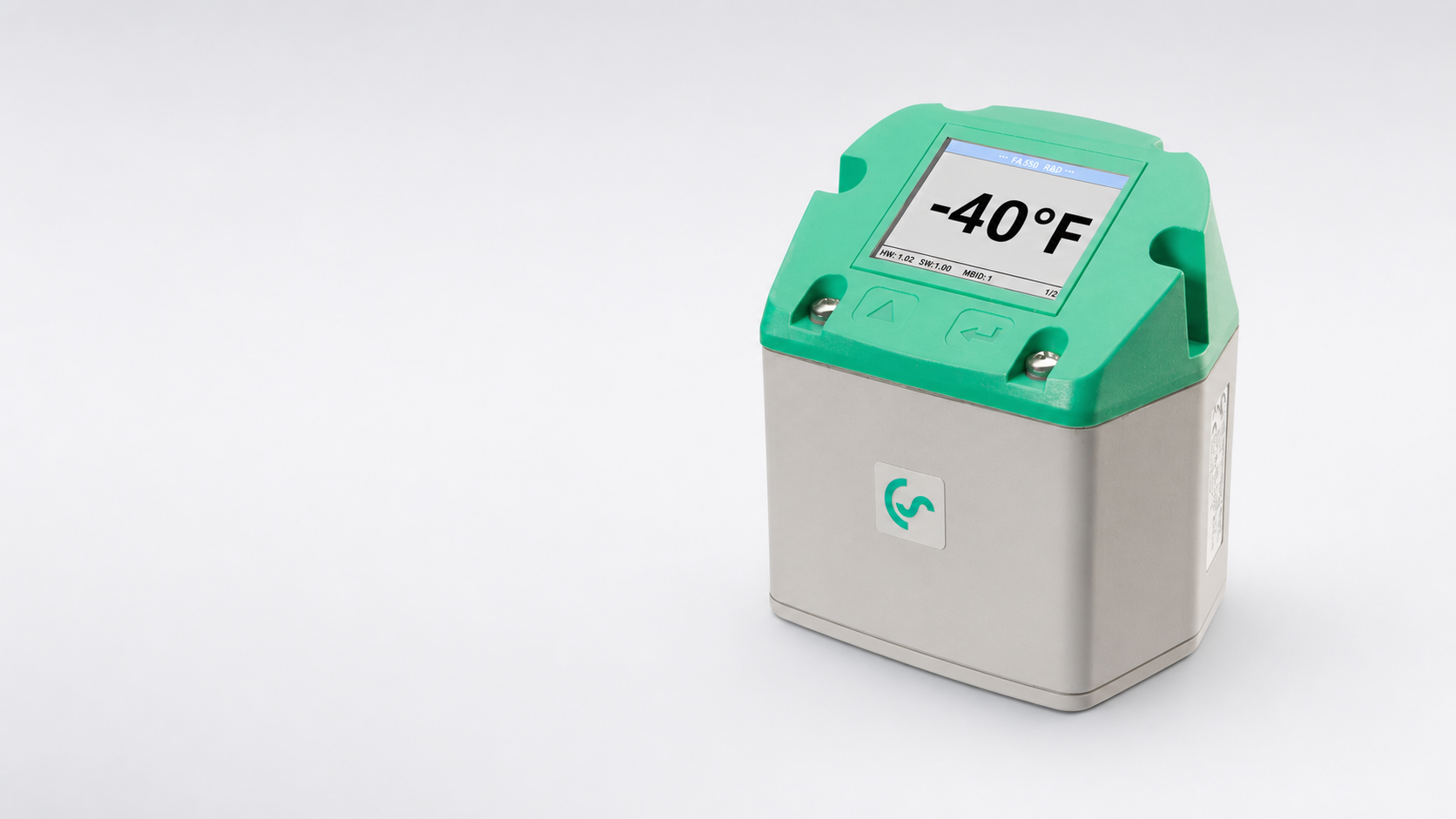
See why dryer dewpoint must be paired with direct resin moisture measurement.
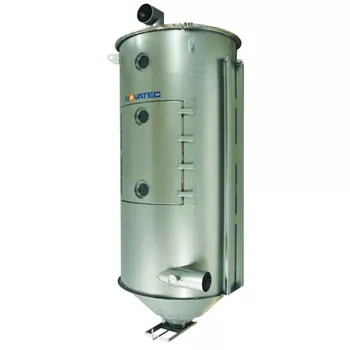
Explore hopper design, airflow, and residence time for consistent resin drying.
Ask the Plastic Drying Expert

Author Profile:
Mark Haynie has designed and installed resin drying systems for more than 40 years, working in thousands of plastics plants across the industry. As Novatec’s Vice President of Moisture & Drying Technologies, he leads the company’s drying technology group, including its work on moisture measurement and predictive drying. He also serves as a technical reviewer for Novatec’s Drying Knowledge Center and has authored numerous technical articles and whitepapers on resin drying and moisture.
Mark earned a Bachelor of Science in Chemical Engineering from Virginia Tech.
Through Novatec’s Ask the Expert program, Mark regularly helps processors troubleshoot drying performance and resin-moisture challenges.