

RESIN DRYING
How Moisture Leaves a Plastic Pellet: Diffusion, Temperature, and Drying Time
By Mark Haynie and Joshua Belisle · Edited by Dana Gardner · Published October 8, 2026 · Technically reviewed by Mark Haynie, October 2026 · 8 min read
Short answer. Moisture inside a hygroscopic pellet leaves by diffusion. Water bound to the polymer has to work its way to the surface before air or vacuum can carry it off. The rate of that migration is set by temperature, which raises it exponentially; how much of it happens is set by time. Dry air and vacuum both keep the surface clear so the gradient holds. Neither moves water through the solid any faster.
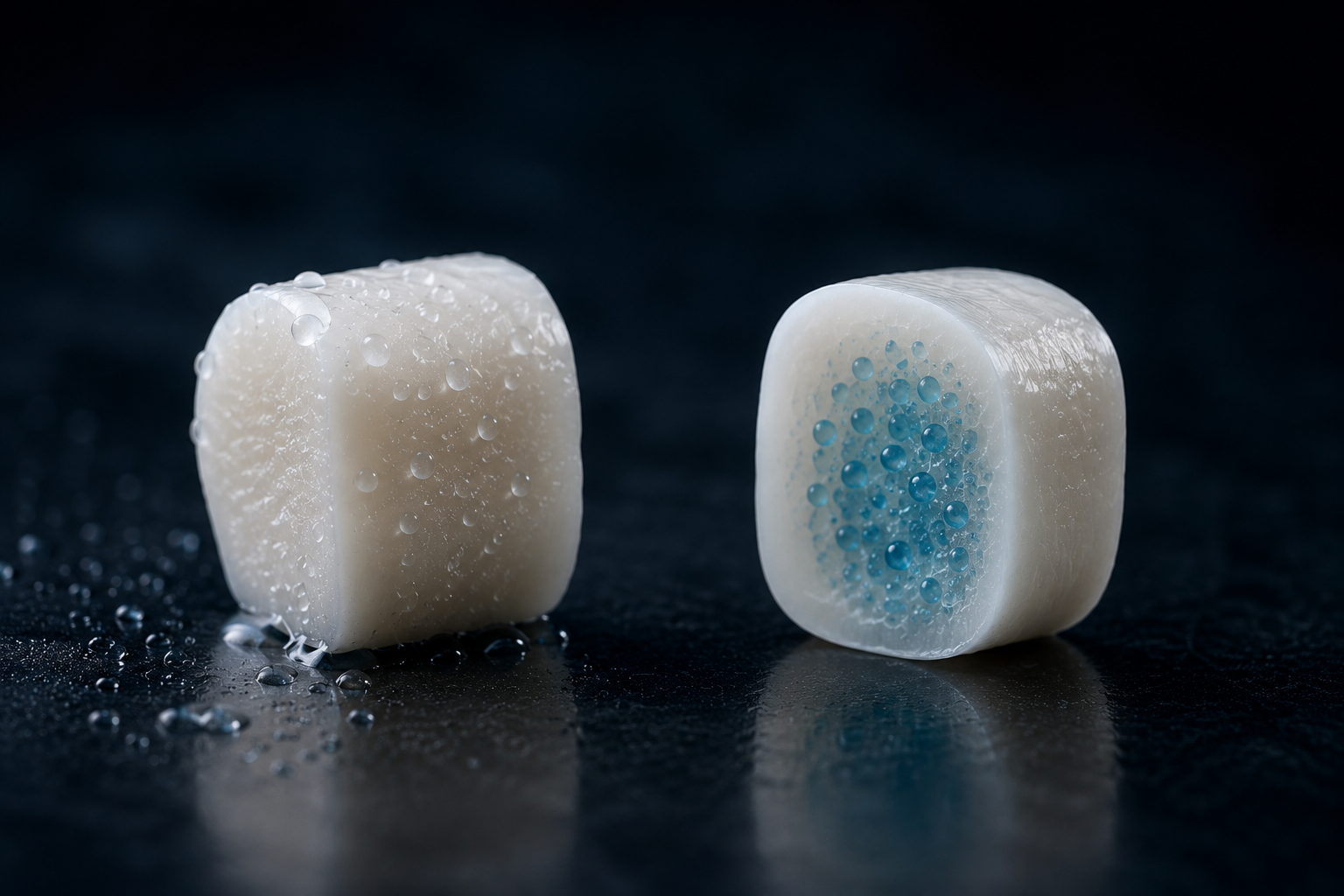
A nylon part splays at the gate on a Tuesday in August. The dryer’s dew point reads −40°F, the hopper is at setpoint, and the material sheet says four hours. The pellets at the throat look dry, and on the outside they are. The water causing the splay is still inside them.
That gap between a dry surface and a dry pellet is the whole subject of resin drying, and it comes down to one mechanism: diffusion. Once you see drying as water moving through a solid, most of the arguments about dryer types, dew points and cycle times sort themselves out. This article explains the mechanism, shows what it looks like in a drying hopper, and draws the line between what heat does, what dry air does, and what vacuum does. It supports The Science of Vacuum and Desiccant Drying for Engineering Plastics, which compares the two approaches in full.
Where the water is
Two kinds of water ride along with a hygroscopic pellet. Surface water sits on the outside: on fines, in surface irregularities, in the voids between pellets. It comes off quickly with warm air, with airflow, or with vacuum. Absorbed water is different. It sits inside the polymer, bound to the chain. In nylon, water molecules hydrogen-bond to the polar amide groups along the backbone, which is why nylon can hold anywhere from 2% to 9.5% of its weight in water, depending on the grade and how long it has been exposed. Polycarbonate, PBT, PET and TPU absorb less, but they absorb it the same way, and they are damaged by it the same way: in the melt, trace water hydrolyzes the polymer, shortening the chains and lowering molecular weight, so parts lose strength even when they look fine. Polyethylene and polypropylene do not absorb water, which is why they are the exception to most of what follows.
A pellet can have a dry shell and a wet core at the same time. That is not a defect in the dryer. It is what the physics produces whenever surface water is removed faster than interior water can follow.
How internal moisture moves
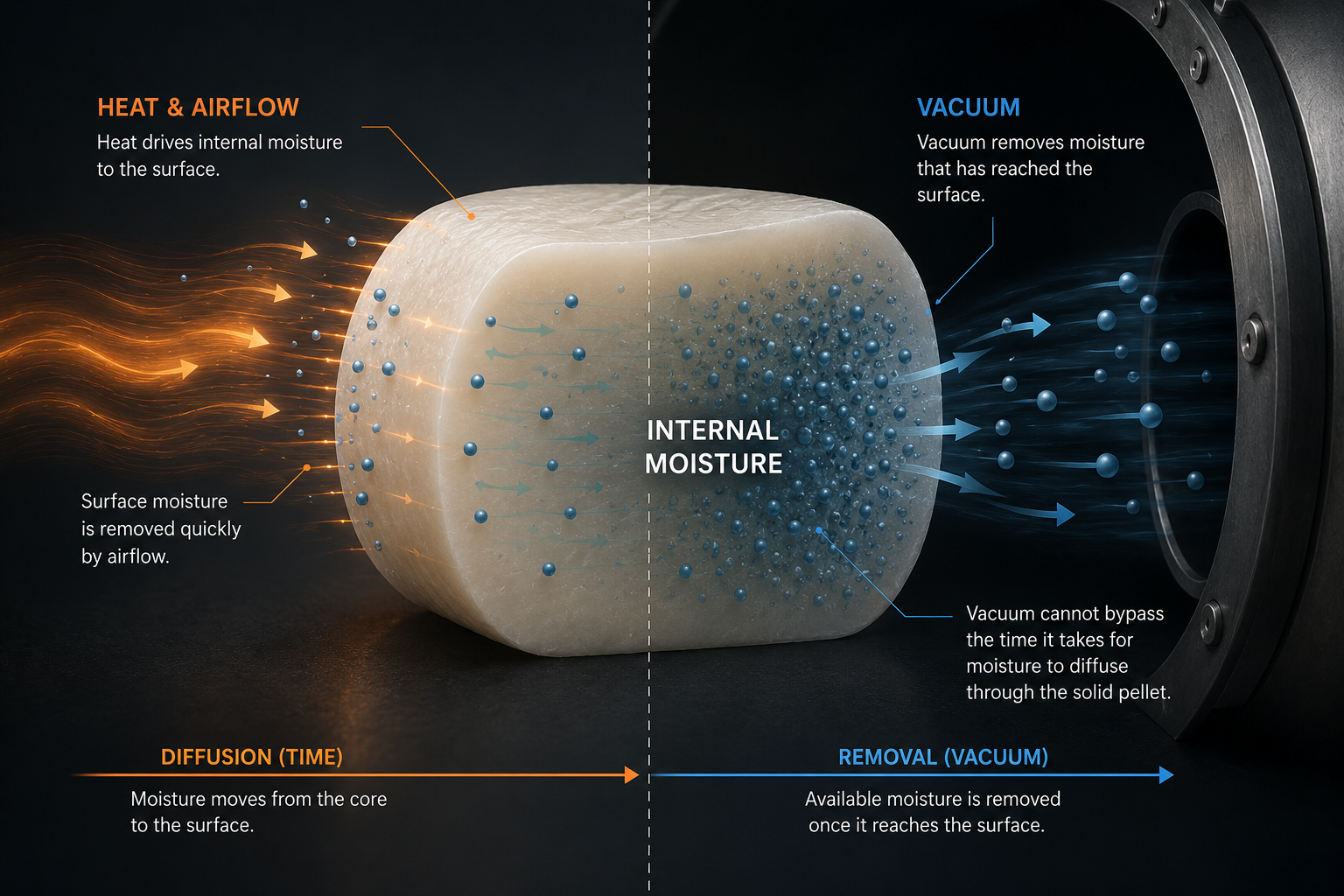
Water inside a solid moves by diffusion, from where its concentration is higher to where it is lower. Plastics Technology’s drying primer puts it plainly: water molecules must first be diffused from the polymer chain before they can migrate to the pellet surface. Work on polymer molding compounds done for NASA’s electronic parts program found that both absorption and desorption follow Fick’s law, and that the diffusion coefficient rises exponentially with temperature along an Arrhenius curve.
Three things set the rate of that migration. The first is the gradient between the wet interior and the surface; keep the surface dry and the gradient stays steep. The second is the distance the water has to travel, which is set by pellet size and shape, so a large pellet or a thick regrind flake dries slower than a micro-pellet at the same conditions. The third, and by far the strongest, is temperature. The diffusion coefficient depends on it exponentially, so a modest change in hopper temperature produces a large change in drying rate.
Notice what is not on that list. The pressure in the chamber is not in the diffusion equation. Neither is the dew point of the air, the airflow rate, or the dryer’s technology. Those things act at the pellet surface: they decide whether water that has arrived there is carried away, and they set the gradient by keeping the surface dry. They do not reach inside the pellet. Only heat and time do that.
Why temperature does most of the work
Plastics Technology’s drying data for ABS shows the exponential dependence in plain numbers. Starting at 0.35% moisture with 0°F dew point air, ABS reaches 0.1% in about 5 hours at 160°F, in 2 hours at 180°F, and in roughly 45 minutes at 208°F. Forty-eight degrees of temperature cut the drying time by a factor of nearly seven. That is what an Arrhenius relationship looks like in a hopper.
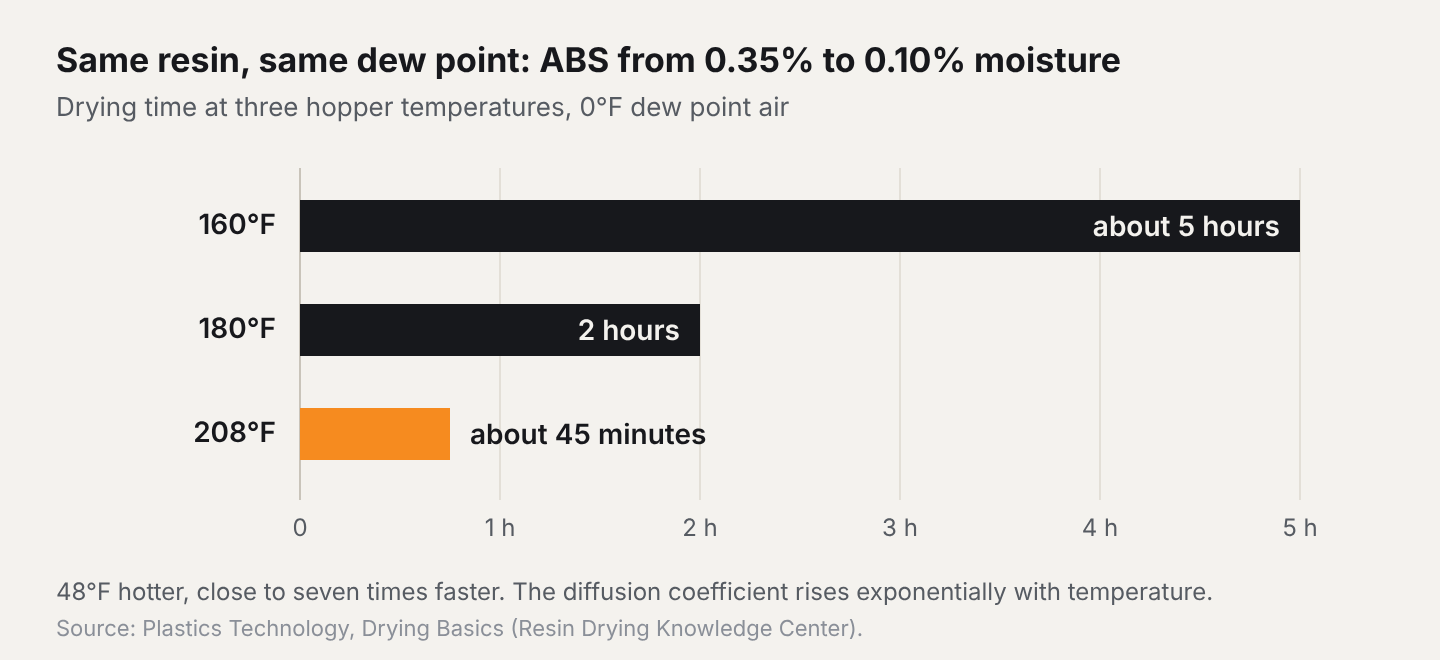
So why not run the dryer hot? Because each resin has a ceiling. Above it, pellets soften and bridge, additives migrate, color shifts, and some materials start to oxidize or degrade. Nylon is the familiar case: run it too hot or too long and it overdries, and the parts turn brittle. The supplier’s recommended temperature is the ceiling. Below it, the only other lever on the inside of the pellet is time, which is why drying time, not dew point, is the number that decides whether the core gets dry.
Most resins need one to four hours at their recommended temperature, and the supplier’s time assumes a particular starting moisture. A lot of polycarbonate that arrives at more than 3,000 ppm in July needs considerably longer than the same grade at 500 ppm in January, at identical dryer settings. Plastics Technology’s advice is to measure incoming moisture rather than assume it, and the same advice closes this article.
What dry air does, and what vacuum does
Dry air and vacuum do the same job at the pellet surface. Both lower the water vapor pressure outside the pellet so the surface stays dry and the gradient from the interior stays steep. Desiccant air conditioned to a −40°F dew point does it by removing water from the air; The Madison Group notes that hydrolysis-sensitive resins, which typically need to be below 0.02% moisture, generally require desiccant air at that dew point. A vacuum chamber does it by removing most of the air, water vapor included.
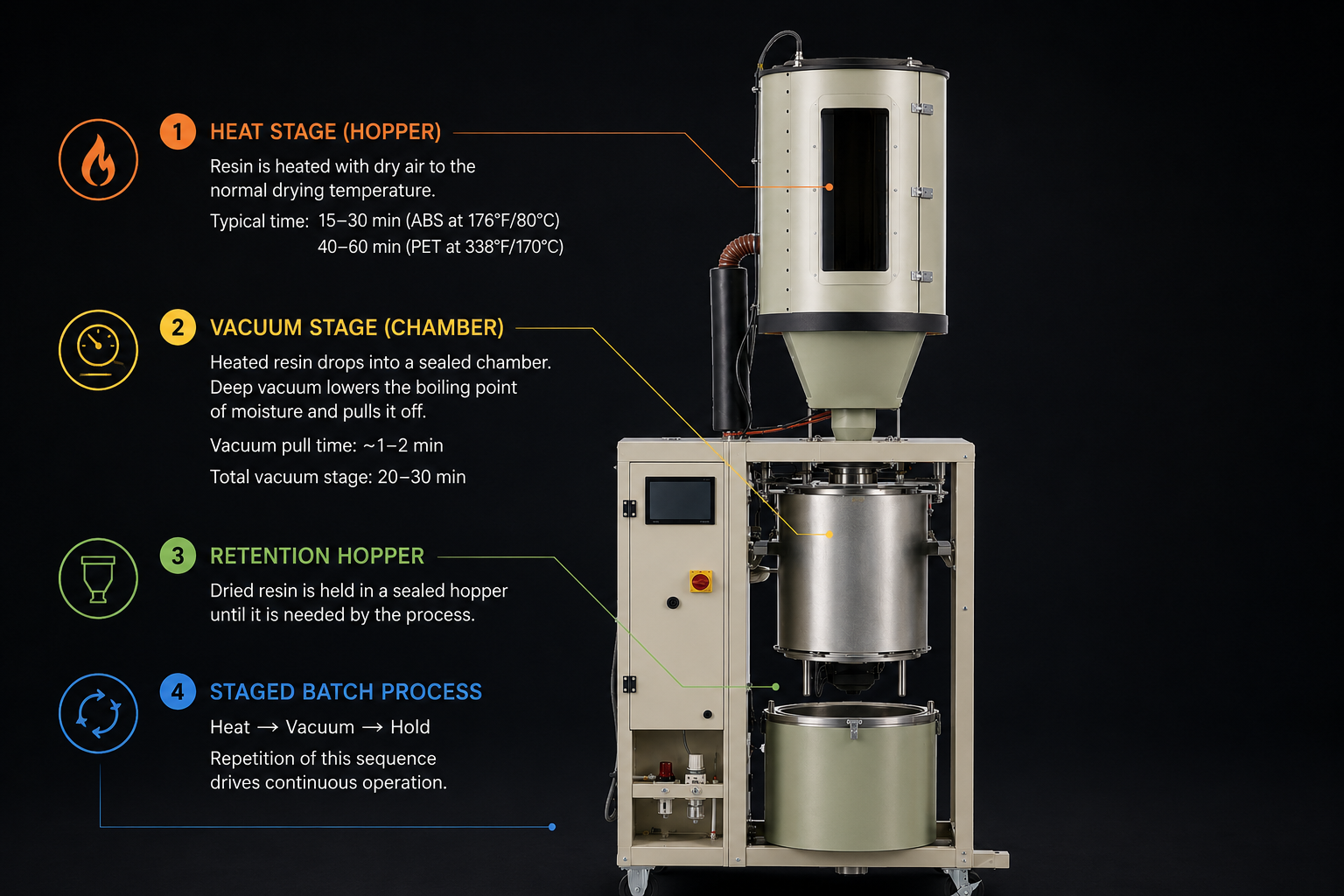
The differences are in how long the condition is held, and in what it does to the pellet’s temperature. A desiccant dryer holds the low dew point over the full residence time, so the gradient is there for the hours the interior needs. The vacuum dryers sold into plastics processing are hybrid hot-air and vacuum systems, not true vacuum dryers: a heating hopper brings the resin to temperature with hot air over a short cycle, a sealed chamber then holds it under vacuum for roughly 20 to 30 minutes, with the pump actively pulling for only a minute or two, and a retention hopper holds the dried charge until it is used. True batch vacuum drying, which holds resin under vacuum for hours at modest temperature, is a different process, and results from one should not be read as results for the other. The heat stage does the diffusion work. The vacuum finishes the water that reached the surface. Water still inside the pellet at the end of the heat stage keeps moving at the rate temperature allows and no faster; the pull does not reach it.
The vacuum step also cools the pellet, and not mainly by evaporation; removing the last fraction of a percent of moisture takes only a degree or two of heat from the resin. The pellets cool because the vacuum step adds no heat, and a charge sitting in an unheated chamber loses heat to it. A PET charge at 300°F or more has thermal margin to spare, which is one reason a short vacuum finish suits PET. A nylon or PC/ABS charge at 160 to 180°F does not, and a cooler pellet diffuses more slowly at the moment it still needs to.
The boiling-point argument deserves a line of its own, because it comes up often. Under the vacuum typically cited, free water boils at about 133°F. That is true, and it matters less than it sounds. Water dissolved in a hygroscopic polymer has no liquid phase, so it does not boil; what vacuum does is push the water-vapor pressure at the pellet surface close to zero, the same job −40°F dewpoint air does. Nylon is dried at roughly 160 to 180°F, ABS up to 180°F, PET up to 350°F, and the water that limits the process is inside a solid, where only temperature and time reach it. The argument has the most force for the narrow group of resins dried at or above 212°F.
None of this makes the hybrid the wrong tool. Where the heat stage drives moisture out quickly, as it does with PET, a short vacuum finish is a legitimate way to complete the job with a shorter heat history and less maintenance. Where diffusion is slow, as it is with nylon, PC/ABS, PBT and TPU, the resin needs time at temperature in a sustained dry environment, and whatever the method, it has to provide that. The full comparison, including the energy accounting, is in the vacuum and desiccant drying guide.
What this means at the hopper
Variable
What it changes
Where it acts
Temperature
The diffusion coefficient, exponentially
Inside the pellet
Residence time
How far the water can travel before discharge
Inside the pellet
Pellet size and shape
The distance the water has to travel
Inside the pellet
Dew point, or vacuum
The vapor pressure at the surface, which sets the gradient
The surface
Airflow
Heat delivery into the bed and removal of surface moisture, top to bottom
The surface and the bed
Starting moisture
How much water has to move
Both
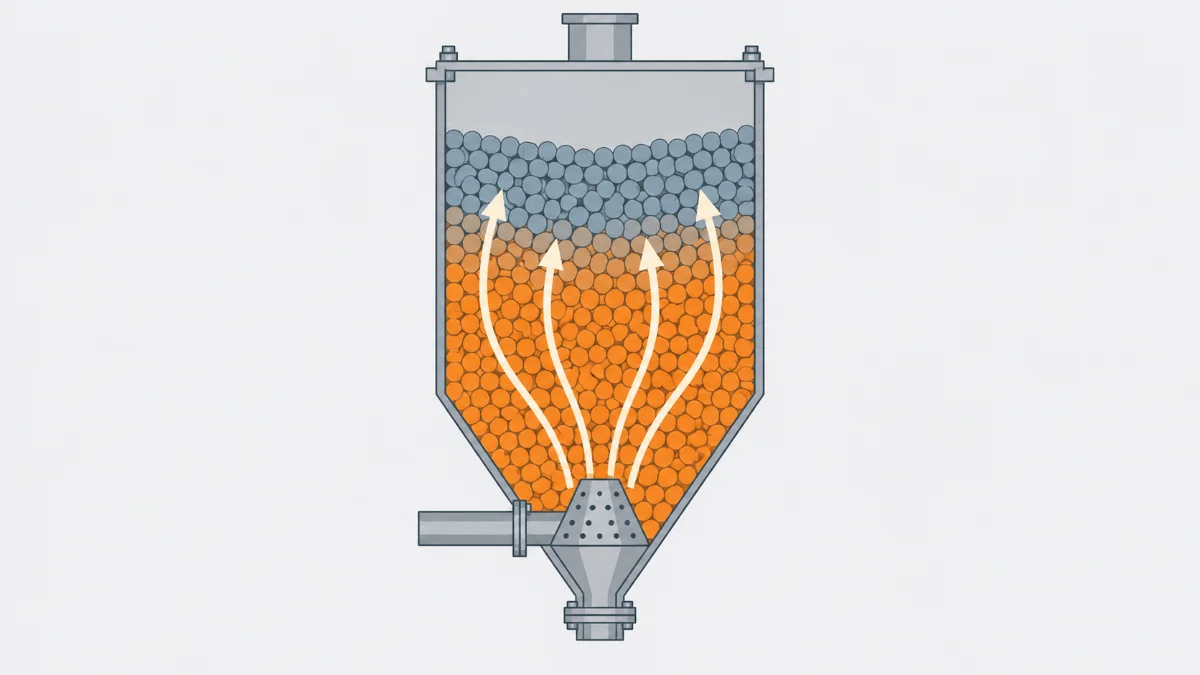
Four things follow from the table. Residence time has to be real time at temperature at full production throughput, not the hopper’s nominal capacity divided by a hoped-for rate. The bed has to be uniform, because a cold upper hopper means part of the resin is spending part of its residence below optimum drying temperature. The dew point has to be controlled for the whole cycle, in August as well as February, because a heat stage fed by humid plant air is a weaker gradient on the days you need it most. And the incoming moisture has to be known, because the supplier’s drying time was written for a particular starting point.
The fifth thing is the one that settles arguments: measure the resin, not the air. The dew point tells you the dryer is working. Whether the core of the pellet is dry is a question only the pellet can answer, and the moisture rebound test is how you ask it.
How we know this: Novatec measures drying curves like this in the Resin Proving Ground, its own resin drying and moisture lab, by Karl Fischer titration.
Related reading: Understanding Moisture in Resin · Drying Hoppers for Plastic Resins
How Novatec Approaches It
At Novatec, we believe a dryer has to be designed around the physics of the resin, and the physics says low-temperature engineering resins need time at temperature in a sustained low dew point environment. That is why our recommendation for nylon, PC, PC/ABS, PBT and TPU is desiccant-based continuous drying, in whichever size the job calls for. The NovaDrier handles up to 100 lb/hr with the Desiccating Cartridge and patented Dual Drying Zones, holding a −40°F dew point or lower with no loose desiccant and no moving parts. The NDB Series dual bed dryers carry the same controlled low dew point from machine side to central systems up to 10,000 lb/hr, and the NovaWheel covers 25 to 4,000 lb/hr for central drying. We build vacuum dryers too, for the applications where a vacuum finish fits.
We decide which is which the way this article describes. We dry the resin, we measure it, and we let the curve decide.
If you are not sure which side of the line your material falls on, give us a holler on the form below.
No sales pitch. No pressure. Just a conversation about what’s best for your operation.
Frequently Asked Questions
Does vacuum remove moisture from inside plastic pellets?
Not directly. Vacuum lowers the vapor pressure at the pellet surface, so water that has reached the surface leaves quickly. Water still bound inside the polymer has to diffuse to the surface first, and the rate of that diffusion depends on temperature and time, not on chamber pressure. In the hybrid hot-air and vacuum dryers sold for plastics, the heating stage does that work and the short vacuum stage finishes it.
Why does nylon take so long to dry?
Nylon binds water to the amide groups along its chain and can hold several percent of its weight in it. That water has to diffuse out of the solid, and nylon’s recommended drying temperature, roughly 160 to 180°F, is low enough that diffusion is slow. Running hotter risks overdrying, brittle parts and discoloration, so time at temperature in low dew point air is the lever that works.
Can I shorten drying time by raising the temperature?
Up to the resin supplier’s limit, yes, and strongly. Plastics Technology’s ABS data shows drying time falling from about 5 hours at 160°F to roughly 45 minutes at 208°F for the same moisture change. Above the limit, pellets soften and bridge, color shifts, and some resins degrade. Stay at the recommended temperature and give the material the residence time it needs.
Does dew point change how fast resin dries?
It sets the condition at the pellet surface, which keeps the gradient steep so interior water keeps moving outward. Below about −40°F there is little further gain for most resins, because the surface is already effectively dry and the interior is still limited by diffusion. A good dew point reading tells you the dryer is working. It does not tell you the pellet is dry.
How long does it take to dry hygroscopic resin?
Most resins need one to four hours at their recommended temperature, and the supplier’s figure assumes a typical starting moisture. Resin that arrives wetter, which is common in humid months, needs longer at the same settings. The only way to know the core is dry is to measure the resin, which is what the moisture rebound test is for.
About the Authors

Vice President of Moisture & Drying Technologies, Novatec
Mark Haynie has designed and installed resin drying systems for more than 40 years, working in thousands of plastics plants across the industry. As Novatec’s Vice President of Moisture & Drying Technologies, he leads the company’s drying technology group, including its work on moisture measurement and predictive drying. He also serves as a technical reviewer for Novatec’s Drying Knowledge Center and has authored numerous technical articles and whitepapers on resin drying and moisture.
Mark earned a Bachelor of Science in Chemical Engineering from Virginia Tech.
Through Novatec’s Ask the Expert program, Mark regularly helps processors troubleshoot drying performance and resin-moisture challenges.

Technology Manager, Novatec
Joshua Belisle is Technology Manager at Novatec, where his work focuses on simulation and technology development for resin drying. He earned a B.S. in Mechanical Engineering with a minor in Engineering Business from the University of Virginia in 2023 and joined Novatec that same year. Joshua uses simulation tools to investigate previously difficult-to-measure aspects of the drying process, helping Novatec better understand airflow, heat transfer and other variables that influence resin-drying performance.
Sources
- Plastics Technology, Drying Basics, Resin Drying Knowledge Center: drying variables, the ABS drying-time data at 160°F, 180°F and 208°F, the one-to-four-hour range, and the advice to measure incoming moisture.
- Erik Foltz, The Madison Group, Drying of the Resin in Plastic Manufacturing, January 19, 2023 (updated June 5, 2025): hydrolysis mechanism, the 0.02% moisture target for hydrolysis-sensitive resins and the −40°F desiccant dew point, non-hygroscopic polyolefins.
- Alexander Teverovsky, Moisture Characteristics of Molding Compounds in PEMs, NASA Electronic Parts and Packaging Program: Fickian diffusion and the Arrhenius temperature dependence of the diffusion coefficient.
- Novatec, The Science of Vacuum and Desiccant Drying for Engineering Plastics, August 2026: staged vacuum-dryer cycle, evaporative cooling, typical drying temperatures, the boiling-point argument.
- Novatec, Dewpoint Is a Dryer Output, Not a Resin Readiness Score, September 2026: nylon water absorption, polycarbonate incoming-moisture range by season.
Related Articles
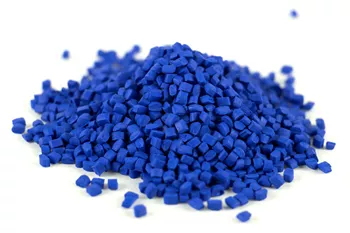
Understand surface and absorbed moisture, starting moisture levels, and their effect on resin processing.
See why dryer dewpoint must be paired with direct resin moisture measurement.
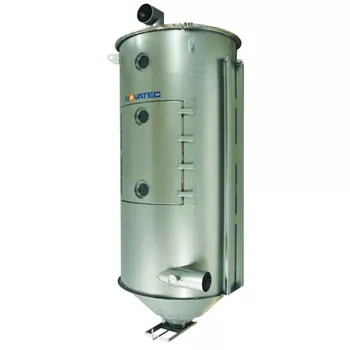
Explore hopper design, airflow, and residence time for consistent resin drying.
Ask the Plastic Drying Expert

Author Profile:
Mark Haynie has designed and installed resin drying systems for more than 40 years, working in thousands of plastics plants across the industry. As Novatec’s Vice President of Moisture & Drying Technologies, he leads the company’s drying technology group, including its work on moisture measurement and predictive drying. He also serves as a technical reviewer for Novatec’s Drying Knowledge Center and has authored numerous technical articles and whitepapers on resin drying and moisture.
Mark earned a Bachelor of Science in Chemical Engineering from Virginia Tech.
Through Novatec’s Ask the Expert program, Mark regularly helps processors troubleshoot drying performance and resin-moisture challenges.