

The Science of Vacuum and Desiccant Drying for Engineering Plastics
Short Answer
Vacuum drying is not universally better than desiccant drying. Vacuum-assist can be an excellent fit for high-temperature resins such as PET, where heat drives moisture toward the pellet surface before the vacuum acts. For lower-temperature hygroscopic engineering resins such as nylon, PC/ABS, PBT and TPU, internal moisture removal is diffusion-limited and depends on heat, time and a sustained low-moisture gradient. For those applications, controlled low-dewpoint desiccant air remains the more reliable general-purpose approach.
The deciding test is simple: does the resin reach the processing machine at the supplier-specified moisture level and remain stable after moisture has had time to redistribute?
Vacuum vs. Desiccant Drying at a Glance
| Question | Controlled desiccant drying | Short-cycle vacuum drying |
|---|---|---|
| How does it dry? | Sustained heat, airflow and controlled low-dewpoint air over the full residence time. | Heats the resin first, then applies a short vacuum stage to remove moisture made available by the heat stage. |
| Best fit | Broad range of hygroscopic engineering resins, including nylon, PC, PC/ABS, PBT and TPU. | Strongest fit where the heat stage can drive moisture outward quickly, especially high-temperature applications such as PET. |
| What controls the result? | Temperature, residence time, airflow and dewpoint. | Quality and duration of the heat stage, followed by the vacuum stage. |
| Main process advantage | Stable, season-independent drying conditions across a wide resin mix. | Shorter heat history, lower maintenance and potentially lower dryer-level energy in well-matched applications. |
| How should performance be judged? | Supplier-spec pellet moisture at the machine, with a stable rebound reading. | The same standard: supplier-spec pellet moisture at the machine, with a stable rebound reading. |
A confident message is circulating in plastics processing: that desiccant drying is a relic, that the discipline of low-dewpoint air is no longer necessary, and that a faster, lower-energy, vacuum-based method has quietly retired half a century of process control. Newer vacuum dryers are marketed as drying material six times faster than desiccant systems, at a fraction of the energy — so low it is “almost free to run.” The implication is that the old approach was wasteful and the science behind it has been superseded.
That impression is creating real confusion, and it deserves a careful, physics-based answer. The honest one is not “desiccant good, vacuum bad.” It is this: vacuum is a legitimate tool with a real and sometimes superior place, but the laws that govern how a hygroscopic engineering resin actually dries have not changed — and for a large class of materials those laws make controlled dry air essential, not optional. Where a fast vacuum cycle appears to make desiccation unnecessary, it usually has not removed the requirement; it has relocated the consequences downstream, into the molding-machine barrel, where they are harder to see and more expensive to fix.
The central issue is not which dryer category wins. It is whether the resin reaches the injection molding machine or extruder at the correct moisture level, at the correct temperature, at full throughput, and — critically — whether it stays in specification after moisture has had time to redistribute. That single standard, resin condition at the machine, settles every claim in this debate.
The physics of engineering-resin drying has not changed
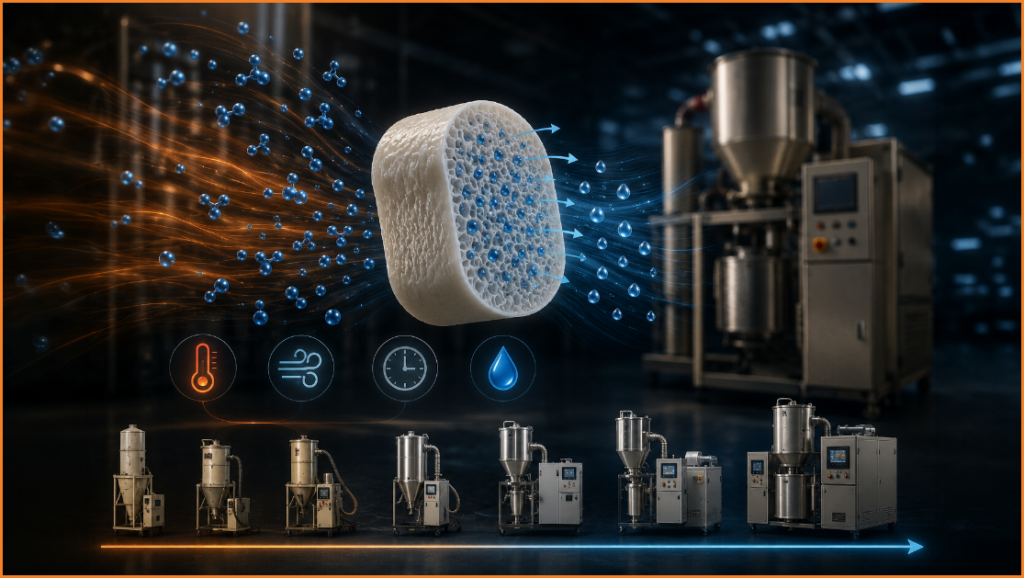
Dryer technology has genuinely advanced. Controls, regeneration, hopper design, airflow management, sensors and energy management have all improved, and those improvements matter. What has not changed is the physics governing hygroscopic engineering resins. Moisture inside Nylon, PC, PC/ABS, PBT, PET, TPU and similar materials must migrate through the solid pellet before it can be removed. That movement depends on heat, residence time, airflow, and a surrounding environment dry enough to keep the moisture gradient alive. Plastics Technology summarizes those same fundamentals as airflow, temperature, dewpoint and drying time.
Every generation of drying equipment has chased the same goals: less time, less energy, less airflow, simpler maintenance, lower operating cost. Many of those efforts have helped processors. But the underlying challenge is unchanged — a dryer for hygroscopic engineering resins must supply enough heat, dry-air capacity, airflow and time for absorbed moisture to leave the pellet before the resin reaches the machine. Remove or shorten any one of those and you have not beaten the physics; you have simply changed where its bill comes due.
Surface moisture is the easy part. Internal moisture is the job.
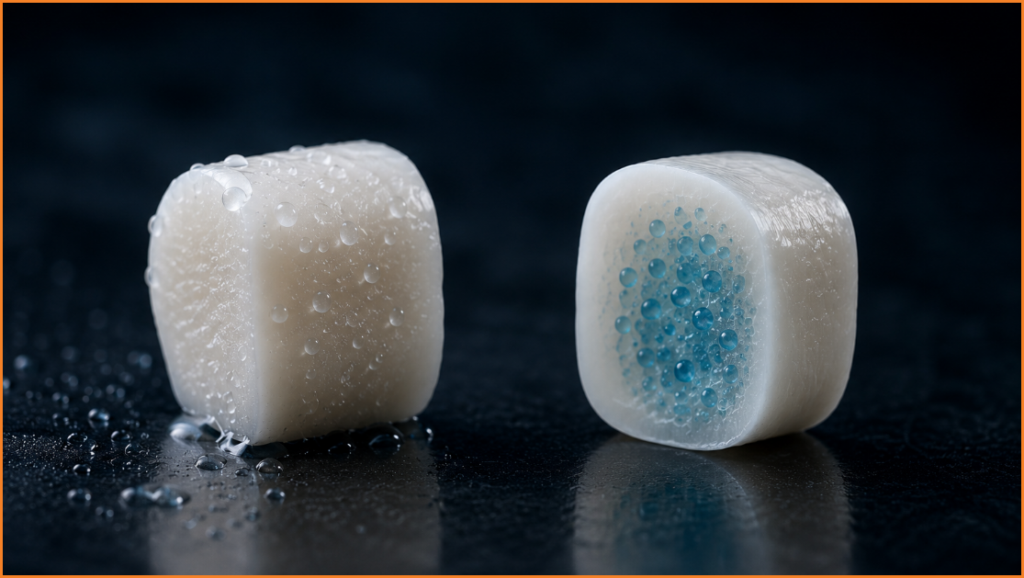
The most important distinction in resin drying is between moisture on the pellet and moisture inside it. Surface and near-surface moisture — water in fines, pellet irregularities and void spaces — is already exposed to the environment, so heat, airflow and vacuum can remove it quickly. Absorbed internal moisture is different. Hygroscopic resins take water into the polymer structure; in Nylon, water hydrogen-bonds directly to the polar amide groups along the chain rather than sitting as free liquid. Technical guidance on nylon moisture explains that surface water comes off readily, while moisture absorbed deeper into the polymer may require far longer drying because the molecules must diffuse to the surface (Teknor Apex).
This is why a pellet can read dry at the surface while still carrying water internally, and why that water keeps moving outward after the pellet leaves the dryer — showing up later as moisture rebound, processing instability, or part defects. The consequences are not only cosmetic. Plastics Technology explains that trace water in PC, PET, Nylon, PBT and certain elastomers can drive hydrolysis during melt processing, shortening polymer chains and reducing long-term properties even when parts look acceptable at first inspection.
How Does Vacuum Drying Work for Plastic Resin?
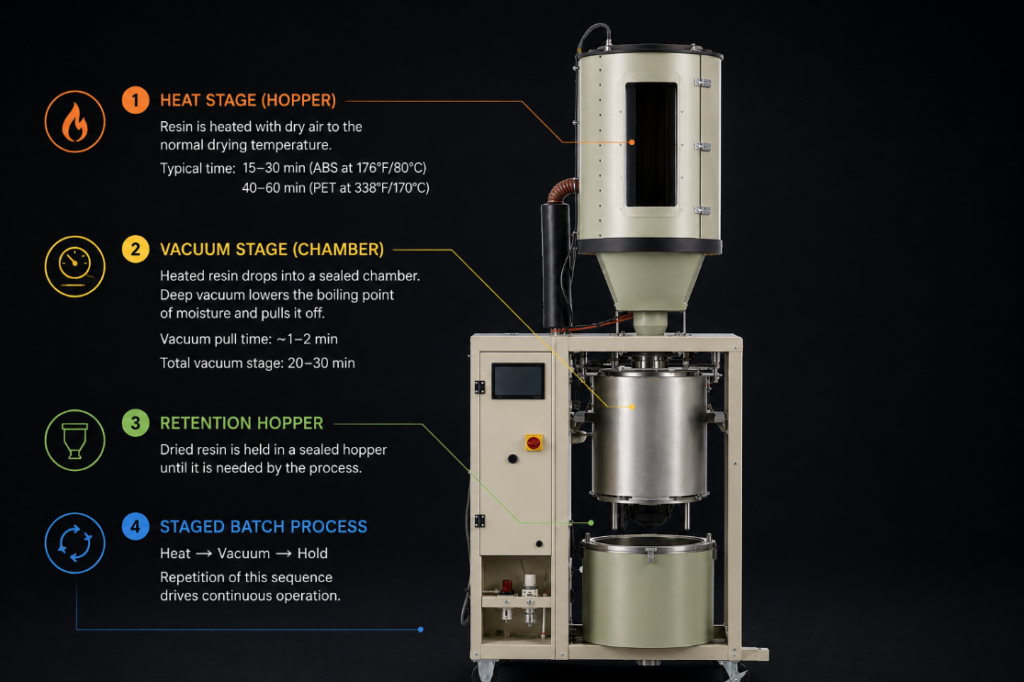
Most plastics “vacuum dryers” are not continuous vacuum chambers. They are staged batch systems, and reading their own published sequence is most of the analysis. A representative current design heats material in a hopper to the normal drying temperature for a short period — by the manufacturer’s examples, roughly 15–30 minutes for ABS at 176°F/80°C, or 40–60 minutes for PET at 338°F/170°C — then drops the hot charge into a sealed chamber where a deep vacuum lowers the boiling point of moisture, typically for 20–30 minutes. The vacuum itself is described as actively pulling for only about one to two minutes per cycle. A retention hopper then holds the material until it is used.
That sequence matters. The first stage is doing the primary drying work: as the pellet heats, absorbed moisture begins migrating to the surface and the airflow carries it away. By the time resin enters the vacuum zone, much of the readily available moisture is already gone, and the vacuum finishes what heat, time and airflow have made available. Vacuum can help complete the available moisture-removal job. It does not replace the internal diffusion that must happen inside the pellet — and a one-to-two-minute pull cannot extract water that has not yet reached the surface. A longer residence time in the heat stage — on the order of two to three times the typical cycle — would normally allow proper diffusion to occur before the vacuum is ever applied, which is itself a reminder that diffusion, not pressure, governs how completely the pellet dries.
For a deeper look at how the hybrid hot air architecture works and where it fits different resin types, see What Is Vacuum Drying for Plastics Processors.
So the performance of a vacuum dryer is set by the quality of its heat stage: resin temperature, residence time, airflow, heating uniformity, starting moisture, and the moisture content of the air used to heat it. If that stage is short, uneven, or fed with variable ambient air, the vacuum cannot recover diffusion work that never happened.
Not All Vacuum Drying Is the Same: True Vacuum vs. Hybrid Hot-Air/Vacuum Drying
The term “vacuum drying” can describe very different processes. Traditional batch vacuum drying may hold resin under vacuum for many hours at relatively modest temperatures. Modern production vacuum dryers used in plastics processing are typically hybrid systems: the resin is first heated with air, then transferred into a vacuum chamber for a much shorter vacuum stage.
That distinction matters when comparing published drying guidance. Data from a long-duration batch vacuum process should not automatically be used as proof of what a short-cycle hybrid dryer can achieve, and the reverse is also true. The correct comparison is the complete process — how the resin is heated, how long it remains at temperature, the condition of the heating air, the vacuum stage, and the final moisture condition of the pellet.
Why Is Resin Drying Different From Vacuum Devolatilization?
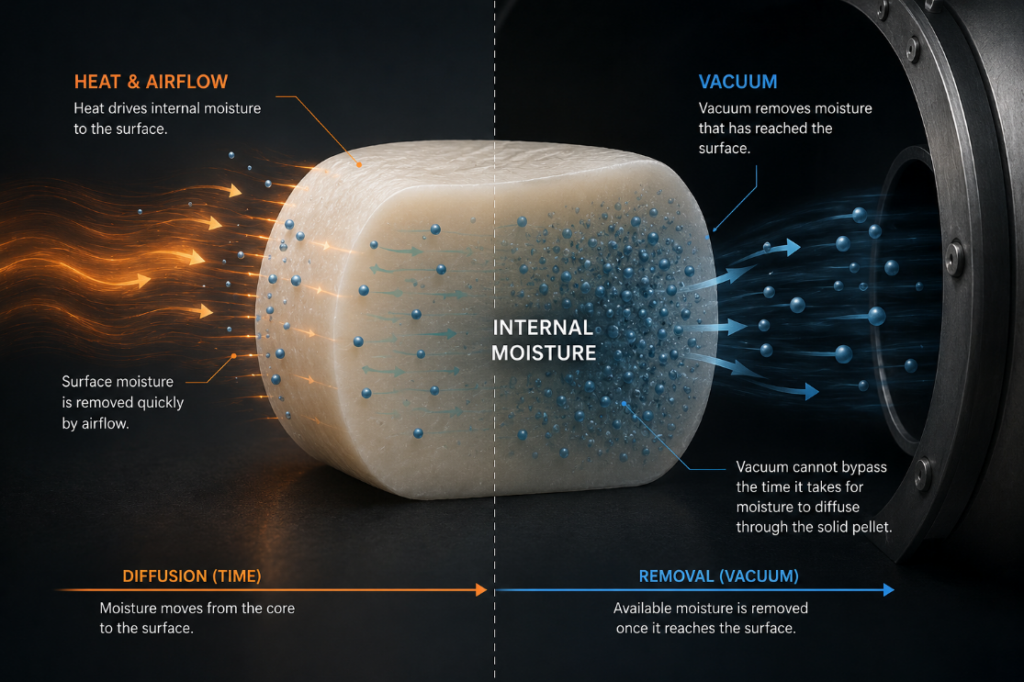
Vacuum is genuinely powerful for devolatilization in resin manufacturing, compounding and some melt-extrusion — including high-recycled-content PET — because the material is already molten, softened and exposed in a geometry that lets vapor escape. Secondary processing is different: the material starts as solid pellets feeding a machine. A pellet is a solid body with internal diffusion limits. Lowering the pressure outside it may reduce the boiling point of free water, but it does not eliminate the time absorbed moisture needs to travel through the solid. Vacuum can accelerate removal of available moisture; it cannot make internal moisture instantly available.
Does Vacuum Remove Moisture From Inside Plastic Pellets?
Internal moisture movement in a solid polymer is governed by diffusion: water migrates from higher concentration inside the pellet toward lower concentration outside, at a rate set by the material, the pellet geometry and the temperature. A pellet is not a hollow vessel to be evacuated; it is a solid that must change through its cross-section, and the center cannot be skipped. Temperature is the accelerator — as it rises, molecular mobility and diffusion increase. NASA reliability work on moisture in polymer molding compounds describes this movement as Fickian diffusion and notes that the temperature dependence of the diffusion coefficient follows an Arrhenius relationship (NASA).
This is the hinge of the whole debate. The diffusion coefficient depends exponentially on temperature and not at all on the external pressure around the pellet. Reducing chamber pressure does not reach inside the solid and pull moisture out; it only acts on water that has already arrived at the surface. That is why a high-temperature resin such as PET can suit a vacuum-assist stage — at 300°F-plus the heat itself drives moisture outward fast — while a lower-temperature hygroscopic resin dried at 150–180°F migrates its internal moisture far more slowly and needs sustained time and a dry-air gradient to finish. You can’t rush Mother Nature — or Fick’s Law. That is the entire point.
Why Does Low-Dewpoint Air Matter for Hygroscopic Resins?
Drying is driven by a moisture gradient. Heat increases mobility; residence time gives the movement time to occur; airflow removes moisture that reaches the surface. But the surrounding air must also stay dry enough to keep pulling. If the air around the pellet is humid, the driving force weakens; if its dewpoint tracks the weather, so does the process. Controlled low-dewpoint air removes that variability — it surrounds every pellet with air consistently able to accept moisture, holding the vapor-pressure gradient open while internal moisture migrates outward.
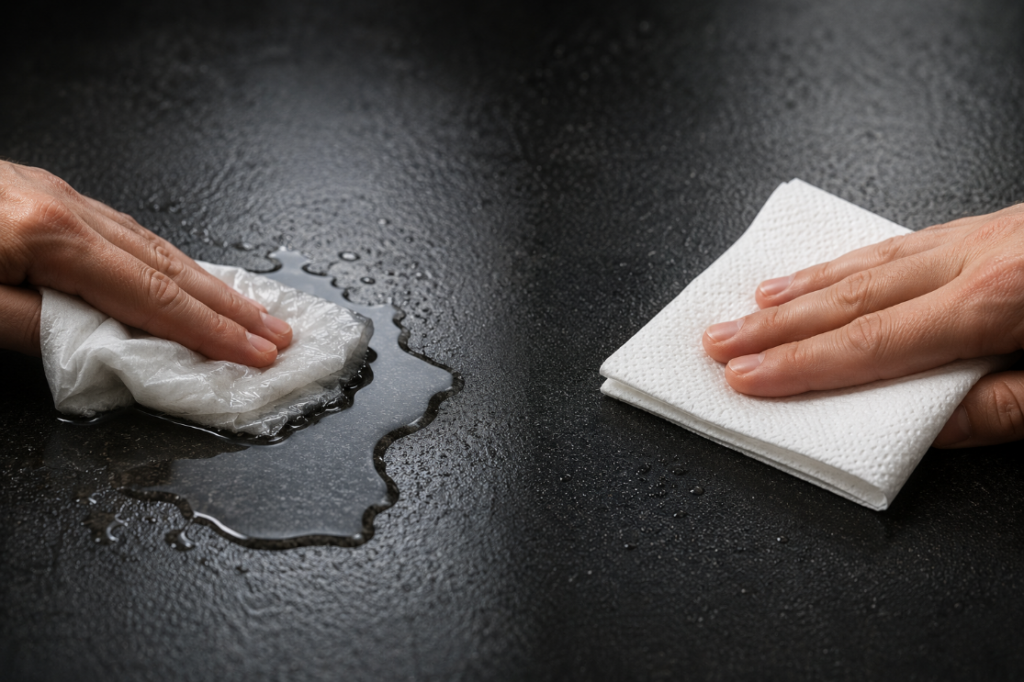
A simple analogy: drying a spill with a damp towel versus a dry one. The dry towel keeps pulling water because it has capacity to accept it. Controlled low-dewpoint air plays that role — not merely hot air, but air with enough remaining moisture capacity to keep accepting water as it surfaces. Reliably and consistently reaching the moisture levels that hydrolysis-sensitive resins require — often below 0.02% — typically calls for desiccant air conditioned to a −40°F dewpoint (The Madison Group). Other technologies — well-engineered membrane or compressed-air systems — can also produce low dewpoints; the governing requirement is the controlled low-moisture environment itself, sustained over the residence time the polymer needs.
The boiling-point argument is narrower than it sounds
A central marketing claim for vacuum rests on the boiling point of water: lower the pressure and water vaporizes at a lower temperature — a vacuum dryer may cite a boiling point as low as 56°C/133°F — supposedly making moisture easy to remove at reduced drying temperatures. That physics is real for free water at a free surface. Its relevance to hygroscopic engineering resins is much narrower.
Most difficult engineering resins are dried well above that figure anyway — Nylon at roughly 160–180°F, ABS up to 180°F, PET up to 350°F — so at drying temperature, any moisture that has reached the surface is already free to leave. The limiting step was never whether surface water can boil; it is whether enough heat, time and dry-air gradient exist for internal moisture to migrate out. Lowering the surface boiling point answers a question the hard resins were not asking. For the narrow group of resins genuinely dried at or above 212°F, the argument carries more weight — and even there, the rebound test, not the brochure, decides whether the process is complete.
Does Vacuum Drying Really Save Energy?
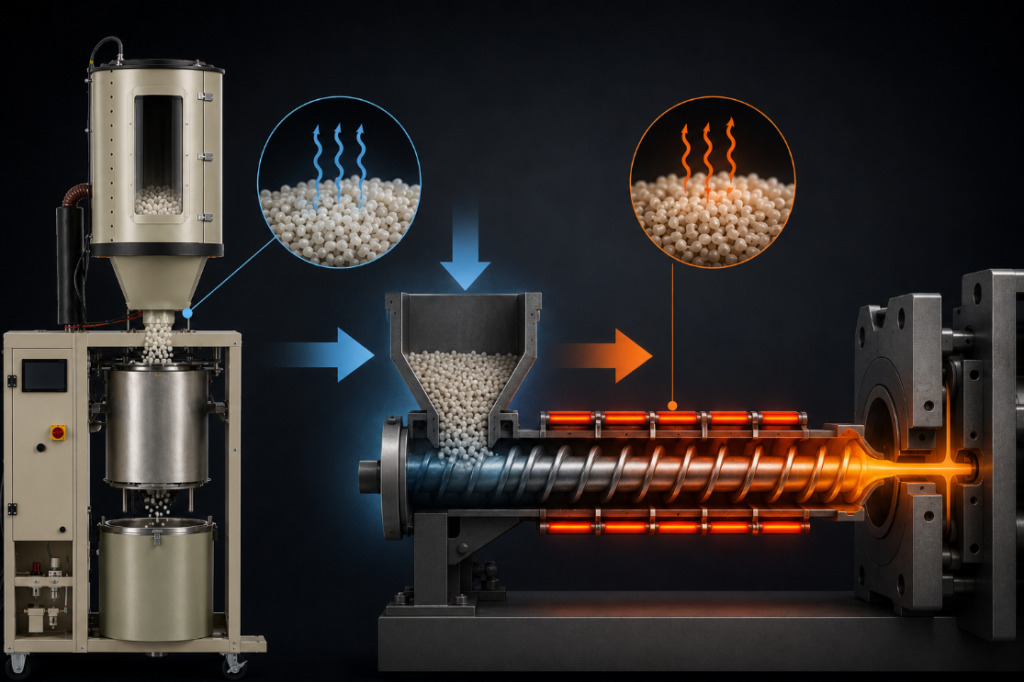
There is also a thermodynamic catch that cabinet-level energy numbers hide. When surface moisture flashes to vapor inside a vacuum chamber, it consumes latent heat and cools the pellet — the same evaporative cooling that chills skin as water evaporates. A high-temperature resin like PET enters the chamber with a large thermal buffer and survives the drop. A lower-temperature resin enters with little margin, and the flash can pull its surface temperature down sharply, slowing the very diffusion that still has to finish.
That cooled resin then drops into the machine feed throat colder than resin handed off from a continuously insulated, full-temperature desiccant hopper. The energy “saved” at the dryer is not gone — it must be resupplied by the barrel’s heater bands and the mechanical shear of the screw to bring the cold core up to melt temperature. The plant’s total energy is frequently not reduced; the load is shifted from the drying floor, where it is metered and visible, to the molding line, where it is buried in cycle and absorbed as a cost of doing business. A genuine comparison counts dryer energy, regeneration energy, retained resin heat, reheat at the machine, scrap, and the cost of unstable material — not just the number on the dryer cabinet.
Surface energy, rebound, and why an immediate test misleads

A hot pellet pulled from deep vacuum leaves the chamber with energetic, moisture-starved surface groups and a steep chemical-potential gradient toward any humidity around it. Discharged into ambient factory air, transit lines or a machine hopper throat, it can re-absorb moisture faster than virgin resin — an accelerated “sponge” effect. By the time the resin reaches the feed zone, re-absorbed surface moisture plus any unfinished core moisture can exceed processing limits, even when a test taken minutes earlier looked acceptable.
This is why immediate post-dryer moisture readings can flatter a process. Karl Fischer titration is the standard method, but it depends on extracting water under the right conditions. Sigma-Aldrich notes that water trapped within polyamide must be released through diffusion — by dissolving or swelling the sample, or by oven heating — before titration. Metrohm, a recognized supplier of Karl Fischer instrumentation, advises that the oven temperature be “as high as possible, within reason” for a “fast and complete release of the water,” warns that excessive temperature can decompose the sample and “falsify the water content,” and recommends temperature-gradient development to find a reproducible range. A surface-dry, wet-core pellet releases its deep moisture slowly; a too-short or too-cool extraction reports a false low. The discipline that exposes the truth is the rebound test — pull a sample at discharge, seal it 20–30 minutes, and re-measure. A stable reading indicates a pellet at equilibrium; a rise indicates surface drying over a wet core.
How vacuum systems are configured for hard-to-dry resins
A practical way to understand the boundaries of any drying method is to read how its own manufacturers configure it for the most demanding materials. Vacuum-dryer product literature is helpful here, because the recommended settings and options line up closely with what the physics of diffusion predicts:
- Heating energy is the same across methods. Vacuum-dryer literature is clear that the energy to heat material from ambient to drying temperature is identical for all drying processes, and that the headline savings come from the separate “dry” energy stage. That is a useful clarification for buyers: in a desiccant system, the “dry” energy is largely the recirculated low-dewpoint air and regeneration that hold the moisture gradient open across the full residence time. The two systems are spending energy on different things, so a like-for-like comparison has to account for what each kilowatt is actually doing.
- The hardest resins call for more heat-stage time. Vacuum systems commonly offer a heating-hopper extension to increase heat residence time, recommended specifically for materials such as PA (Nylon) and PET. This is consistent with diffusion: lower-temperature, strongly hygroscopic resins need more time at temperature for internal moisture to migrate out, so the fastest cycle times generally apply to easier materials rather than the most demanding ones.
- Highly hygroscopic materials often warrant a dry-air purge. For the most hygroscopic resins, vacuum systems frequently offer an optional dry-air purge — a positive low-pressure dry-air blanket that prevents moisture re-absorption in the vacuum and retention stages. In other words, where materials are hardest to dry and hold dry, controlled dry air re-enters the picture. That is not a contradiction so much as a confirmation that, for these resins, a dry-air environment does real work that pressure alone does not.
None of this is hidden; it is in the published specifications. Taken together, it offers a reliable buyer’s heuristic: the closer a material sits to the hard end of the hygroscopic range, the more a drying process — of any type — has to supply heat, time and a controlled dry-air gradient to finish the job.
Without controlled air, the process tracks the weather
When the primary drying stage runs on non-desiccated air, its capacity is whatever the building hands it that day. Dewpoint shifts with humidity, which shifts with season, weather, time of day, plant HVAC and proximity to other equipment. The same dryer, cycle and resin can deliver one result in February and another in August. Processors have lived this: defect rates climb in humid months with no process change, and the diagnostic effort moves to the press, the mold or the screw while the real variable entered upstream, in material condition.
In one well-known pattern, a processor running hybrid hot-air vacuum systems ultimately installed room dehumidification to pre-condition the production-area air so the dryers could perform acceptably — in effect adding a desiccation step in front of a system that was supposed to make desiccation unnecessary. That is what an uncontrolled input looks like in practice. Precision machines and precision tooling deserve a precision-controlled material condition feeding into them; letting the weather set the dryer’s most important input is the opposite of process control.
| Question | Controlled desiccant drying | Short-cycle vacuum drying |
|---|---|---|
| Primary drying driver | Sustained thermal diffusion in controlled dry air, over the full residence time | Short heat-up, then a brief pressure-differential flash (active vacuum ~1–2 min/cycle) |
| Moisture profile achieved | Homogeneous dryness through the pellet cross-section | Risk of a steep gradient: dry shell over a wetter core on low-temperature resins |
| Governing variable | Heat, time, airflow and dewpoint — controllable, season-independent | Heat stage often fed by ambient air; result varies with plant humidity |
| Best-fit materials | Broad mix of hygroscopic engineering resins (Nylon, PC, PC/ABS, PBT, TPU) | High-temperature resins (PET) where heat drives diffusion before the vacuum acts |
| Energy, honestly counted | Higher metered dryer energy; lower hidden reheat, scrap and instability | Low cabinet energy; reheat at the barrel, rebound and scrap can offset the saving |
| Verification that settles it | Rebound-stable, supplier-spec moisture at the machine, across seasons | Same test — a throughput rating or an immediate reading is not proof |
How Should Vacuum and Desiccant Dryers Be Compared?
Manufacturers of any drying technology can point to data showing rebound-stable, in-spec resin, and that is exactly the right currency for the comparison. The way to use it well is to apply the same standard to every system under consideration. Ask to see the data on the resins that actually stress the method — Nylon and PC/ABS rather than PET — and at full production throughput rather than a small demonstration batch. Ask that the sample be taken after a sealed 20–30 minute hold, measured on a Karl Fischer method developed and validated for that polymer, against the resin supplier’s specification rather than a generic industry number, and in the most humid season the line will run. A process that passes that test has earned its place, whatever the label on the cabinet; a process that has not been shown to pass it simply has not been verified yet. The test is technology-neutral — and that is what makes it fair.
How to evaluate any drying claim
The most useful framing in any drying conversation is to ignore the label on the cabinet and judge the system by the condition of the resin downstream of it. These questions cut through marketing language and apply to every technology, desiccant included:
- Dewpoint at the hopper inlet — is it controlled and low under real plant conditions, not just on a brochure?
- Temperature and residence time — held at the correct drying temperature for the required time at full throughput?
- Uniformity — is conditioned air delivered evenly through the whole resin bed, top to bottom?
- Seasonality — does it perform in August as well as February?
- Rebound — does a sealed sample hold its reading after 20–30 minutes?
- Supplier spec — does the resin meet the maker’s moisture number, validated by proper KF method?
- Full production run — stable, defect-free parts across a run, not a single batch?
Desiccation is not outdated. Uncontrolled drying is.
The most durable technologies are rarely the newest-sounding; they are the ones that keep solving the fundamental problem better than the alternatives. For hygroscopic engineering resins the fundamental problem is internal moisture, and removing it takes more than a fast cycle and aggressive surface treatment. It takes a controlled drying environment that keeps moisture moving out of the pellet until the job is done — low-dewpoint air at a controlled dewpoint, the correct temperature for the specific resin, sufficient airflow, adequate residence time, and a hopper that delivers those conditions uniformly.
Vacuum has legitimate, sometimes superior uses: surface and near-surface moisture, high-temperature resins, devolatilization, organic decontamination, and lower-maintenance operation. It is not a replacement for the controlled dry-air environment that diffusion-limited drying depends on — a fact the vacuum systems’ own option lists quietly confirm when the resins get hard. The final authority is always the resin at the injection molding machine or extruder. If it meets the supplier’s moisture spec, holds stable after rebound, arrives at the right temperature, and produces stable parts at full throughput, the drying process is working. If it does not, speed, a passable short-term reading, or an isolated energy number cannot substitute for complete drying.
Frequently Asked Questions
Is vacuum drying better than desiccant drying for plastic resin?
Does vacuum drying work for nylon and PC/ABS?
Why can vacuum dryers appear to dry resin faster?
Does vacuum drying use less energy than desiccant drying?
How do I know if my resin is actually dry?
Is all vacuum drying the same process?
How Novatec Approaches Resin Drying
At Novatec, we manufacture drying equipment across multiple technologies — including two vacuum dryer series, the Novatec Ultra Vacuum Dryer and the NovaVac II, for the applications where vacuum drying is a genuine fit. We’re not writing this to steer processors away from a technology we participate in. We’re writing it because processors running engineering resins deserve an honest account of what each technology does and doesn’t do — and that account is worth having before a capital equipment decision is made.
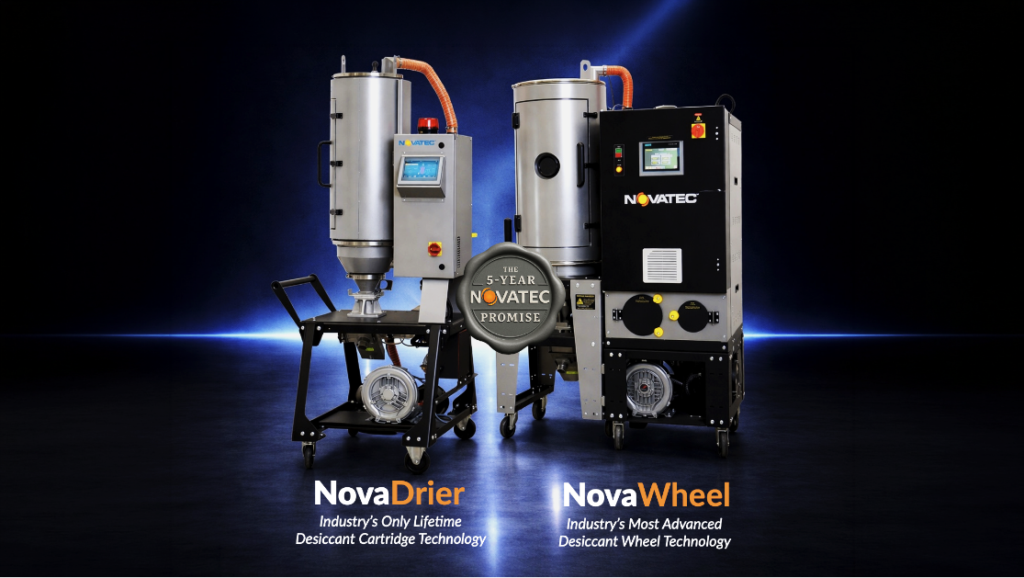
For processors running low-temperature engineering resins, our recommendation is that the physics require a desiccant-based continuous drying approach. Our drying line covers that requirement at every scale — from machine-side dryers to the largest central systems — including two technologies, the NovaDrier and the NovaWheel, built specifically to address the variables that cause desiccant dryers to underperform despite having the right underlying approach.
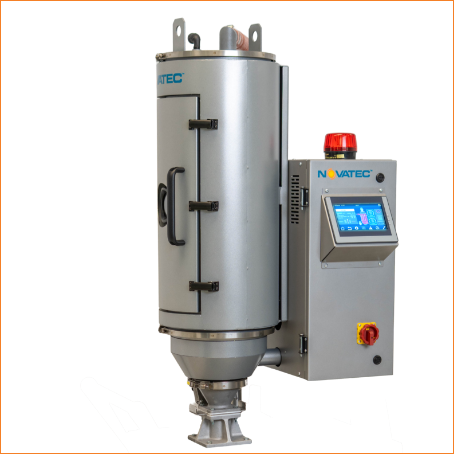
NovaDrier
Desiccating Cartridge Dryer — up to 100 lbs/hr
The industry’s only Lifetime Desiccating Cartridge — permanently potted hollow fibers that never degrade and never shed desiccant dust — combined with patented Dual Drying Zones that eliminate the cold upper hopper problem single-flow designs have never solved. Guaranteed -40°F or lower dew point for the life of the dryer. No loose desiccant. No moving parts. Near-zero maintenance.
NDB Series
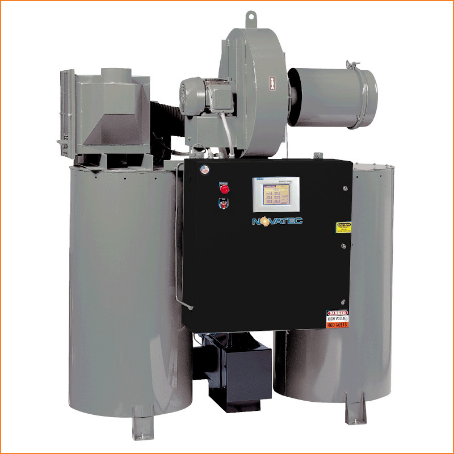
Dual Bed Desiccant Dryer — up to 10,000 lbs/hr
Proven twin-bed molecular sieve desiccant drying — one bed dries the process air while the other regenerates, delivering continuous low-dewpoint performance from machine-side drying up to the largest central drying systems.
NovaWheel
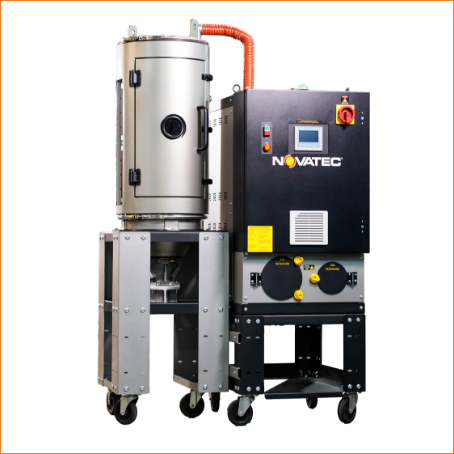
Desiccant Wheel Dryer — 25 to 4,000 lbs/hr
A molecular sieve zeolite desiccant honeycomb impregnated directly onto the wheel — no loose beads, no desiccant dust, up to 15-year wheel life — delivering continuous ultra-low dew points for central drying and high-volume production.
All three are built for the hardest case: if a dryer handles Nylon correctly, everything else is straightforward.
Not sure which is right for your operation? Give us a holler on the form below. No sales pitch, no pressure — just a conversation about what you run, at what volumes, and what problems you may be trying to solve.
About the Authors

Vice President of Moisture & Drying Technologies, Novatec
Mark Haynie has designed and installed resin drying systems for more than 40 years, working in thousands of plastics plants across the industry. As Novatec’s Vice President of Moisture & Drying Technologies, he leads the company’s drying technology group, including its work on moisture measurement and predictive drying. He also serves as a technical reviewer for Novatec’s Drying Knowledge Center and has authored numerous technical articles and whitepapers on resin drying and moisture.
Mark earned a Bachelor of Science in Chemical Engineering from Virginia Tech.
Through Novatec’s Ask the Expert program, Mark regularly helps processors troubleshoot drying performance and resin-moisture challenges.

Technology Manager, Novatec
Joshua Belisle is Technology Manager at Novatec, where his work focuses on simulation and technology development for resin drying. He earned a B.S. in Mechanical Engineering with a minor in Engineering Business from the University of Virginia in 2023 and joined Novatec that same year. Joshua uses simulation tools to investigate previously difficult-to-measure aspects of the drying process, helping Novatec better understand airflow, heat transfer and other variables that influence resin-drying performance.
Sources
Plastics Technology — resin drying basics and history of desiccant dryers
The Madison Group — moisture targets and −40°F dewpoint for hydrolysis-sensitive resins
NASA — Fickian moisture diffusion and Arrhenius temperature dependence in polymer molding compounds
Metrohm and Sigma-Aldrich — Karl Fischer oven-method development and slow release of internal moisture in polyamides.
Teknor Apex and Toray Amilan — nylon moisture behavior and drying guidance.
Vacuum-dryer process descriptions, energy claims, heating-hopper extension and optional dry-air purge drawn from current vacuum-dryer manufacturer product literature, accessed 2026.
Ask the Expert: Drying
"*" indicates required fields
Ask the Plastic Drying Expert

Author Profile:
Mark has designed and installed resin drying systems for more than 40 years, working in thousands of plastics plants across the industry. He leads Novatec’s drying technology group, including its work on moisture measurement and predictive drying, and serves as the technical reviewer for the drying articles in the Knowledge Center. He has authored numerous technical articles and whitepapers on resin drying and moisture, including How to Optimize Resin Drying in Humid Weather, and answers processors’ drying questions through the Knowledge Center’s Ask the Expert program.