

RESIN DRYING
What Is Fick's Law, and What Does It Have to Do With Drying Plastic?
By Mark Haynie and Joshua Belisle · Edited by Dana Gardner · Technically reviewed by Mark Haynie
Short answer. Fick’s Second Law (1855) describes how a substance spreads through a material over time: ∂C/∂t = D · ∇²C. In resin drying, C is the water concentration inside the pellet and D is the diffusion coefficient, the rate at which water can move through the polymer. D rises exponentially with temperature; a 30°F drop in drying temperature can cut it by 40 to 60 percent. It does not respond to pressure outside the pellet. That is why temperature is the lever in drying, why Nylon at 160 to 180°F needs hours rather than minutes, why a fixed timer cannot land resin that arrives at different moisture levels on the same endpoint, and why a sealed sample re-measured after at least 20 to 30 minutes tells you whether the core is actually dry.
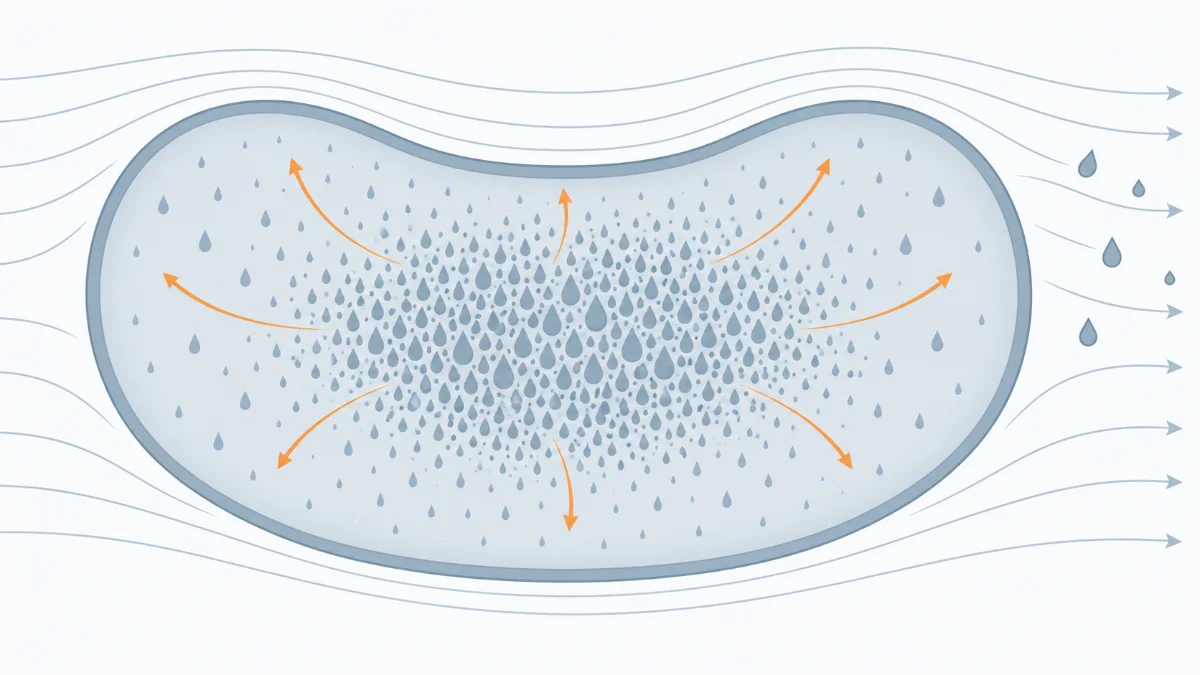
If you have read anything about resin drying recently, you have probably encountered the word “diffusion.” It gets invoked often in discussions about why certain drying methods work and others fall short for engineering resins. But diffusion is rarely explained. It is treated as a given that everyone understands, when most people in plastics processing have never had a reason to dig into what it actually means.
Understanding diffusion, and the law that governs it, changes how you think about resin drying. It clarifies why heat is the critical variable, why time cannot be compressed beyond a certain point, why pressure outside the pellet has limited effect on what happens inside it, and why controlled dry air at the pellet surface is not just a nice-to-have but a physical requirement for complete drying of hygroscopic engineering resins. This article is the equation behind How Moisture Leaves a Plastic Pellet, which covers the same mechanism with drying-time data.
What Diffusion Actually Is
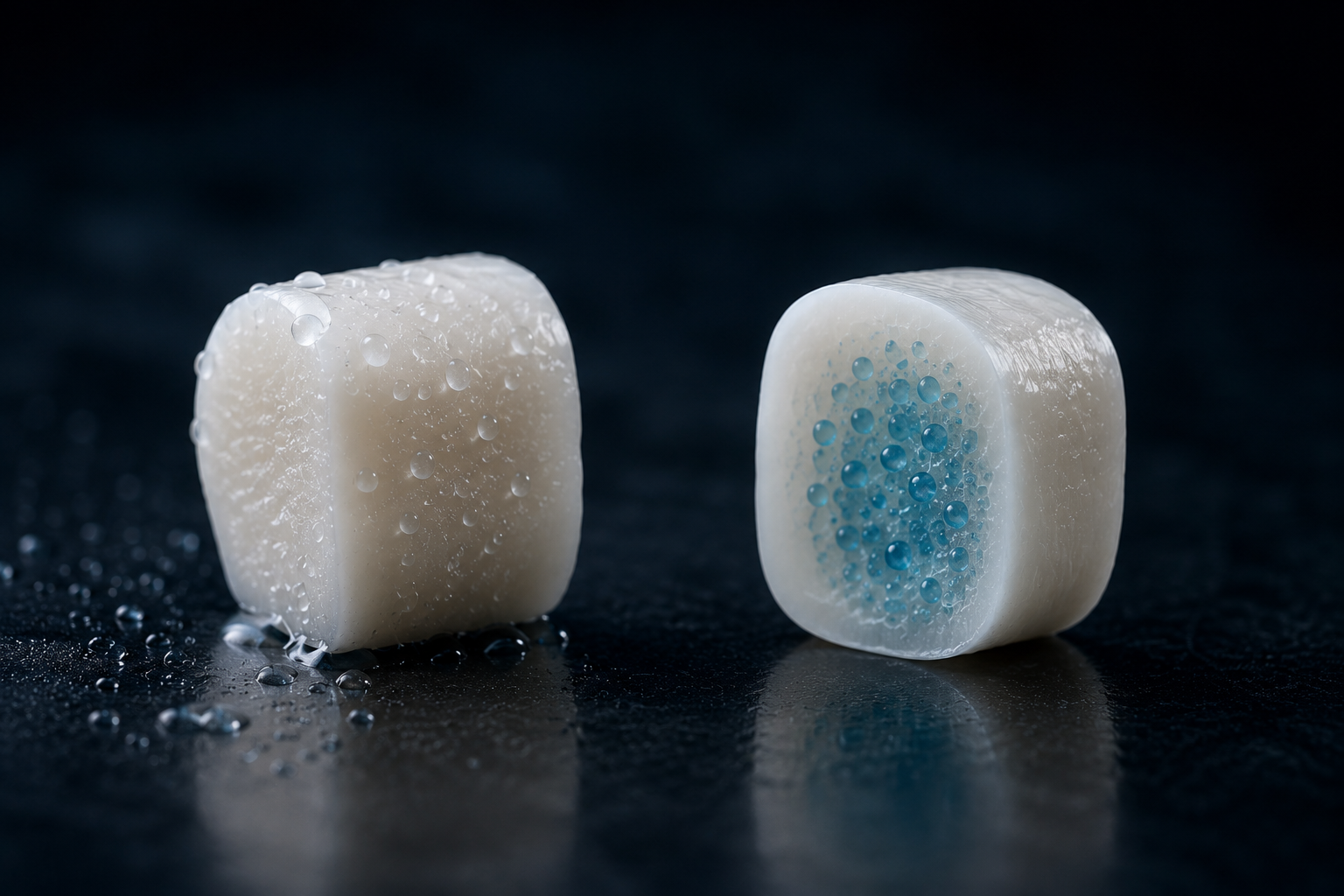
Diffusion is the process by which molecules move from an area of higher concentration toward an area of lower concentration. It happens spontaneously: no pump, no pressure, no mechanical force required. The driving force is simply the concentration difference itself, called a gradient. Where there is more of something in one place than another, molecules will tend to move toward equalization.
You see diffusion constantly. A drop of dye spreading through water. A scent moving through a room. Salt dissolving into a liquid. In each case, molecules are migrating from where they are concentrated toward where they are less concentrated, not because anything is pulling them, but because random molecular motion statistically moves them toward equilibrium over time.
In resin drying, the molecules in question are water molecules. In hygroscopic engineering resins such as Nylon, Polycarbonate, PET, PBT, TPU and PC/ABS, water does not just sit on the pellet surface. It bonds within the polymer matrix, distributed throughout the interior of the pellet. Getting that water out requires it to migrate from inside the pellet, where moisture concentration is high, toward the pellet surface, where the surrounding dry air maintains a low moisture concentration. Diffusion is how it gets there.
Fick's Second Law: The Equation That Governs the Process
In 1855, Adolf Fick quantified how diffusion works in a medium. His Second Law describes how the concentration of a diffusing substance changes over time within that medium:
∂C/∂t = D · ∇²C
In plain language: the rate at which moisture concentration changes at any point inside the pellet depends on the diffusion coefficient D and the spatial distribution of moisture concentration throughout the pellet.
The formula looks abstract, but its implications for resin drying are concrete.
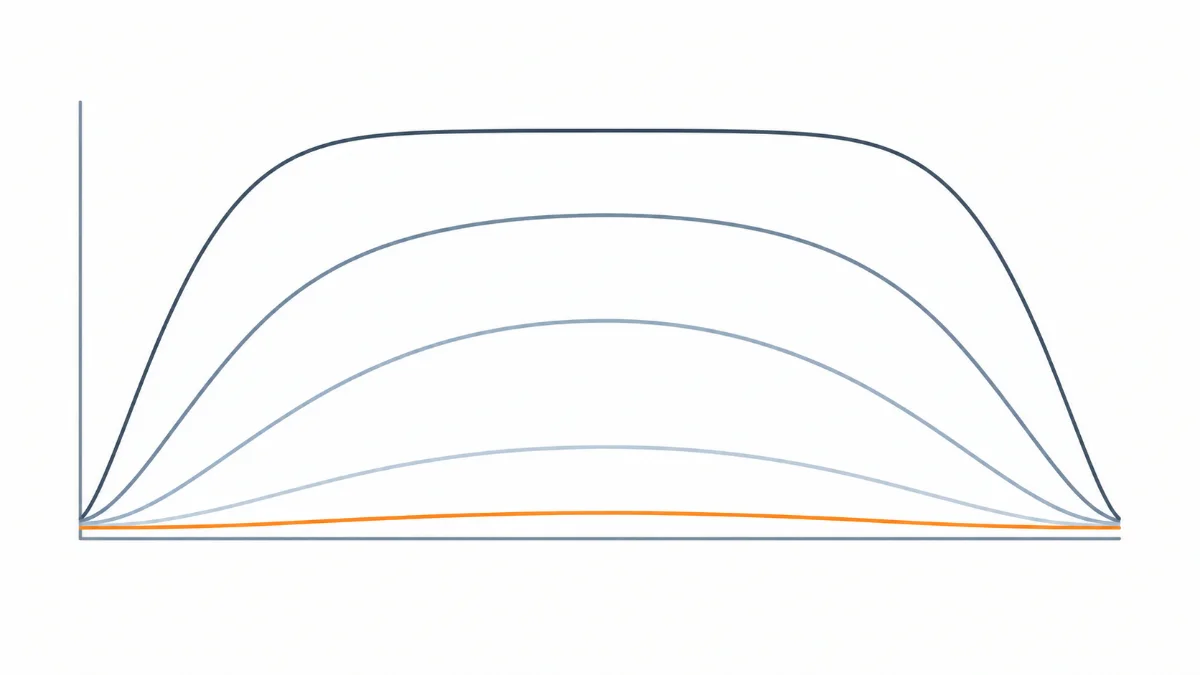
First: moisture removal from the pellet interior is a time-dependent process. The concentration at any given point inside the pellet can only change as fast as diffusion allows, and diffusion through a solid polymer matrix is not instantaneous. The center of the pellet cannot be dried in the same moment the surface is dried. The moisture at the core must migrate outward through the polymer, step by step, molecule by molecule, until it reaches the surface where it can be carried away.
Second: the rate of that process is determined by D, the diffusion coefficient. And D is not a fixed number. It changes dramatically based on conditions. Which brings us to the most important variable in the entire equation.
The Arrhenius Relationship: Why Temperature Is the Lever
The diffusion coefficient D follows what is called an Arrhenius relationship with temperature:
D = D₀ · e(−Ea / RT)
Where Ea is the activation energy for diffusion, R is the gas constant, and T is the absolute temperature. The critical word in that equation is the exponential. This is not a linear relationship. A modest change in temperature produces a dramatic change in the diffusion rate.
What this means practically: reducing drying temperature by 30°F does not save 10 percent of drying effort. It can reduce the diffusion coefficient by 40 to 60 percent, depending on the resin. The moisture inside the pellet moves far more slowly at lower temperatures. The time required to reach equilibrium moisture extends dramatically, or, if the cycle is fixed, the pellet simply does not finish drying within the available time.
This is why temperature is the primary lever in resin drying. Not pressure. Not airflow alone. Not cycle time management. Temperature governs how fast moisture can physically migrate through the polymer matrix. Everything else is secondary to that fundamental relationship.
This is also why Nylon presents such a demanding drying challenge. Its recommended drying temperature of 160 to 180°F is deliberately low; higher temperatures cause yellowing and thermal degradation in the hopper. But that relatively low temperature means the diffusion coefficient is operating at the less efficient end of its range. Internal moisture migrates slowly. Nylon is one of the hardest resins to dry completely not because of anything unique about its chemistry but because its safe drying temperature keeps diffusion inherently slow, which is why it needs hours of sustained drying under proper conditions, not minutes. Nylon also arrives carrying far more water than most engineering resins do, so there is simply more of it to move at that slow rate.
Why the Outside of the Pellet Doesn't Tell You About the Inside
Fick’s Law makes clear why surface moisture readings can be misleading after incomplete drying. Diffusion from the core of the pellet to the surface takes time. When a drying process aggressively removes surface moisture, whether through hot air, vacuum, or any other mechanism, it can create a steep moisture gradient inside the pellet: very dry at the surface, still significantly wet at the core.
If you measure moisture at that moment, you measure the surface. The core moisture has not reached the surface yet. The reading looks encouraging. The pellet is not dry.
After the drying process ends, diffusion does not stop. The internal gradient is still present: lower moisture at the surface, higher moisture inside. Fick’s Law says that gradient will continue driving moisture outward. Which means the moisture reading taken at discharge is not the final state of the pellet. It is a point-in-time reading on a pellet that is still internally redistributing moisture. Take that same reading 20 to 30 minutes later and it will often be higher, a phenomenon called moisture rebound, and direct physical evidence of incomplete drying.
This is the basis of the moisture rebound test. A pellet at true moisture equilibrium, fully dried throughout its cross-section, will show a stable moisture reading after a sealed wait. There is no internal gradient left to equalize. A pellet that was surface-dried but core-wet will show a rising reading as internal moisture continues its outward migration. Fick’s Law predicts this behavior exactly.
Why Pressure Outside the Pellet Has Limited Effect on D
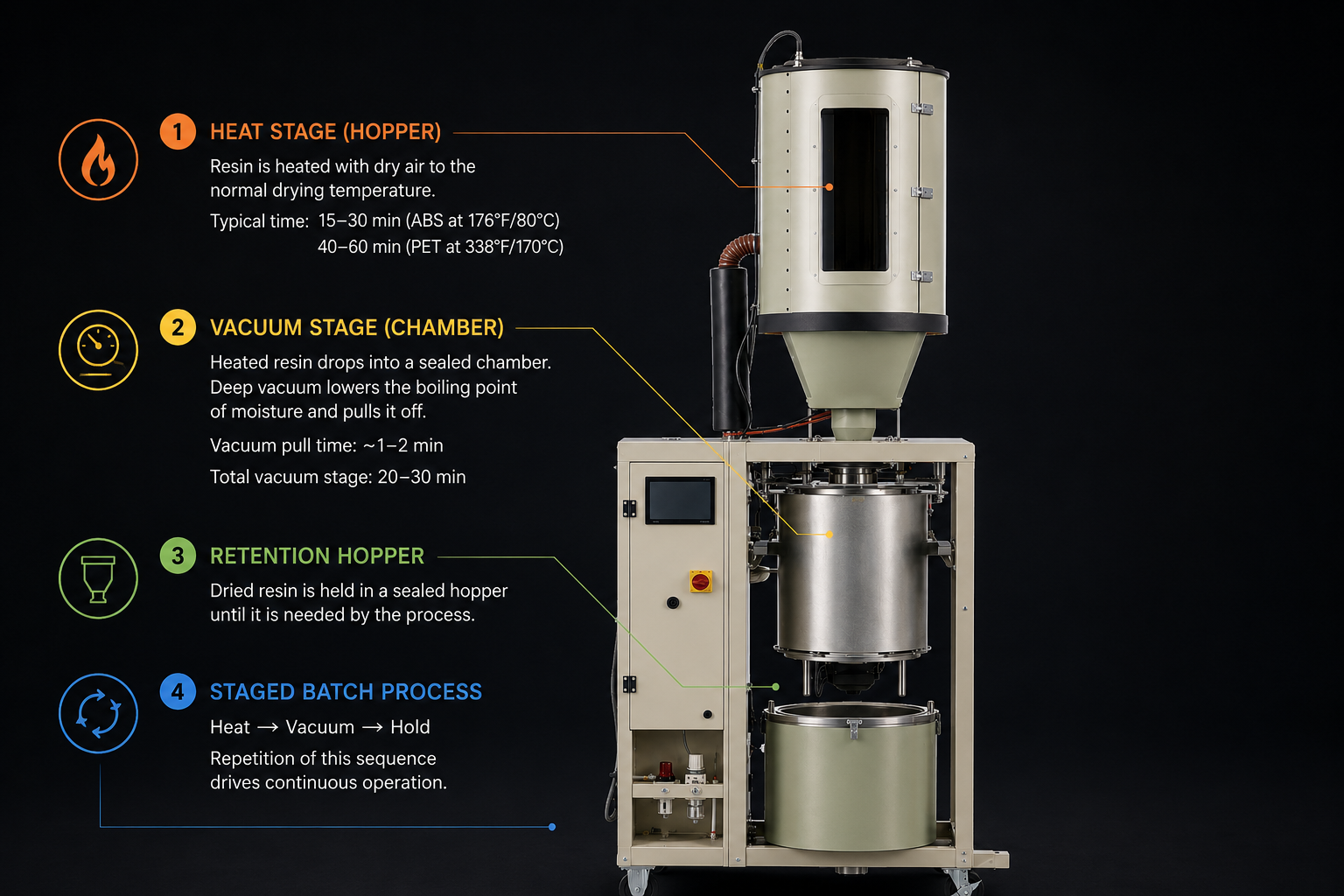
One of the implications of Fick’s Law that matters most in current drying discussions is this: the diffusion coefficient D is a function of temperature, material properties, and pellet geometry. It is not meaningfully a function of external pressure.
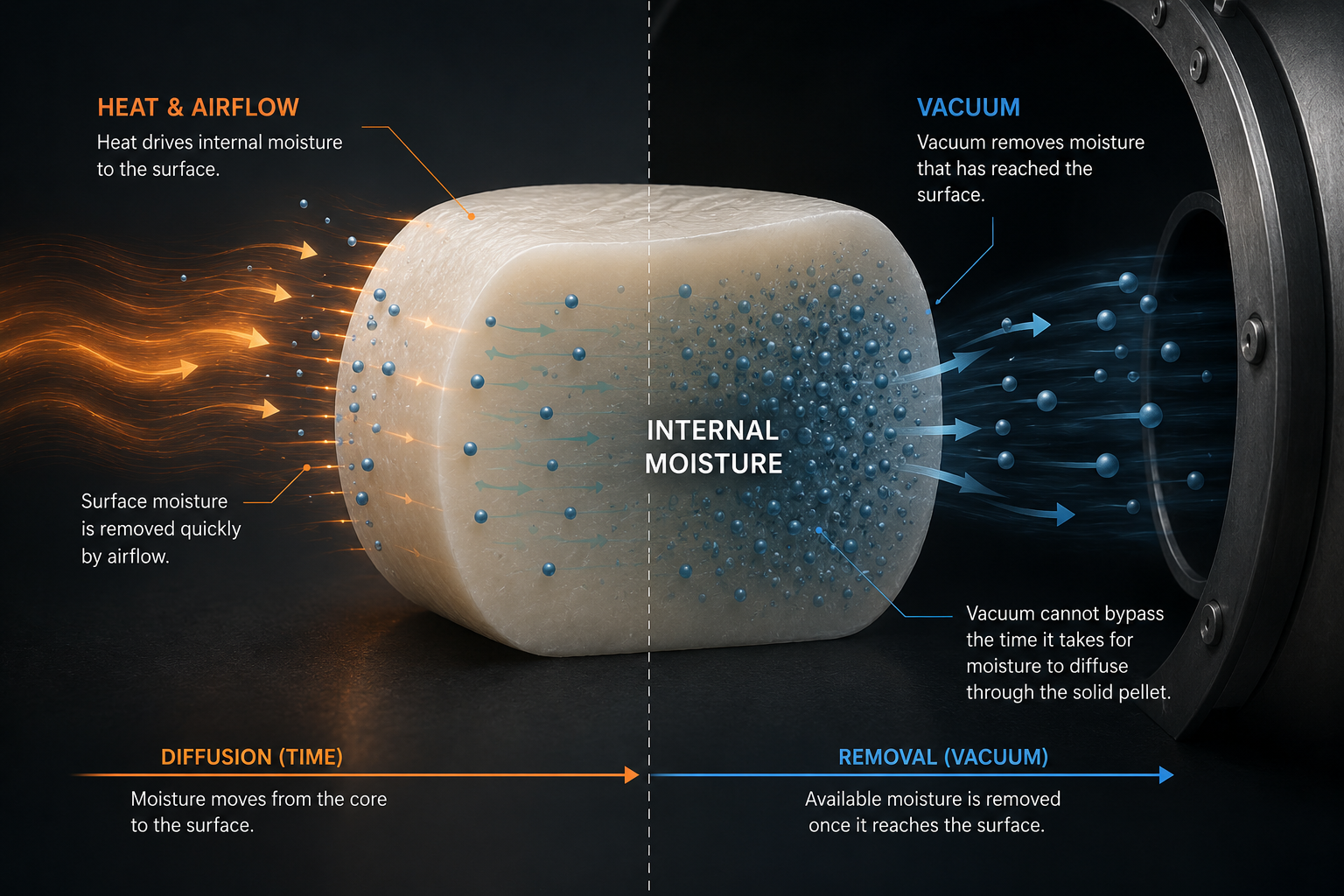
Reducing the atmospheric pressure around a pellet does not change what is happening inside the solid polymer matrix. The pellet does not know or respond to the pressure outside it. Internal moisture still has to migrate from the core to the surface through the polymer, at a rate still governed by temperature and the Arrhenius relationship. It helps to be precise about what vacuum does. Water dissolved in a hygroscopic polymer has no liquid phase, so it does not boil. Vacuum works by pushing the water-vapor pressure at the pellet surface close to zero, which is the same job −40°F dewpoint air does. That makes moisture already at the surface leave quickly. It cannot reach inside the solid and accelerate the diffusion that is still occurring through the polymer matrix.
This is the fundamental reason why the short, unheated vacuum finishing step in a hybrid hot-air/vacuum dryer has limited effect on lower-temperature hygroscopic engineering resins. The hard part of drying those resins was never surface moisture removal. It was the slow internal diffusion that low drying temperatures create. And because the vacuum step adds no heat, the pellets cool during it, which lowers D in the very stage meant to finish the drying. Lowering the pressure outside the pellet answers a question those resins were not asking.
For a full technical comparison of vacuum-assist and desiccant drying across engineering resin types, see The Science of Vacuum and Desiccant Drying for Engineering Plastics.
Why Desiccated Air Fits Into the Fick's Law Framework
Fick’s Law says diffusion is driven by a concentration gradient: moisture moving from high concentration inside the pellet toward lower concentration outside. For that gradient to remain active throughout the entire drying cycle, the environment outside the pellet has to stay dry.
This is where desiccated air earns its place. Controlled dry air at a consistent low dewpoint, typically −40°F or lower, maintains the lowest possible moisture concentration at the pellet surface throughout the entire residence time. That sustained low-moisture environment keeps the vapor pressure gradient open and active, continuously pulling moisture outward as fast as diffusion can deliver it to the surface.
If the surrounding air is humid, ambient air on a summer day for example, the moisture concentration outside the pellet rises. The gradient weakens. Diffusion slows, not because the temperature changed, but because the driving force at the boundary weakened. Fick’s Law predicts this directly: the rate of moisture movement depends on the concentration difference, and if the outside concentration rises, the rate falls.
Desiccation is the mechanism that prevents that from happening. It maintains the outside condition at a known, controlled, consistently low level regardless of what the ambient air is doing, giving Fick’s Law the boundary conditions it needs to complete the job.
A Note on Alternative Energy Delivery
Fick’s Law governs diffusion driven by conventional heating of the pellet mass, which is how hot air drying and desiccant drying both work. It is worth acknowledging that other energy delivery mechanisms exist. Infrared and microwave technologies, for example, can deposit energy directly into the interior of the pellet rather than waiting for heat to conduct inward from the surface. Under those conditions, the interior of the pellet can reach drying temperature very quickly, potentially in minutes rather than hours, because the energy delivery mechanism itself bypasses the thermal conduction lag that makes conventional drying slow at the core.
These technologies are real and in some specialized industrial applications they work. The practical constraints, equipment scale, capital cost, material handling complexity, and the requirement that pellets move continuously through an energy field without hotspots or melting, mean they are not yet widely available at a practical production-scale cost for most processors. But they are a legitimate avenue for reducing drying time without shortcutting the diffusion physics, because they change D by changing the temperature of the pellet interior directly, rather than trying to work around D by reducing external pressure.
What does not work is a mechanism that tries to accelerate internal moisture removal without changing pellet temperature. Fick’s Law does not offer that shortcut. Temperature is the lever. Time is the requirement. The gradient is what sustains the process. Every practically available drying method for solid pellets works within those constraints or pays the penalty downstream.
How we know this: Fick’s Second Law and the Arrhenius dependence of the diffusion coefficient are established physics, confirmed for polymer molding compounds in NASA’s electronic-parts moisture studies; the drying-temperature and rebound figures are Novatec drying engineering field practice, checked in the Resin Proving Ground.
What This Means for Your Drying Process
Fick’s Law provides a simple, physics-based checklist for evaluating whether your drying process is actually completing the job.
Is the temperature correct? Not just the inlet air temperature, but the actual temperature the pellet reaches and sustains throughout its residence time. At the correct temperature, the diffusion coefficient is large enough for moisture to migrate outward within the available time. Below the correct temperature, the coefficient drops exponentially and the physics work against you.
Is residence time adequate? Given the diffusion coefficient at your drying temperature, the pellet geometry, and the starting moisture level, there is a minimum time required for internal moisture to reach the surface. That time cannot be arbitrarily compressed without consequence. For Nylon at typical drying temperatures, that time is measured in hours, not minutes.
Is the moisture gradient sustained? The dry air surrounding the pellet must stay at a low dewpoint throughout the entire residence time: not just at startup, not just at peak performance, but continuously. Any drift in dewpoint weakens the driving force and slows or stalls diffusion at exactly the moment it needs to be completing.
Do you know the starting moisture? Fick’s Law removes a fraction of the moisture in a given time, not a fixed number of ppm. Resin that arrives at 8,000 ppm and resin that arrives at 1,500 ppm cannot reach the same endpoint in the same cycle at the same temperature. A fixed timer is drying blind. Measuring incoming moisture is what turns a recipe into a process.
Is the resin actually dry, or just surface-dry? The rebound test answers this directly: verify after the moisture settles. A stable reading after a sealed hold of at least 20 to 30 minutes confirms the pellet is at moisture equilibrium. A rising reading confirms diffusion is still running outward from a wet core, which means the drying process did not finish the job.
How Novatec Approaches It

At Novatec, we believe a dryer’s job is to give Fick’s Law what it asks for: the right temperature at every pellet, enough time, and a dry boundary that never drifts. So we built two drying systems around those three requirements.
For machine-side and portable drying up to 100 lb/hr, the NovaDrier Desiccating Cartridge Dryer holds the boundary with a Desiccating Cartridge that is guaranteed for the life of the dryer and delivers −40°F or lower dew points, and holds the temperature with patented Dual Drying Zones that keep the upper bed at drying temperature as well as the lower one, so pellets at the top of the hopper get the same heat and dry air as pellets at the bottom. For central drying systems up to 5,000 lb/hr, the NovaWheel desiccant wheel dryer delivers continuous low dew points from a molecular sieve desiccant bonded to the wheel: no loose beads, no desiccant dust, and up to 15 years of wheel life.
When the physics are right, the resin is right. When the resin is right, the parts are right. Adolf Fick worked out the math in 1855. The dryer just has to execute it.
Want to talk through drying times for the resins you run? Give us a holler on the form below.
No sales pitch. No pressure. Just a conversation about what’s best for your operation.
Frequently Asked Questions
What is Fick's Law in simple terms?
Fick’s Law says that a substance spreads from where there is more of it to where there is less, and that the speed of that spreading depends on a property called the diffusion coefficient. In resin drying, the substance is water inside the pellet, and the diffusion coefficient is how fast water can move through the solid polymer. Fick’s Second Law adds the time dimension: it describes how the water concentration at each point inside the pellet changes as drying proceeds.
Why does temperature matter more than anything else in resin drying?
Because the diffusion coefficient rises exponentially with temperature, following the Arrhenius relationship. Lowering the drying temperature by 30°F can cut the diffusion coefficient by 40 to 60 percent, so moisture inside the pellet moves far more slowly and drying takes far longer. Airflow and dry air carry moisture away once it reaches the surface, but only temperature changes how fast it gets there.
Does vacuum speed up diffusion inside a pellet?
No. The diffusion coefficient depends on temperature, the material, and pellet geometry, not on the pressure outside the pellet. Water dissolved in the polymer has no liquid phase and does not boil; vacuum lowers the vapor pressure at the pellet surface, the same job dry air does, so moisture that has already reached the surface leaves quickly. It does not change how fast moisture moves through the solid polymer from the core, which is the slow step for resins such as Nylon that are dried at 160 to 180°F. In a hybrid hot-air/vacuum dryer, the hot-air stage does the diffusion work and the short, unheated vacuum step finishes the surface.
Why does nylon take so long to dry?
Nylon’s safe drying temperature, 160 to 180°F, is deliberately low to avoid yellowing and degradation, and at that temperature the diffusion coefficient is at the slow end of its range. Nylon also takes up more water than most engineering resins, so there is more moisture to move. The result is hours of drying under proper conditions rather than minutes.
How can I tell whether my resin is dry inside, not just on the surface?
Run a moisture rebound test. Measure a sample at the dryer discharge, seal a second sample for at least 20 to 30 minutes, then measure that one. If the second reading settles close to the first and both meet the supplier’s specification, the core is dry. If the second reading climbs, moisture was still diffusing out of a wet core when the first reading was taken.
About the Authors

Vice President of Moisture & Drying Technologies, Novatec
Mark Haynie has designed and installed resin drying systems for more than 40 years, working in thousands of plastics plants across the industry. As Novatec’s Vice President of Moisture & Drying Technologies, he leads the company’s drying technology group, including its work on moisture measurement and predictive drying. He also serves as a technical reviewer for Novatec’s Drying Knowledge Center and has authored numerous technical articles and whitepapers on resin drying and moisture.
Mark earned a Bachelor of Science in Chemical Engineering from Virginia Tech.
Through Novatec’s Ask the Expert program, Mark regularly helps processors troubleshoot drying performance and resin-moisture challenges.

Technology Manager, Novatec
Joshua Belisle is Technology Manager at Novatec, where his work focuses on simulation and technology development for resin drying. He earned a B.S. in Mechanical Engineering with a minor in Engineering Business from the University of Virginia in 2023 and joined Novatec that same year. Joshua uses simulation tools to investigate previously difficult-to-measure aspects of the drying process, helping Novatec better understand airflow, heat transfer and other variables that influence resin-drying performance.
Sources
- Adolf Fick, Ueber Diffusion, Annalen der Physik, 1855: the original statement of the diffusion laws.
- Alexander Teverovsky, Moisture Characteristics of Molding Compounds in PEMs, NASA Electronic Parts and Packaging Program: Fickian diffusion and the Arrhenius temperature dependence of the diffusion coefficient in polymer molding compounds.
- Novatec, The Science of Vacuum and Desiccant Drying for Engineering Plastics, August 2026: diffusion-limited drying, the boiling-point argument, and the rebound-stable standard.
- Novatec, How Moisture Leaves a Plastic Pellet: Diffusion, Temperature, and Drying Time, 2026: measured drying-time data showing the Arrhenius dependence in practice.
- Dan Mesyn, Teknor Apex, 6 FAQs: Drying Nylon Resin for Injection Molding, June 30, 2021: nylon drying temperature and the 0.02% to 0.20% processing window.
Related Articles
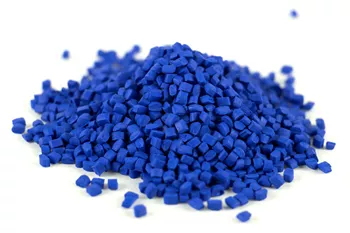
Understand surface and absorbed moisture, starting moisture levels, and their effect on resin processing.
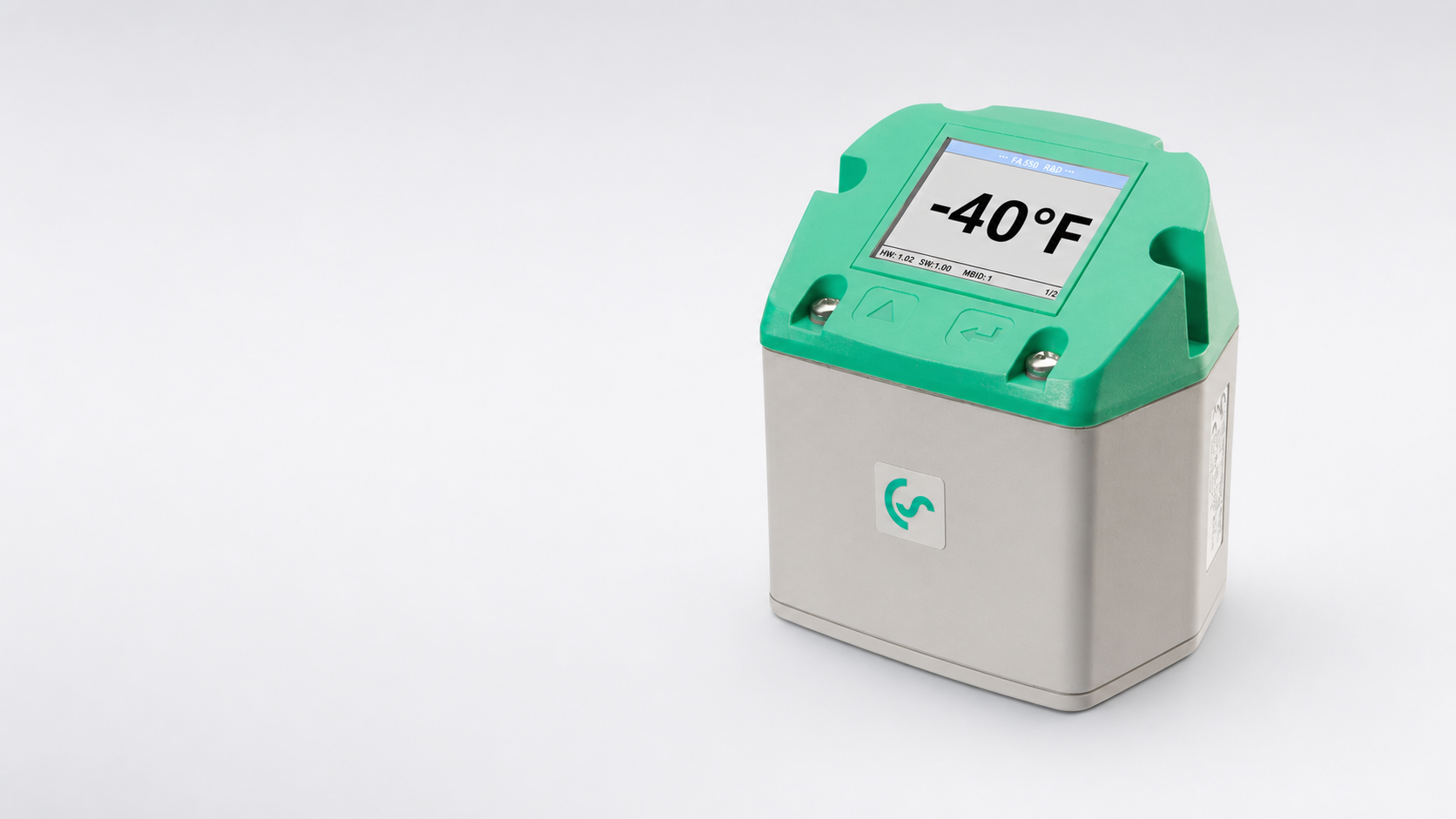
See why dryer dewpoint must be paired with direct resin moisture measurement.
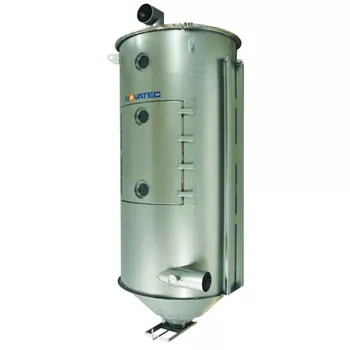
Explore hopper design, airflow, and residence time for consistent resin drying.
Ask the Plastic Drying Expert

Author Profile:
Mark Haynie has designed and installed resin drying systems for more than 40 years, working in thousands of plastics plants across the industry. As Novatec’s Vice President of Moisture & Drying Technologies, he leads the company’s drying technology group, including its work on moisture measurement and predictive drying. He also serves as a technical reviewer for Novatec’s Drying Knowledge Center and has authored numerous technical articles and whitepapers on resin drying and moisture.
Mark earned a Bachelor of Science in Chemical Engineering from Virginia Tech.
Through Novatec’s Ask the Expert program, Mark regularly helps processors troubleshoot drying performance and resin-moisture challenges.