

RESIN DRYER TECHNOLOGIES
What Is Desiccant Regeneration, and Does It Make Desiccant Dryers Energy Hogs?
By Mark Haynie and Joshua Belisle · Edited by Dana Gardner · Technically reviewed by Mark Haynie
Short answer. Regeneration is the periodic heating of a desiccant bed or wheel to drive out the water it has adsorbed from the process air, so it can adsorb again. It uses real energy, and it belongs in any cost comparison. It is also a smaller share of the picture than it is usually presented as. Heating accounts for roughly 50 to 85 percent of a drying system’s energy, regeneration is one slice of that heating budget, and the adsorption process itself gives back 7 to 15°F of process air temperature that the heater never has to supply. The fair comparison is the total energy per pound to take pellets from ambient to melt, compressor energy included, not the dryer’s meter alone.
If you have been evaluating resin drying equipment recently, you have probably heard some version of this claim: desiccant dryers are energy-intensive because they have to regenerate their desiccant medium, and that regeneration cycle consumes energy that newer technologies avoid entirely. The implication is that choosing desiccant drying is choosing a higher operating cost, and that processors who have invested in desiccant equipment are paying an ongoing energy penalty for it.
That claim deserves a careful look. The regeneration energy conversation is real, but it is frequently presented in a way that leaves out the most important parts of the picture. Understanding what regeneration actually is, why it is necessary, and how to evaluate its true cost in context leads to a different conclusion than the one-number comparison most marketing material offers. This article supports The Science of Vacuum and Desiccant Drying for Engineering Plastics, which covers the energy question across drying technologies.
What Desiccant Regeneration Actually Is
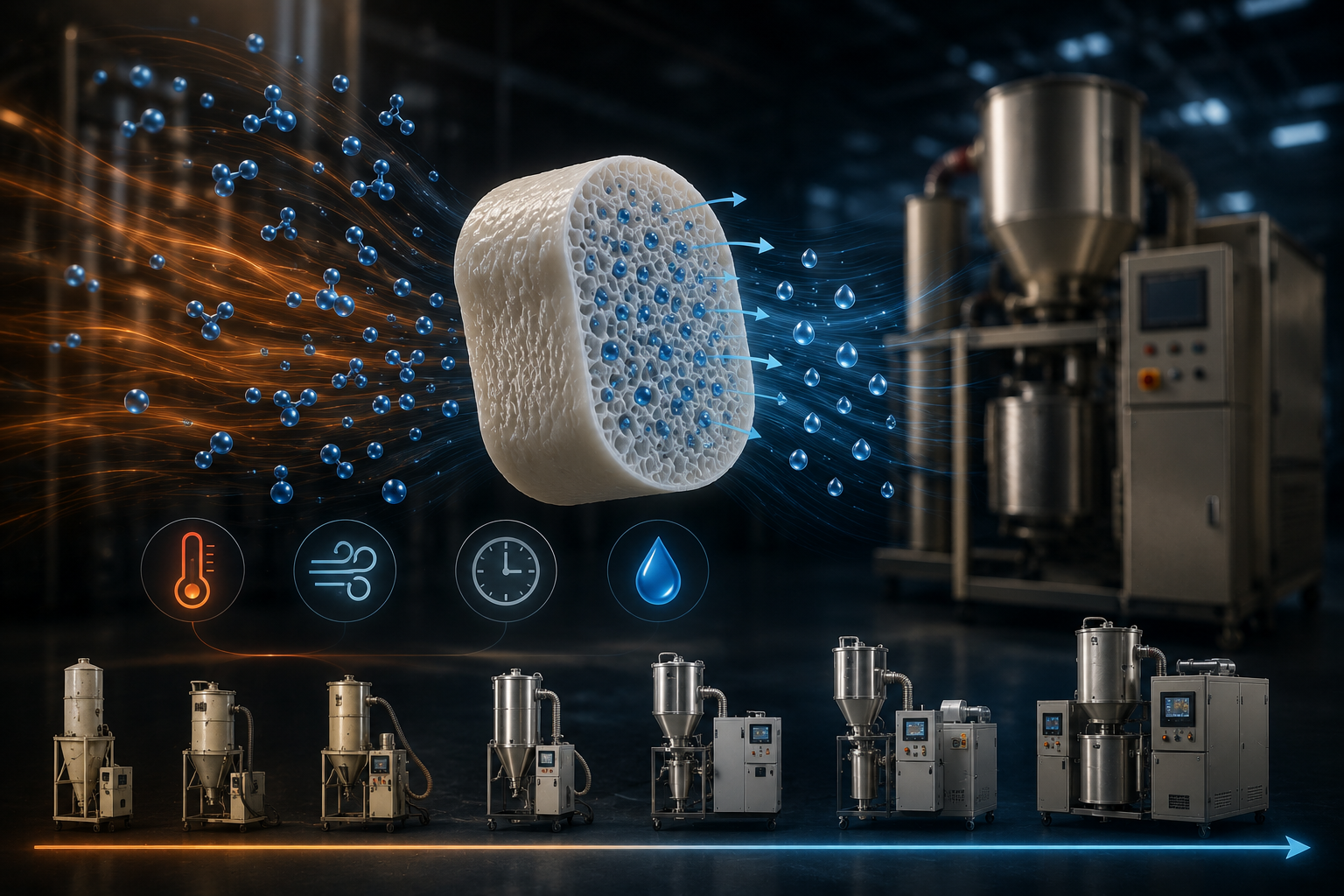
A desiccant dryer works by passing process air through a desiccant medium, a molecular sieve bed or a desiccant wheel, that adsorbs moisture from the air and brings it down to a very low dewpoint before delivering it to the hopper. At −40°F dewpoint or lower, that air creates the vapor pressure gradient that drives internal moisture out of hygroscopic engineering resin pellets.
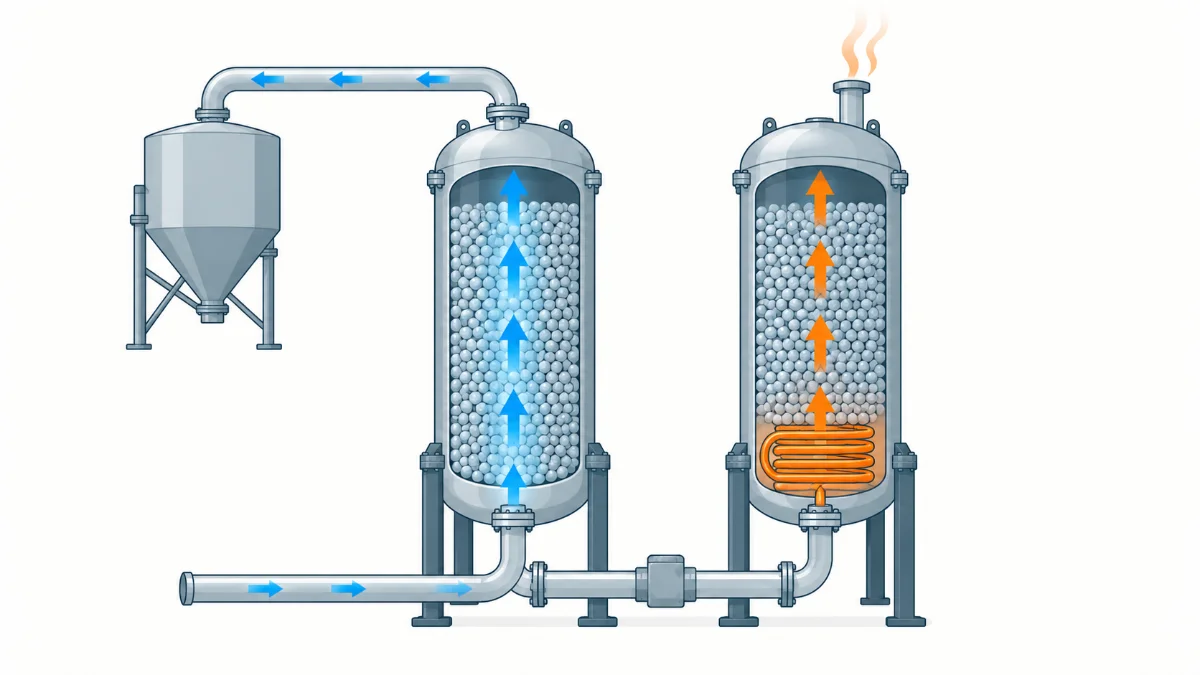
The desiccant medium can only hold a finite amount of moisture. As it adsorbs water from the process air, it gradually becomes saturated. A saturated desiccant no longer lowers the dewpoint of the air passing through it, which means it no longer creates the drying gradient the process depends on. Before that happens, the desiccant must be regenerated: superheated to drive out the adsorbed moisture and restore the medium’s capacity to adsorb again.
In a twin-tower desiccant dryer, one tower is always drying process air while the other is being regenerated, alternating so the process air supply never interrupts. In a desiccant wheel dryer, the wheel rotates continuously through dedicated drying, regeneration, and cooling zones, maintaining constant dewpoint without the switching that tower designs require. The mechanism differs but the principle is the same: the desiccant adsorbs moisture, gets regenerated, and returns to adsorb again.
This is the cycle that consumes the regeneration energy the marketing claims are talking about. And yes, it is real energy. Heating the desiccant medium to the temperatures required for thorough regeneration, typically several hundred degrees, requires electricity. That cost exists and it belongs in any honest operating cost comparison.
What the one-number comparison almost always leaves out is what that regeneration energy is actually buying.
The Part Nobody Mentions: Heat of Adsorption
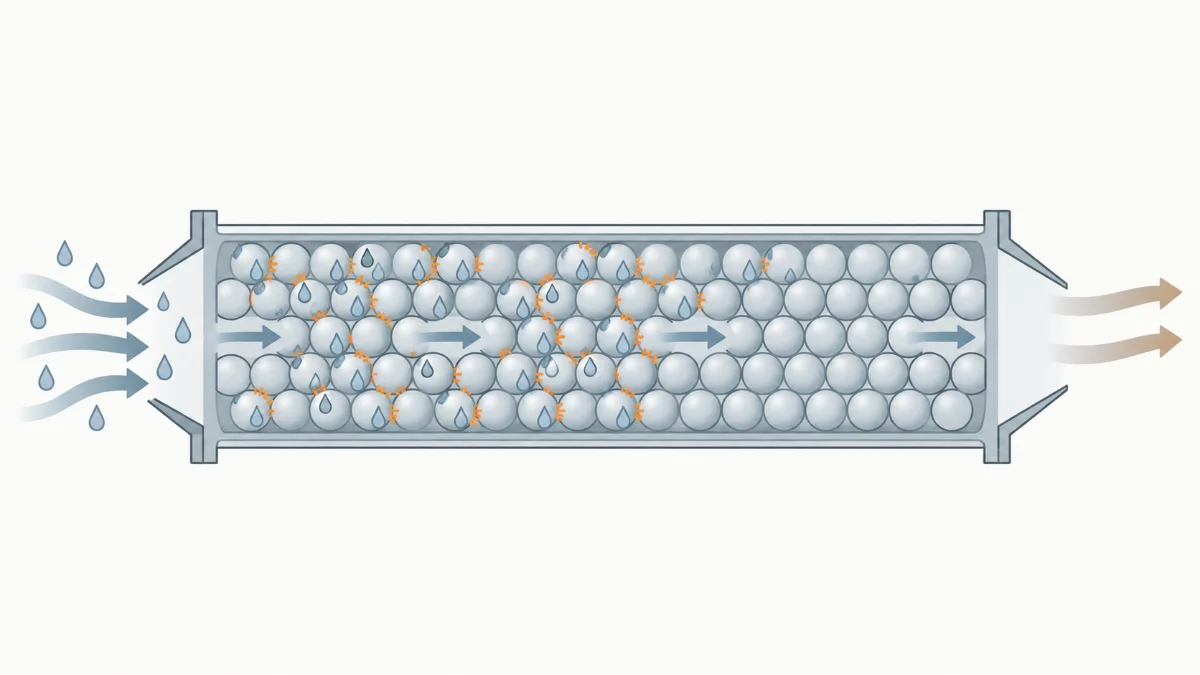
When moisture adsorbs onto a molecular sieve desiccant surface, it does not just disappear into the medium. The adsorption process releases heat, called heat of adsorption, at the desiccant surface. For water on molecular sieve, that heat is about 1,800 BTU per pound of water adsorbed, more than the heat it takes to boil the same water. That heat transfers to the process air passing through the desiccant bed.
The result is that process air leaving the desiccant medium is warmer than the air entering it. If ambient air enters the desiccant at 100°F and the drying process needs to deliver 180°F air to the hopper for Nylon drying, the desiccant stage contributes heat toward that target at no additional electrical cost. The energy came from the adsorption process itself: heat generated by the physics of moisture capture.
Nobody includes this in the regeneration energy comparison. The regeneration energy cost is quoted prominently. The adsorption heat credit is never mentioned. A complete accounting would subtract the heat contribution from the stated regeneration cost, because the dryer heater has to do less work to reach target temperature when the desiccant stage is already warming the process air.
This is not a marginal effect. Depending on the operating conditions, incoming moisture load, and desiccant medium, the heat of adsorption contributes meaningfully to the process air temperature. In polymer drying, that contribution typically runs 7 to 15°F, heat the dryer’s heater does not have to supply during active drying. The energy balance is more favorable than the regeneration number alone suggests.
Where Drying System Energy Actually Goes
The regeneration cycle is the visible, easy-to-quote energy number in a desiccant dryer. But regeneration is not where most of the energy in a drying system lives. A useful breakdown:
Approximately 50 to 85 percent of energy consumption in a drying system is in heating: heating the process air, heating the resin to drying temperature, and maintaining that temperature throughout the residence time. This is the work of drying itself, and it applies to every drying technology that uses heat. A hot air dryer, a desiccant dryer, and a hybrid hot-air/vacuum dryer all have to do this work. The energy to heat resin from ambient to drying temperature is essentially identical across methods. It is physics, not equipment choice.
The remaining energy is in air movement: blowers, motors, and the mechanical work of moving process air through the system. This is where equipment design makes a real difference, and where modern desiccant dryer designs have improved substantially.
The regeneration energy is a portion of that 50 to 85 percent heating budget, specifically the energy to superheat the desiccant medium rather than the resin. It is real. It is also a much smaller fraction of total system energy than the marketing conversation implies. Comparisons that present regeneration energy as the dominant cost of running a desiccant dryer are not presenting a complete picture.
Energy item
In the one-number comparison?
In a complete accounting?
Heating process air and resin to drying temperature
Yes
Yes. Roughly 50 to 85 percent of system energy, and essentially the same for every heated drying method.
Blowers and motors
Yes
Yes
Desiccant regeneration
Yes, usually as the headline
Yes, as one slice of the heating budget
Heat of adsorption returned to the process air
No
Yes, as a credit: typically 7 to 15°F the heater does not supply
Compressed air for a venturi vacuum, where one is used
No
Yes. The compressor’s energy is real; it is on the plant’s meter, not the dryer’s.
Reheating cool resin at the machine
No
Yes. Energy not spent at the dryer appears at the press.
Scrap, rework and instability from incomplete drying
No
Yes
What "Energy Saver" Modes Actually Do
Many desiccant dryers offer energy-saver modes: settings that reduce energy consumption during low-demand periods by dialing back heaters, airflow, or regeneration frequency. For certain applications and operating conditions, these modes deliver real savings without sacrificing drying performance.
The important question is what the mode is actually reducing. If energy savings come from smarter regeneration timing, regenerating only when the desiccant medium actually needs it rather than on a fixed schedule, that is a real efficiency gain with no drying penalty. The dryer is doing the same drying work with less regeneration waste.
If energy savings come from reducing process air temperature, cutting airflow, or shortening the drying cycle, the calculus changes. Lower temperature reduces the diffusion rate inside the pellet, the same exponential relationship that makes Nylon so demanding to dry. Reduced airflow weakens the moisture removal at the pellet surface. A shortened cycle may not give internal moisture enough time to complete its migration outward. In those cases the energy saver is not saving energy from drying. It is saving energy by doing less drying. The resin leaving the dryer reflects that tradeoff, whether or not any instrument at the dryer catches it.
The test is always the same: does the resin meet the supplier’s moisture specification under those settings, verified by a rebound-stable Karl Fischer measurement at full production throughput in the most demanding seasonal conditions the line will actually run? The moisture rebound test is how to check.
The Whole-Process Energy Comparison
The energy comparison between desiccant drying and alternative approaches only makes sense when it accounts for the entire process, not just the dryer cabinet.
A hybrid hot-air/vacuum dryer, hot-air heating and pre-drying followed by a short, unheated vacuum finishing step, may show lower energy consumption at the dryer. Some of that difference is real. Eliminating regeneration does reduce dryer cabinet consumption, and for non-hygroscopic commodity resins where deep drying is not required, that saving is legitimate. Some of it is relocated rather than saved: where the vacuum is drawn by a venturi, the compressed air behind it is compressor energy that never appears on the dryer’s meter.
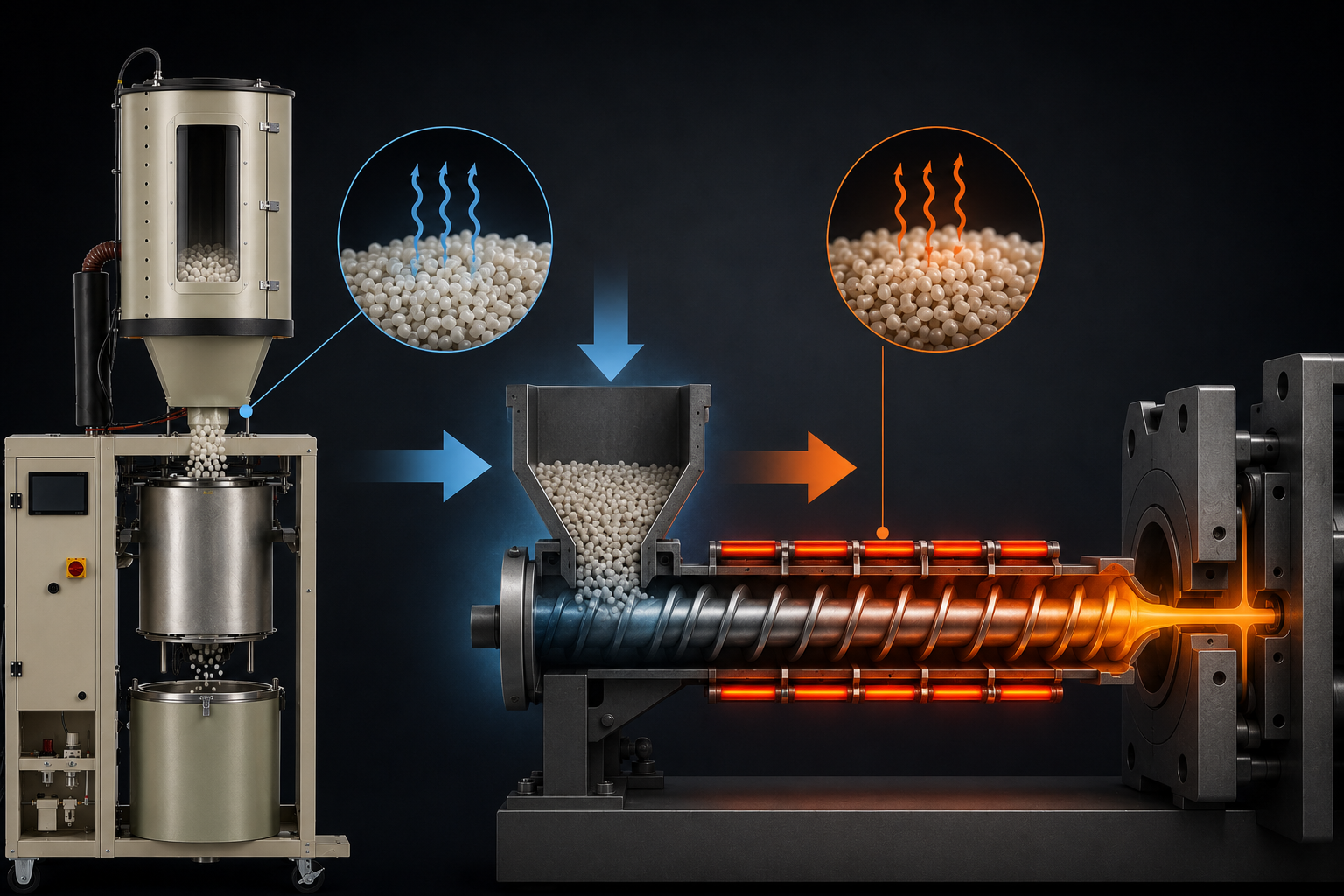
For hygroscopic engineering resins, however, two additional factors belong in the comparison. First: the vacuum step adds no heat, so the pellets cool during it. Resin that enters the vacuum chamber at drying temperature leaves it cooler, mainly because it is losing heat to an unheated chamber with nothing heating the pellets. Heat that was already paid for is thrown away, and the cooler resin arrives at the injection molding machine below the optimal processing temperature, so the barrel heater bands and screw shear have to make up the difference. Energy not spent at the dryer appears as energy consumed at the press.
Second: incomplete drying produces scrap, instability, and rework. Splay, brittleness, inconsistent shot weights, and dimensional variation all have energy costs: the energy of the shots that failed, the downtime to diagnose and adjust, the regrind that has to be reprocessed. A complete energy comparison counts those costs. They are real and they belong in the accounting even though they do not appear on the dryer’s energy meter.
For a detailed breakdown of how the energy argument applies to specific drying technologies and resins, see The Science of Vacuum and Desiccant Drying for Engineering Plastics.
Modern Approaches to Regeneration Efficiency
The regeneration energy conversation has driven real innovation in desiccant dryer design. Two approaches worth understanding:
Demand-based regeneration. Rather than regenerating on a fixed time schedule regardless of actual desiccant saturation, modern dryers can monitor desiccant condition and regenerate only when the medium actually needs it. Regenerating only as much as conditions require, rather than running a fixed cycle regardless of load, delivers energy savings without any compromise to dew point performance. This is legitimate efficiency: same drying result, less regeneration waste.
Eliminating regeneration entirely. A sealed desiccating cartridge takes a different approach. Instead of a bed or wheel that saturates and is periodically heated back to capacity, the desiccating mechanism is continuous, so there is no regeneration cycle because there is no medium that needs to be restored. The only meaningful energy consumption is in heating, which is where it needs to be to complete the drying.
How we know this: the heat-of-adsorption figure comes from desiccant manufacturers’ published adsorption data; the energy shares and the 7 to 15°F process-air contribution are field figures from Novatec’s drying engineering group, drawn from more than 40 years of dryer installations.
The Right Question to Ask About Energy
The right question in any drying energy conversation is not “how many kilowatts does the dryer consume?” It is: “what is the total energy cost, across the entire process, of delivering resin to the machine at the correct moisture level, at the correct temperature, consistently, in every season?”
That question includes dryer energy, regeneration energy, heat of adsorption credit, retained resin temperature, reheat at the barrel, scrap from incomplete drying, and the cost of process instability. It asks for the number at full production throughput on the hardest resin the line runs, in August conditions, not a demonstration batch in ideal circumstances.
A desiccant dryer that regenerates efficiently, hands off hot resin at full drying temperature, produces stable parts across the production run, and delivers a rebound-stable moisture reading at discharge is not an energy hog. It is a controlled process doing its job completely. The energy it uses to do that job completely is money well spent, because the alternative cost of doing it incompletely is paid somewhere else in the process, in someone else’s budget line, at a time when the root cause is much harder to trace.
Regeneration is not a flaw in desiccant drying. It is the price of maintaining a controlled input. And a controlled input is what consistent output requires.
How Novatec Approaches Regeneration
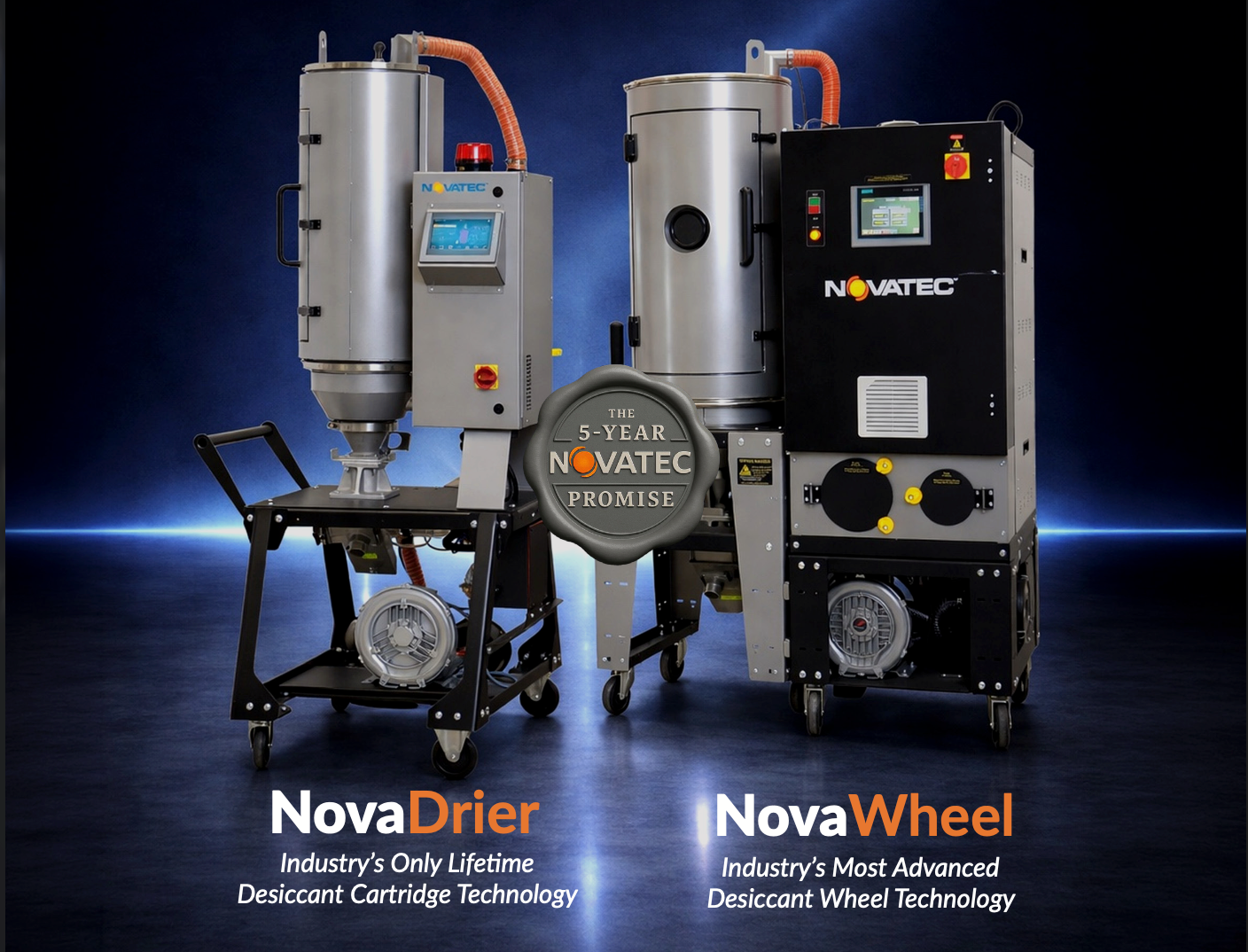
At Novatec, we believe the energy question should be answered at the machine, not at the dryer’s meter, so we built our two showcase dryers around the two approaches above.
The NovaWheel desiccant wheel dryer uses Intelligent Regeneration, which monitors the regeneration process in real time and adjusts heater output to actual desiccant saturation rather than running a fixed cycle. The molecular sieve desiccant is bonded to the wheel rather than packed as loose beads, so there is no desiccant dust and no drift in dewpoint as the medium ages, with wheel life of up to 15 years. Resin leaves at full drying temperature, so the energy invested in drying stays in the material.
The NovaDrier Desiccating Cartridge Dryer has no regeneration cycle at all. Its Desiccating Cartridge is guaranteed for the life of the dryer, delivers −40°F or lower dew points without a bed or wheel to restore, and sheds nothing into the process air. A venturi air amplifier replaces electric blowers and motors, so the only meaningful energy consumption is in heating, and patented Dual Drying Zones keep the upper bed at temperature as well as the lower one. Cartridges installed in 1999 are still delivering −60°F or lower today.
Not sure how the energy math works out for the resins you run? Give us a holler on the form below.
No sales pitch. No pressure. Just a conversation about what’s best for your operation.
Frequently Asked Questions
What is desiccant regeneration in a resin dryer?
Regeneration is the periodic heating of the desiccant, a molecular sieve bed or a desiccant wheel, to several hundred degrees to drive out the water it has adsorbed from the process air. Once the water is driven off, the desiccant can adsorb again and keep delivering −40°F or lower dewpoint air to the hopper. In a twin-tower dryer one tower regenerates while the other dries; in a wheel dryer the wheel rotates continuously through drying, regeneration and cooling zones.
How much energy does desiccant regeneration use?
It is a real cost, but a smaller one than it is usually presented as. Roughly 50 to 85 percent of a drying system’s energy goes to heating, and regeneration is one slice of that heating budget. The rest is blowers and motors. Adsorption also returns heat to the process air, typically 7 to 15°F in polymer drying, which the dryer’s heater does not have to supply.
Is a dryer with no regeneration always more energy efficient?
Not necessarily. A dryer that avoids regeneration by running on ambient air, at lower temperature, or on a shorter cycle may use less energy at the cabinet while delivering resin that is cooler or not fully dry. That energy reappears as reheating at the machine, and as scrap and instability. Compare the total energy per pound from ambient pellets to melt, compressor energy included, in the most humid season the line runs.
Do dryer energy-saver modes affect drying quality?
It depends on what the mode reduces. Smarter regeneration timing saves energy with no drying penalty. Lower process air temperature, less airflow, or a shorter cycle save energy by doing less drying. Check the resin with a rebound test under the energy-saver settings before trusting it in production.
About the Authors

Vice President of Moisture & Drying Technologies, Novatec
Mark Haynie has designed and installed resin drying systems for more than 40 years, working in thousands of plastics plants across the industry. As Novatec’s Vice President of Moisture & Drying Technologies, he leads the company’s drying technology group, including its work on moisture measurement and predictive drying. He also serves as a technical reviewer for Novatec’s Drying Knowledge Center and has authored numerous technical articles and whitepapers on resin drying and moisture.
Mark earned a Bachelor of Science in Chemical Engineering from Virginia Tech.
Through Novatec’s Ask the Expert program, Mark regularly helps processors troubleshoot drying performance and resin-moisture challenges.

Technology Manager, Novatec
Joshua Belisle is Technology Manager at Novatec, where his work focuses on simulation and technology development for resin drying. He earned a B.S. in Mechanical Engineering with a minor in Engineering Business from the University of Virginia in 2023 and joined Novatec that same year. Joshua uses simulation tools to investigate previously difficult-to-measure aspects of the drying process, helping Novatec better understand airflow, heat transfer and other variables that influence resin-drying performance.
Sources
- Novatec, The Science of Vacuum and Desiccant Drying for Engineering Plastics, August 2026: the whole-process energy comparison, reheat at the barrel, and the rebound-stable standard.
- Sorbent Systems, Desiccant Charts: heat of adsorption of water on molecular sieve, about 1,800 BTU per pound of water adsorbed, compared with about 1,300 BTU per pound on silica gel.
- Novatec, Drying Basics: the four drying parameters and why temperature setback moves heating load to the press rather than removing it.
- Novatec, The Ultimate Guide to Choosing the Right Desiccant Resin Dryer, 2026: twin-tower, wheel and sealed-cartridge designs and their desiccant service life.
Related Articles
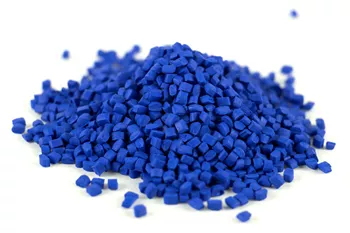
Understand surface and absorbed moisture, starting moisture levels, and their effect on resin processing.
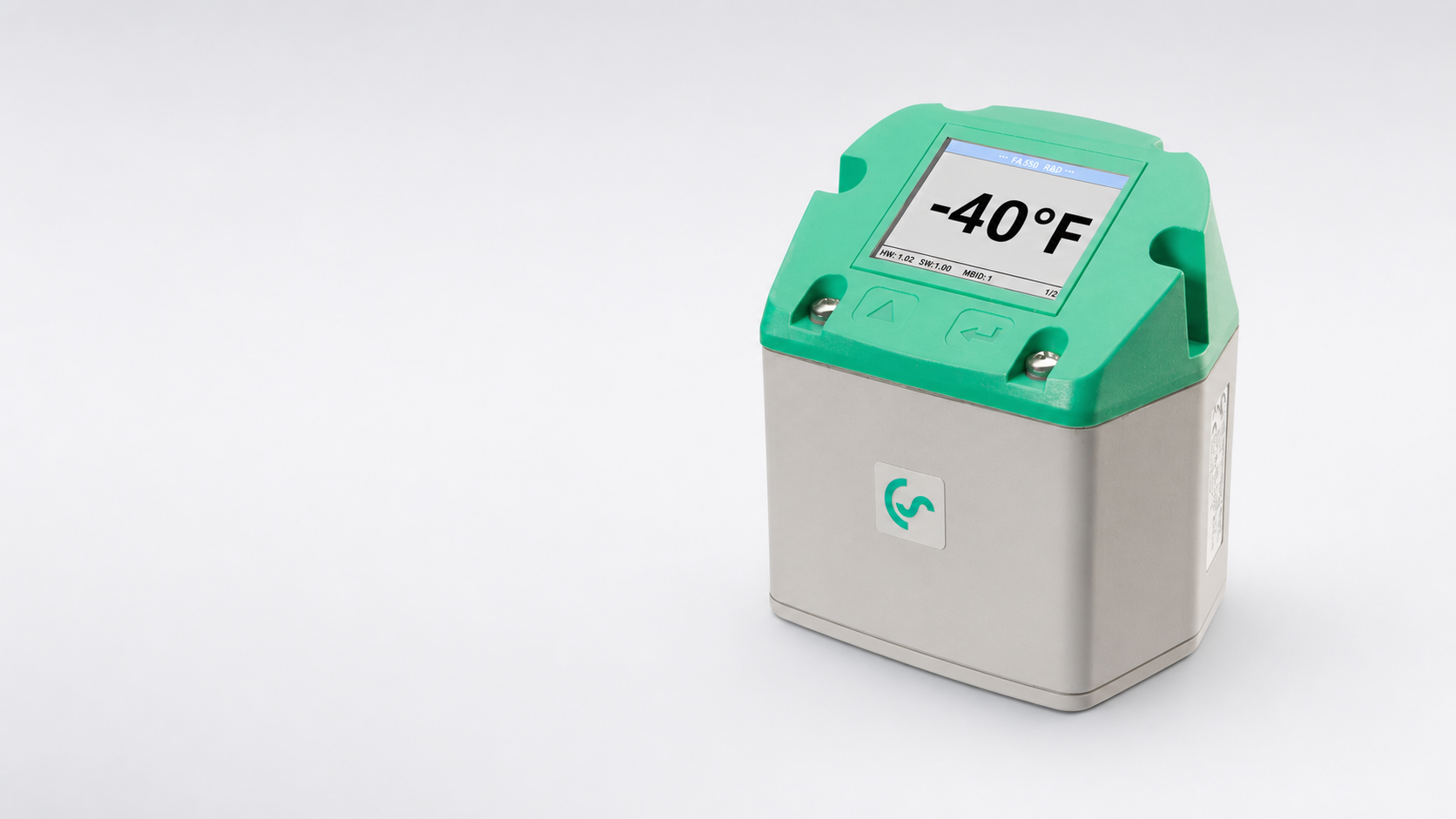
See why dryer dewpoint must be paired with direct resin moisture measurement.
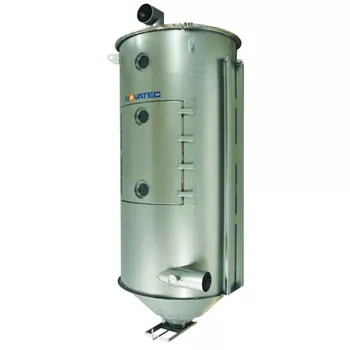
Explore hopper design, airflow, and residence time for consistent resin drying.
Ask the Plastic Drying Expert

Author Profile:
Mark Haynie has designed and installed resin drying systems for more than 40 years, working in thousands of plastics plants across the industry. As Novatec’s Vice President of Moisture & Drying Technologies, he leads the company’s drying technology group, including its work on moisture measurement and predictive drying. He also serves as a technical reviewer for Novatec’s Drying Knowledge Center and has authored numerous technical articles and whitepapers on resin drying and moisture.
Mark earned a Bachelor of Science in Chemical Engineering from Virginia Tech.
Through Novatec’s Ask the Expert program, Mark regularly helps processors troubleshoot drying performance and resin-moisture challenges.