What is a dual bed desiccant dryer and how does it work?
A dual bed, or twin tower, dryer uses two beds of desiccant beads. While one bed supplies dry process air to the drying hopper, the other is regenerated by forcing hot air through it, and then the beds swap roles. These dryers reach a -40°F dew point and dry most resins well, but carry higher energy use, footprint and maintenance.
Dual Bed (also called Twin Tower) dryers used to be the most commonly purchased type of resin dryer. In fact, it is estimated that there are between 10 and 20,000 of these dryers still in use today despite their disadvantages.
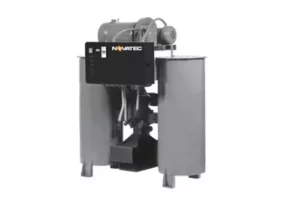
Dual Bed dryers consist of two beds (or towers) of desiccant beads, process and regenerative blowers, process and regeneration heaters and valves to re-direct the airflow. While one bed of desiccant supplies dry process air to flow through the drying hopper, the other bed – with saturated desiccant – is regenerated, by forcing hot air through it. When the regeneration is complete, that bed becomes the one supplying the dry process air and the first bed goes into the regeneration mode.
Dual Bed dryers are commonly used because they attained a -40˚ dew point and generally do a good job of drying most resins.
They do have their disadvantages:
High energy usage
Large footprint
Relatively high maintenance
Spikes and deviations in temperature and dew point during bed changeover
In recent years, there have been great advances made in drying technology and several types of dryers now overcome the disadvantages of Dual Bed dryers. These new dryer types include Desiccant Wheel, Membrane, Vacuum and Infrared versions.
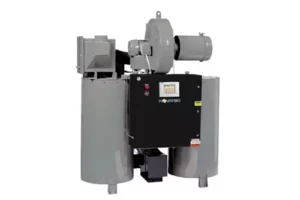
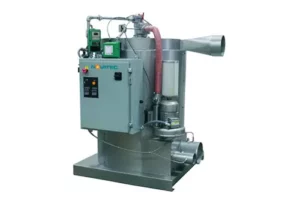
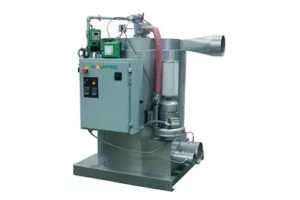
NDB Series Dual Bed Desiccant Dryer – 100-3800 LB/HR (45-1725 KG/HR) – includes separate heaters and blowers for process and regeneration cycles.
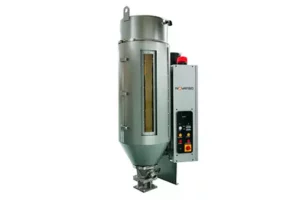
Dual Bed (also called Twin Tower) dryers used to be the most commonly purchased type of resin dryer. A look at why, and where the technology has progressed.
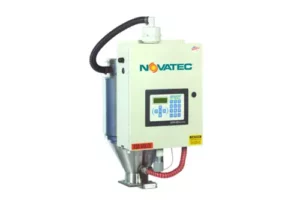
Resin drying machines that can be moved from machine to machine within a plastics processing plant have advantages and disadvantages over a central drying system.
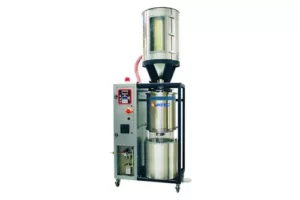
Learn about the keys to drying PET efficiently while saving space and energy.
Frequently Asked Questions
What are the disadvantages of dual bed dryers?
Dual bed dryers carry four main drawbacks: high energy usage, a large footprint, relatively high maintenance, and spikes and deviations in temperature and dew point when the dryer switches from one bed to the other at changeover. Newer dryer designs were developed specifically to address those disadvantages.
Why do dual bed dryers have dew point spikes?
A dual bed dryer alternates between two desiccant beds, regenerating one while the other supplies dry process air to the hopper. At bed changeover, the switch from one bed to the other can cause spikes and deviations in both process temperature and dew point, one of the design’s recognized disadvantages.
Are dual bed dryers still in use?
Yes. Dual bed dryers used to be the most commonly purchased type of resin dryer, and an estimated 10,000 to 20,000 are still in service today. They remain common because they reach a -40°F dew point and generally do a good job of drying most resins.
Vice President of Moisture & Drying Technologies, Novatec
Mark Haynie has designed and installed resin drying systems for more than 40 years, working in thousands of plastics plants across the industry. As Novatec’s Vice President of Moisture & Drying Technologies, he leads the company’s drying technology group, including its work on moisture measurement and predictive drying. He also serves as a technical reviewer for Novatec’s Drying Knowledge Center and has authored numerous technical articles and whitepapers on resin drying and moisture. Mark earned a Bachelor of Science in Chemical Engineering from Virginia Tech. Through Novatec’s Ask the Expert program, Mark regularly helps processors troubleshoot drying performance and resin-moisture challenges.
Joshua Belisle is Technology Manager at Novatec, where his work focuses on simulation and technology development for resin drying. He earned a B.S. in Mechanical Engineering with a minor in Engineering Business from the University of Virginia in 2023 and joined Novatec that same year. Joshua uses simulation tools to investigate previously difficult-to-measure aspects of the drying process, helping Novatec better understand airflow, heat transfer and other variables that influence resin-drying performance.
Mark Haynie, Vice President, Moisture & Drying, Novatec, Inc.
Author Profile:
Mark Haynie has designed and installed resin drying systems for more than 40 years, working in thousands of plastics plants across the industry. As Novatec’s Vice President of Moisture & Drying Technologies, he leads the company’s drying technology group, including its work on moisture measurement and predictive drying. He also serves as a technical reviewer for Novatec’s Drying Knowledge Center and has authored numerous technical articles and whitepapers on resin drying and moisture.
Mark earned a Bachelor of Science in Chemical Engineering from Virginia Tech. Through Novatec’s Ask the Expert program, Mark regularly helps processors troubleshoot drying performance and resin-moisture challenges.