

By Greg Washburn and Joshua Belisle · Edited by Dana Gardner
Published August 6, 2024 · Reviewed by Greg Washburn · July 14, 2026
Summary
How do I stop resin plating out in conveying lines?
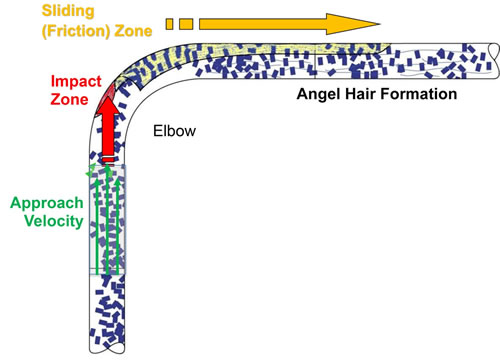
Plating out on the walls of conveying lines usually comes from pickup velocity that is too high, and softer materials such as PE and PP are most prone, especially inside elbows. Set pickup velocity for your material using 500 times the square root of its bulk density, and consider elbows with rifled interiors, which make pellets tumble instead of slide and reduce frictional heat.
Question:
Cross contamination, what about material that plates out on the wall of the main resin line?=
Response:
This can be caused by a number of things. Of course, softer materials like PE or PP are most likely to plate out, especially on the insides of elbows but lots of materials may do the same thing if the pickup velocity is too high. See the attached formula to determine what the proper pickup velocity should be for your material. The minimum pickup velocity for plastic pellets is 3000 fpm.
You may also overcome the problem by installing elbows with rifling on the interior surfaces as they tend to make the pellets tumble instead of sliding around the curves. This reduces frictional heat.
500 x the square root of Material Bulk Density = Pickup Velocity
500 x the square root of 36 lb/cu ft = 500 x 6 = 3000 fpm
500 x sq root of 50 lb/cu ft = 500 x 7.07 = 3535 fpm
Other Factors:
- Particle size
- Flowability – coefficient of friction
Question:
When you purge the pellets during material change, where do they go?
Response:
There are two reasons for purging. First, purging lines after each loading sequence will ensure that all the pellets conveyed will go to the intended destination. Secondly, purging clears the lines to avoid contamination of the material being conveyed next.
Thank you to all for your questions.
Conveying questions are answered by Novatec experts
Frequently Asked Questions
How do I calculate pickup velocity for plastic pellets?
Multiply 500 by the square root of the material’s bulk density in lb/cu ft. For a material at 36 lb/cu ft, that is 500 x 6, or 3000 fpm. At 50 lb/cu ft it is 500 x 7.07, or about 3535 fpm. Particle size and flowability, meaning the coefficient of friction, also affect the right velocity.
Why purge conveying lines after loading?
Purging does two jobs. Purging the lines after each loading sequence ensures that all the pellets conveyed reach their intended destination instead of sitting in the line. It also clears the lines so the next material conveyed is not contaminated by what was left behind, which matters most during material changes.
Do rifled elbows reduce plating out?
Rifled elbows have interior surfaces that make pellets tumble through the curve instead of sliding around it. Tumbling reduces the frictional heat that causes softer materials such as PE and PP to plate out on elbow walls, so rifled elbows are one way to reduce the problem alongside correcting pickup velocity.
About the Authors

Vice President of Operations, Novatec
Greg Washburn is Vice President of Operations at Novatec and has been with the company for more than three decades. He is involved in all phases of engineering design and product manufacturing, giving him a broad perspective on how resin drying and conveying equipment moves from engineering concept through production and into real-world processing environments.
Greg holds a B.S. in Mechanical Engineering from the University of Maryland, Baltimore County (UMBC) and an MBA from Loyola University Maryland. He is a member of the Society of Plastics Engineers (SPE) and the American Society of Mechanical Engineers (ASME), reflecting his professional involvement in both plastics processing and mechanical engineering.

Technology Manager, Novatec
Joshua Belisle is Technology Manager at Novatec, with a focus on simulation and advanced engineering tools used to better understand the science of resin drying. Since joining Novatec in 2023, he has applied new simulation capabilities to investigate aspects of the drying process that were previously difficult to measure directly, helping turn complex process behavior into useful engineering insight.
Joshua earned a B.S. in Mechanical Engineering with a minor in Engineering Business from the University of Virginia in 2023. He is a member of the Society of Plastics Engineers (SPE) and the American Society of Mechanical Engineers (ASME), connecting his work in advanced simulation and engineering analysis with the broader plastics and mechanical engineering communities.
Related Articles
Explore piping, elbow, velocity and cooling practices that reduce angel hair formation.
See how take-off boxes introduce resin and conveying air from storage vessels and drying hoppers.
Review how a purge valve stops material entry so vacuum-on time clears the conveying line.
Ask the Expert