By Greg Washburn and Joshua Belisle · Edited by Dana Gardner
Published August 8, 2024 · Reviewed by Greg Washburn · July 22, 2026
Summary
What does a vacuum take-off box do in a conveying system?
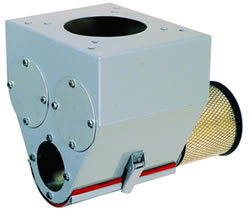
A vacuum take-off box mounts under a silo, surge bin or drying hopper and holds material until a destination calls for it. When a receiver signals demand, the vacuum stream opens and pulls material out of the box through the conveying line. A probe with an adjustable collar meters ambient air into the material stream, and one box can serve one to five destinations.
A vacuum take-off box is mounted under each silo, surge bin and drying hopper in a central system. They are also used under drying hoppers for stand-alone dryers. They are designed to provide material exits to 1-5 destinations.
Material falls from the source container into the VTB where it stays until this material is needed at a destination. A signal at the destination causes the vacuum stream to open and the vacuum pulls material out of the VTB to the desired destination. A probe with a pellet screen and adjustable collar that modulates the airflow controls the amount of ambient air flowing with the material to the destination. Material needs sufficient airflow to be conveyed so the probe valve (see illustration at right) should always be at least 50% open.
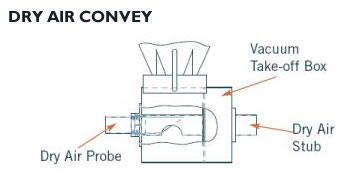
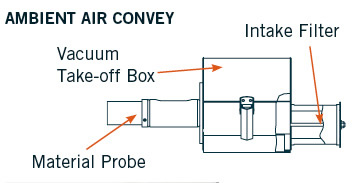
Vacuum takeoff boxes are usually supplied with one or more cartridge filters for ambient air conveying (bottom left). If dry air conveying (bottom right) is being utilized, the cartridge filter(s) are replaced with a dry air stub which connects to a dry air manifold coming from the dryer and a dry air probe is used that does not allow ambient air to contact the material.
DATASHEET: VACUUM TAKE-OFF BOXES
Frequently Asked Questions
Where is a vacuum take-off box installed?
Under each silo, surge bin and drying hopper in a central conveying system, and under drying hoppers on stand-alone dryers. Material falls from the source container into the box and waits there until a destination needs it. One box can provide material exits to as many as five destinations.
How open should the probe valve on a take-off box be?
The probe on the box has a pellet screen and an adjustable collar that modulates how much ambient air flows with the material to the destination. Material needs sufficient airflow to be conveyed, so the guideline is to keep the probe valve at least 50% open rather than restricting it further.
Can a vacuum take-off box be used for dry air conveying?
Yes. For ambient air conveying, the box is supplied with one or more cartridge filters. For dry air conveying, the cartridge filters are replaced with a dry air stub that connects to a dry air manifold from the dryer, and a dry air probe is used so ambient air does not contact the dried material.
About the Authors
Vice President of Operations, Novatec
Greg Washburn is Vice President of Operations at Novatec and has been with the company for more than three decades. He is involved in all phases of engineering design and product manufacturing, giving him a broad perspective on how resin drying and conveying equipment moves from engineering concept through production and into real-world processing environments. Greg holds a B.S. in Mechanical Engineering from the University of Maryland, Baltimore County (UMBC) and an MBA from Loyola University Maryland. His experience spans engineering, manufacturing and operations across Novatec’s material-handling technologies.
Technology Manager, Novatec
Joshua Belisle is Technology Manager at Novatec, where his work focuses on simulation and technology development for resin drying. He earned a B.S. in Mechanical Engineering with a minor in Engineering Business from the University of Virginia in 2023 and joined Novatec that same year. Joshua uses simulation tools to investigate previously difficult-to-measure aspects of the drying process, helping Novatec better understand airflow, heat transfer and other variables that influence resin-drying performance.
Related Articles
Explore equipment and system arrangements for transferring resin from bulk storage.
Review how a common-line conveying system distributes resin to multiple destinations.
Explore surge bins as intermediate resin storage between bulk supply and processing.
Ask the Expert