

By Greg Washburn and Joshua Belisle · Edited by Dana Gardner
Published August 7, 2024 · Reviewed by Greg Washburn · August 10, 2026
Summary
How do I choose a control for a central vacuum conveying system?
Choosing a conveying control starts with the system’s current size and needs, then its likely future. Key questions include the number of pumps and whether to split them across controls, stations per pump, purge, blowback or proportioning needs, central drying, no-load alarm type, Auto ID proofing, Ethernet, and the operator interface. Controls exist for systems up to 20 pumps and 120 receivers.
There are controls designed for systems of every size and capability. Whether you have simple self-contained loaders (with built-in controls) or central systems with 1 to 20 vacuum pumps and up to 120 receivers, you have control choices. Once again, consult with your systems engineer. There are many things to be considered and a good systems person can walk you through the maze to reach a logical conclusion.
Here are the basic things you have to consider when making a choice.
Current conditions:
- What will be the maximum number on the system?
- How many pumps are in the system?
- Should all of those pumps be on one control or should they be divided between 2 or more controls?
- How many stations each pump will serve?
- Do you require purge, blowback or proportioning?
- Are you using central drying?
- Do you have a brand preference?
- Which kind of No-Load Alarm do you need?
- Do you want/need Auto ID Proofing capability?
- Do you want/need Ethernet capability?
- What kind of Operator Interface do you need…Touch screen, size, color, monochrome, pushbutton PLC?
- How much expandability do you need for the future?
Future conditions:
No one has a crystal ball to read the future but consider trends in your markets and within your company.
- Is expansion or consolidation likely to increase the number of processing machines you will have?
- Are you likely to be using new materials that will influence current design parameters?
All of these factors will influence your control choice. Your systems designer is best prepared to give you reliable advice.
Compare Plastic Resin Conveying Controls for Small and Large Applications
Frequently Asked Questions
Should all vacuum pumps be on one conveying control?
It depends on the system. Whether all pumps belong on one control or should be split between two or more controls is one of the basic decisions, along with how many pumps the system has, how many stations each pump serves, and how much expansion you expect. A systems engineer can walk you through the trade-offs.
What operator interface options are there for conveying controls?
Operator interfaces range from pushbutton PLC controls to touch screens, and touch screens vary in size and in color or monochrome displays. Choose the interface alongside the related features the system needs, such as Ethernet capability, Auto ID proofing, and the type of no-load alarm.
How do future plans affect a conveying control choice?
Consider trends in your markets and within your company. If expansion or consolidation is likely to add processing machines, or if new materials could change current design parameters, the control needs room to grow. Expandability is one of the basic selection questions, and a systems designer is best placed to advise on it.
About the Authors

Vice President of Operations, Novatec
Greg Washburn is Vice President of Operations at Novatec and has been with the company for more than three decades. He is involved in all phases of engineering design and product manufacturing, giving him a broad perspective on how resin drying and conveying equipment moves from engineering concept through production and into real-world processing environments. Greg holds a B.S. in Mechanical Engineering from the University of Maryland, Baltimore County (UMBC) and an MBA from Loyola University Maryland. His experience spans engineering, manufacturing and operations across Novatec’s material-handling technologies.

Technology Manager, Novatec
Joshua Belisle is Technology Manager at Novatec, where his work focuses on simulation and technology development for resin drying. He earned a B.S. in Mechanical Engineering with a minor in Engineering Business from the University of Virginia in 2023 and joined Novatec that same year. Joshua uses simulation tools to investigate previously difficult-to-measure aspects of the drying process, helping Novatec better understand airflow, heat transfer and other variables that influence resin-drying performance.
Related Articles

Understand how vacuum receivers, pumps, controls and sequencing valves work together in a central conveying system.
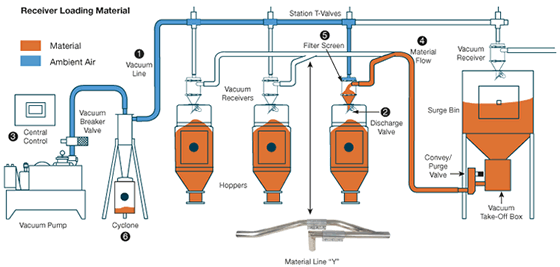
View an animation of receiver loading in a central conveying system.

Explore how automated resin handling reduces labor, waste and floor-space demands as a plant grows.
Ask the Expert
