

By Greg Washburn and Joshua Belisle · Edited by Dana Gardner
Published August 7, 2024 · Reviewed by Greg Washburn · September 7, 2026
Summary
How do I prevent angel hair in pneumatic conveying?
Angel hair forms when pellets slide along the inner wall of conveying elbows, and frictional heat softens and smears low-melt resins into strands. To limit it, keep piping runs short with few elbows, use long-radius elbows of six to nine pipe diameters, fit specialty elbows that make pellets tumble rather than slide, hold conveying velocity near 4,000 ft/min for susceptible resins, cool the conveying air, and trap what forms.
It sounds pretty, but you really don’t want angel hair in your conveying system. Here are some ways to deal it.
Think cobwebs. In houses, they represent messiness, antiquity, and scary. In humans, they symbolize fuzzy thinking. In conveying systems for plastic resins, cobwebs—called angel hair, snakeskins, or streamers, can mean material degradation and contamination, product flaws and discoloration, plugged filters and pipelines, receiver problems, higher maintenance costs, and general inefficiencies in material conveyance, production, and profit making.
Angel hair is primarily a result of frictional heat and abrasion against smooth-walled pipes and elbows. While the best defense is not to have angel hair form to begin with, eliminating all angel hairs (as well as fines and dust) from production might not be possible. What is possible is minimizing the creation of angel hair, and then removing what have been created.
Here are some ways to manage angel hair formation: follow proper piping practices, use specialty elbows, reduce transfer velocities, run at cooler temperatures, and remove what angel hairs come down the line.
The problem
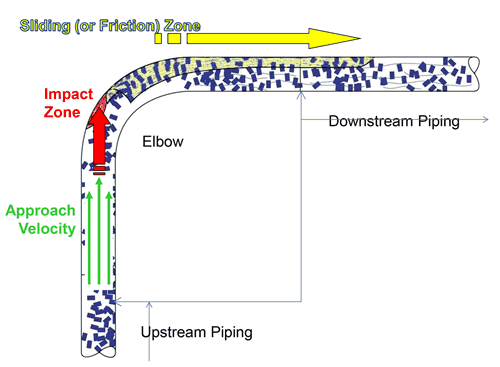
Frictional heat is the primary cause of angel hair. Resin pellets flowing down a pipeline travel primarily in an air stream down the middle of the pipe. That’s true for “straights.” Elbows “bend” the direction of the resin pellets. These bends cause pellets to hit the inner wall of the elbow. Depending on the resin properties, elbow design, and air velocities, some resins get deflected to other areas of the elbow and some get deflected back to the air stream. Most slide against the elbow wall (see Figure 1). This sliding generates frictional heat. Pellets with low melting points, soften and smear along the wall, much like a crayon smears color on a bedroom wall. Smearing can happen fast, and once started, it often grows as incoming pellets rub against the existing smear.
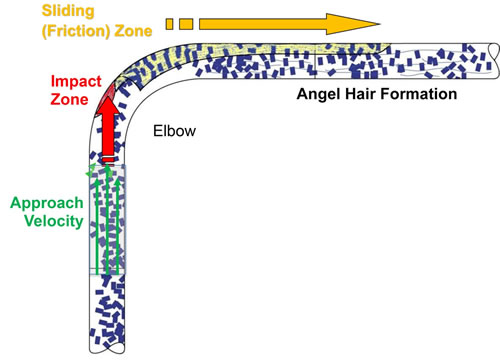
Incoming conveyed pellets randomly break off the smeared plastic into long, ribbon-like strands, almost like loose bird’s nests. This is angel hair, which is then conveyed downstream, entangling with the unaffected resin already moving downstream, often plugging a feed area and eventually starving a receiver. At the very least, angel hair can contaminate resins at the receiver, including changing the resin’s properties and color. In many cases, the angel hairs plug and contaminate.
Focus on proper pipe design
Piping layouts consist of straights and bends—horizontal and vertical lengths of pipe connected by elbows. An effective way of minimizing angel hairs is to keep piping paths short and with few elbows and fittings. Doing this minimizes the impact and sliding zones in the conveying system. Second, it minimizes pressure drops, which affects air velocity—the transport medium for conveying resin materials. If air velocities drop below the material’s saltation velocity, material will drop out of the air stream and just slide along a pipe or elbow. Last, the source of the air stream (blower or vacuum pump) will be happier: better able to maintain the target conveying speed and transfer rate, fewer hard stops or starts, less energy wasted.
Elbows will always be in a conveying system. For elbows, long-radius elbows should have a CLR six to nine times the pipe diameter. For elbows at the base of a high vertical rise, nine to 12 times is preferred.
Use specialty elbows
Angel hairs formation is worse in standard elbows with smooth inner surfaces. While smooth surfaces reduce minimize friction, material wind up sliding more along those surfaces. This generates the frictional heat that’s an anathema to resins with low melting points.
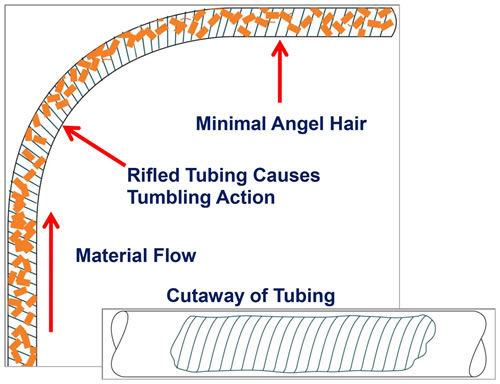
Several types of specialty elbows deter angle hair formation . One type is based on scoring, etching, or otherwise roughening the inside surface of standard, smooth-walled elbows. The rough surface causes material to roll and tumble, rather than slide, along the surface. The tumbling generates less frictional heat than sliding. Surface treatments include shot peening or rifling (spiral groove). (see Figure 2)
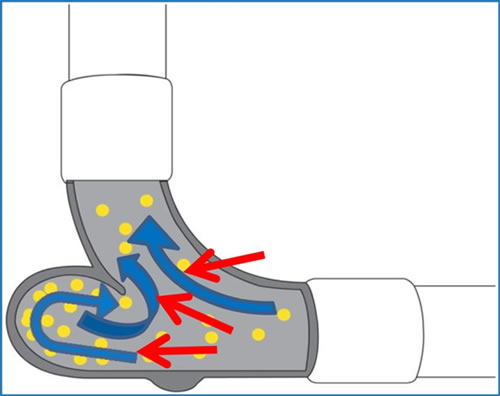
Pocket-type elbows also reduce formation of angel hair by creating a mini cyclone or simple barrier of resin pellets; the pellet-to-pellet interaction between incoming material and the pocket area keeps most of the pellets from hitting and sliding along the elbow wall. Blind tees—a standard pipe tee with one outlet capped—acts like a pocket-type elbow; incoming pellets hit those built up in the capped outlet (see Figure 3).
Run slower
Optimizing conveying velocity falls into the “Goldilocks zone.” Air velocities below the saltation velocity will create instabilities in the conveying system, the worst being the inability to convey material from pickup point to receiver. Just above the saltation velocity, material will get carried and the formation of angel hairs is significantly reduced. With excessive conveying velocities, material travels too fast. This does not lead to higher material transfer capacity, though.
So, regarding the air velocity in pneumatic conveying… less is better. The ideal average conveying velocity for plastic resins that are susceptible to angel hair formation is about 4,000 ft/min.
Run cooler
Frictional heat is just part of the angel hair problem. The operating temperature of your conveying system should be low to begin with—at the source: The air stream that conveys materials, whether positive pressure or vacuum blower systems (or both). Conveying at a typical 6 psi will raise the temperature within the conveying system about 85°F. It’s worth noting that softer materials tend to get sticky at lower temperatures than hard resins.
You may need to install an inline cooler (air- or water-cooled) to reduce the temperature of the conveying air below the resin’s melting point. Coolers may also be necessary to “air condition” the temperature of ambient air in warmer climates.
Remove it
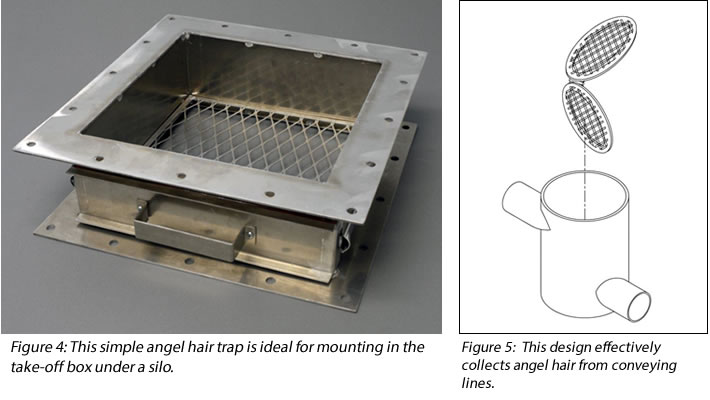
Whatever angel hair that remains should be removed before blenders, feed hoppers or receivers. One type of angel hair trap consists of a drawer with an expanded stainless steel insert that fits into the takeoff box at the bottoms of silos and effectively traps angel hair for later removal. (Fig. 4) There are also in-line angel hair traps that can be used in conveying lines to remove angel hair. (Fig. 5)
The Best Solution
Naturally, the best approach is to stop angel hair from forming in the first place and the good news is that you have several methods of minimizing the formation of angel hair so that its removal is not onerous. Selecting the right method for your plastics conveying system boils down to comparing installation costs vs. maintenance cost, the potential of material contamination, deficiencies in final product and plant shutdown
Frequently Asked Questions
What causes angel hair in a resin conveying system?
Frictional heat is the main cause. Pellets travel in the air stream down the center of straight pipe, but elbows bend their path so they hit and slide along the elbow’s inner wall. That sliding generates heat, and pellets with low melting points soften and smear on the wall like a crayon. Incoming pellets then break the smear off into long ribbon-like strands that travel downstream.
What is the best conveying velocity to avoid angel hair?
About 4,000 ft/min average is the target for resins prone to angel hair. Below the material’s saltation velocity, pellets drop out of the air stream and slide along the pipe, and the system can stop conveying altogether. Just above saltation velocity, material is carried and angel hair formation drops sharply. Running faster than that does not raise transfer capacity.
Which elbows reduce angel hair?
Elbows with a roughened inner surface, such as shot-peened or rifled spiral-groove elbows, make pellets roll and tumble instead of sliding, which generates less frictional heat than a smooth wall. Pocket-type elbows and blind tees build up a cushion of pellets so incoming material hits pellets rather than the wall. Long-radius elbows with a centerline radius of six to nine pipe diameters also help.
About the Authors

Vice President of Operations, Novatec
Greg Washburn is Vice President of Operations at Novatec and has been with the company for more than three decades. He is involved in all phases of engineering design and product manufacturing, giving him a broad perspective on how resin drying and conveying equipment moves from engineering concept through production and into real-world processing environments. Greg holds a B.S. in Mechanical Engineering from the University of Maryland, Baltimore County (UMBC) and an MBA from Loyola University Maryland. His experience spans engineering, manufacturing and operations across Novatec’s material-handling technologies.

Technology Manager, Novatec
Joshua Belisle is Technology Manager at Novatec, where his work focuses on simulation and technology development for resin drying. He earned a B.S. in Mechanical Engineering with a minor in Engineering Business from the University of Virginia in 2023 and joined Novatec that same year. Joshua uses simulation tools to investigate previously difficult-to-measure aspects of the drying process, helping Novatec better understand airflow, heat transfer and other variables that influence resin-drying performance.
Related Articles
Explore wear-resistant elbows and conveying velocity adjustments that reduce component damage.
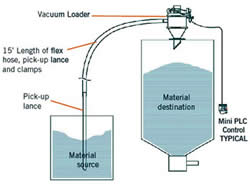
Review loader sizes, pellet and regrind applications, and when to consider central conveying.
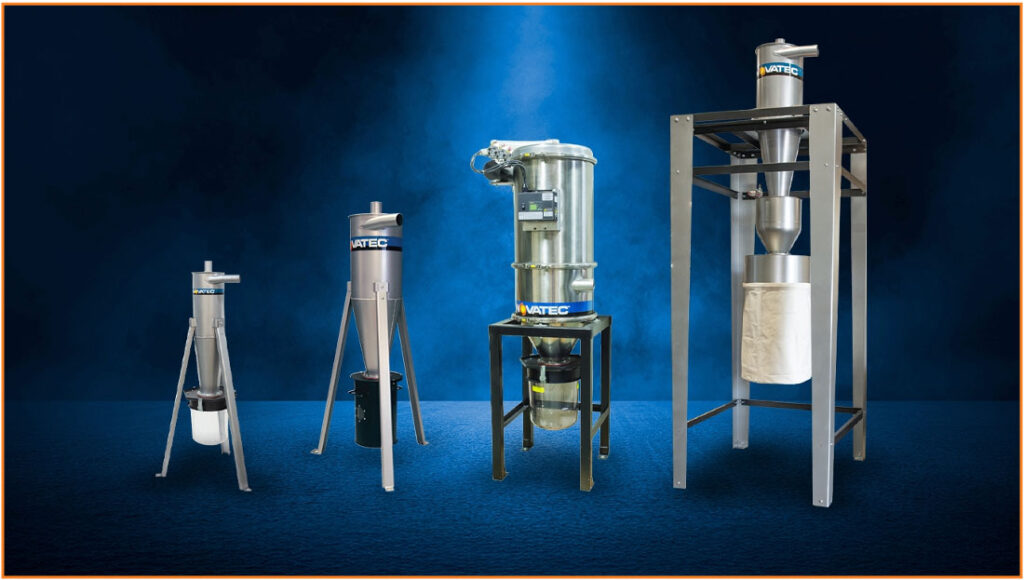
Compare cyclone and filter dust collectors for reducing fines, protecting equipment, and maintaining airflow.
Ask the Expert
