Knowledge Center

Plastics Conveying | Plastics Technology

By Greg Washburn and Joshua Belisle · Edited by Dana Gardner
Published August 6, 2024 · Reviewed by Greg Washburn · July 27, 2026

Summary

How does a compressed air loader work?

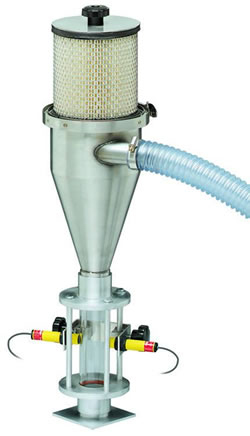
A compressed air loader is a stand-alone self-contained loader that needs no timer or vacuum sealing. An aluminum venturi driven by plant compressed air draws material from the source container and pushes it to the receiver; adjusting the air flow sets the conveying rate. An adjustable-height photo-eye starts the cycle and shuts off the air when material reaches the sensor. It moves up to 500 lb./hr. about 15 feet.

These stand-alone self-contained loaders require no timers, nor vacuum sealing for operation. Material is drawn from the source container and then pushed to the receiver by an efficient, aluminum compressed air venturi.

The rate of material flow is controlled by adjusting the flow of plant compressed air through the venture.

An adjustable -height photo-eye sensor signals the compressed air regulator when to begin the loading cycle and shuts off the air to stop conveying when material reaches the sensor

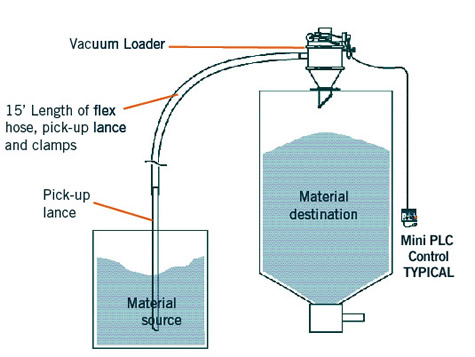
It is possible to transfer up to 500 lb./hr. of plastic pellets and regrind over a distance of about 15 feet. The compressed air loader may be mounted on bins, hoppers or machine throats.

Features to look for:

  • A selection of base plates should be available for mounting to any bins, hoppers or directly to a machine throat

Possible options:

  • A dual inlet proportioning kit should be available to allow simultaneous proportional loading (by air pressure) of regrind with virgin material
  • A dust bag filter kit is a handy option when conveying dusty regrind as it extends the life of the cartridge filter

Drawbacks:
Operating a large number of compressed air loaders is costly from an energy standpoint because of the compressed air usage. Also, since they only convey material about 15 feet, the material source (usually a Gaylord) has to be kept nearby, on the production floor, which adds clutter, requires access by fork lifts or pallet jacks.

Compare Compressed Air Loaders To The Full Family of Loaders for Plastic Resins

 

Frequently Asked Questions

How much material can a compressed air loader move?

Up to about 500 lb./hr. of plastic pellets and regrind over a distance of roughly 15 feet. The rate is set by adjusting the flow of plant compressed air through the venturi, and the loader can be mounted on bins, hoppers or directly on a machine throat, with a selection of base plates to fit each.

What are the drawbacks of compressed air loaders?

Two main ones. Running a large number of compressed air loaders is costly from an energy standpoint because of the compressed air they consume. And since they only convey about 15 feet, the material source, usually a Gaylord, has to sit nearby on the production floor, which adds clutter and requires fork lift or pallet jack access.

Can a compressed air loader blend regrind with virgin material?

Yes, with an option. A dual inlet proportioning kit allows simultaneous proportional loading of regrind with virgin material, with the ratio set by air pressure. When conveying dusty regrind, a dust bag filter kit is a useful add-on because it extends the life of the cartridge filter.

About the Authors

Greg Washburn, Novatec Vice President of Operations

Vice President of Operations, Novatec

Greg Washburn is Vice President of Operations at Novatec and has been with the company for more than three decades. He is involved in all phases of engineering design and product manufacturing, giving him a broad perspective on how resin drying and conveying equipment moves from engineering concept through production and into real-world processing environments. Greg holds a B.S. in Mechanical Engineering from the University of Maryland, Baltimore County (UMBC) and an MBA from Loyola University Maryland. His experience spans engineering, manufacturing and operations across Novatec’s material-handling technologies.

Joshua Belisle, Novatec Technology Manager

Technology Manager, Novatec

Joshua Belisle is Technology Manager at Novatec, where his work focuses on simulation and technology development for resin drying. He earned a B.S. in Mechanical Engineering with a minor in Engineering Business from the University of Virginia in 2023 and joined Novatec that same year. Joshua uses simulation tools to investigate previously difficult-to-measure aspects of the drying process, helping Novatec better understand airflow, heat transfer and other variables that influence resin-drying performance.

Related Articles

Explore how self-contained loaders move resin and what to consider when selecting and maintaining them.

Understand vacuum loader types, operation, and the practical differences between available designs.

Review how self-contained loaders operate and where they fit in resin conveying.

Ask the Expert

Greg Washburn, Conveying Product Engineering Manager, Novatec, Inc.

Submit A Question

Novatec, Inc.

410-789-4811 | 800-237-8379

http://www.novatec.com

Scroll to Top