By Greg Washburn and Joshua Belisle · Edited by Dana Gardner
Published August 7, 2024 · Reviewed by Greg Washburn · August 17, 2026
Summary
What information is needed to design a central resin conveying system?
Designing a central conveying system starts with your goals, whether the facility is new or existing, what equipment will be reused, and any communication protocols to match. The designer also needs the number and size of machines, a plant layout, the materials including regrind, usage and throughput per machine, powders or abrasives, blending and drying needs, material sources, future growth, budget, and schedule.
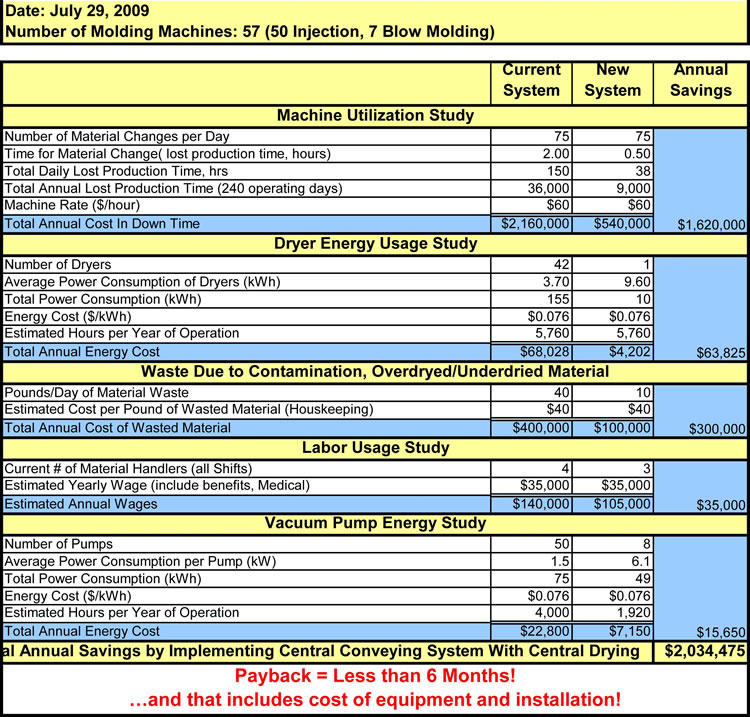
A well-designed, properly installed resin conveying system is a real asset that will pay significant dividends (see image at right) Consult with a systems specialist for professional advice.
The following list identifies some of the initial information that will be required to provide an energy efficient system to satisfy your needs.
- What do you hope to accomplish with the system?
- Will the system be in a new or existing facility?
- Do you want all new equipment or do you prefer to utilize existing handling equipment where possible?
- Does the new system have to be compatible with any existing communication protocols?
- How many, what kind and size of processing machines will be supplied with material?
- Do you have a general plant layout drawing showing machine location?
- How many and what kind of materials will be processed? (including regrind)
- Do you know the usage requirements for each material and throughput of each machine?
- Will there be any powders or very dust regrind processed?
- Will there be any abrasive materials being conveyed?
- Is additive/color feeding or blending required?
- From where will the materials be sourced? (Gaylords, bulk bags, surge bins, silos)
- Is drying or crystallizing required?
- Do you anticipate a requirement for increased throughput, additional materials or machines?
- Do you have a budget range for the project?
- When do you hope to have the system operational?
Your responses to the initial questions above may lead to many more questions. The more information you provide to your systems specialist, the better prepared they will be to provide you with a system that meets all of your present and future expectations.
After considering the responses to the questions above, recommendations will be offered and choices must be made about which system features and components
should be included.
The information presented in the following sections is for educational and general planning purposes only. It is intended to familiarize you with the types of choices and considerations you will face when working with your chosen professional systems engineer.
See Basic Central System Operation for general operational principles.

Frequently Asked Questions
Should a conveying system be planned for future expansion?
Yes. One of the first questions a systems specialist asks is whether you expect more throughput, additional materials, or more machines. The more information you provide up front, the better prepared the specialist is to design a system that meets both present and future expectations, so share growth plans along with current machine counts and material usage.
Can a new conveying system reuse existing equipment?
It can. Part of early planning is deciding whether you want all new equipment or prefer to use existing handling equipment where possible, and whether the new system must be compatible with existing communication protocols. Those answers, together with your plant layout and machine list, shape which system features and components are recommended.
Which materials complicate conveying system design?
Powders or very dusty regrind, abrasive materials, and materials that need drying or crystallizing all affect the design, as do requirements for additive or color feeding and blending. A systems specialist asks about each early, along with how many materials will be processed and the usage of each, and those answers often lead to further questions.
About the Authors
Vice President of Operations, Novatec
Greg Washburn is Vice President of Operations at Novatec and has been with the company for more than three decades. He is involved in all phases of engineering design and product manufacturing, giving him a broad perspective on how resin drying and conveying equipment moves from engineering concept through production and into real-world processing environments. Greg holds a B.S. in Mechanical Engineering from the University of Maryland, Baltimore County (UMBC) and an MBA from Loyola University Maryland. His experience spans engineering, manufacturing and operations across Novatec’s material-handling technologies.
Technology Manager, Novatec
Joshua Belisle is Technology Manager at Novatec, where his work focuses on simulation and technology development for resin drying. He earned a B.S. in Mechanical Engineering with a minor in Engineering Business from the University of Virginia in 2023 and joined Novatec that same year. Joshua uses simulation tools to investigate previously difficult-to-measure aspects of the drying process, helping Novatec better understand airflow, heat transfer and other variables that influence resin-drying performance.
Related Articles
Compare vacuum pump options by conveying distance, throughput, material sensitivity and plant requirements.
Review equivalent conveying distance, line diameter and conveying rate when sizing central system vacuum pumps.
Review how material, throughput, conveying distance and pump selection guide line size and location.
Ask the Expert