

By Greg Washburn and Joshua Belisle · Edited by Dana Gardner
Published August 9, 2024 · Reviewed by Greg Washburn · June 2, 2026
Summary
How do you size a vacuum pump for a central conveying system?
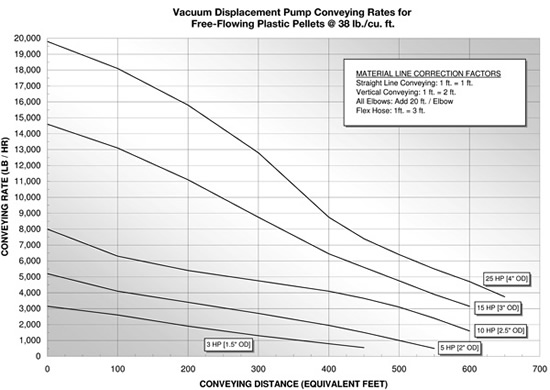
Vacuum pumps for a central conveying system are sized from the equivalent feet of the conveying line, the line diameter, and the required conveying rate, compared against the pump curve for each pump size. Equivalent feet add up the run: one horizontal foot counts as 1, one vertical foot as 2, each 90 degree elbow as 20, and each foot of flex hose as 3.
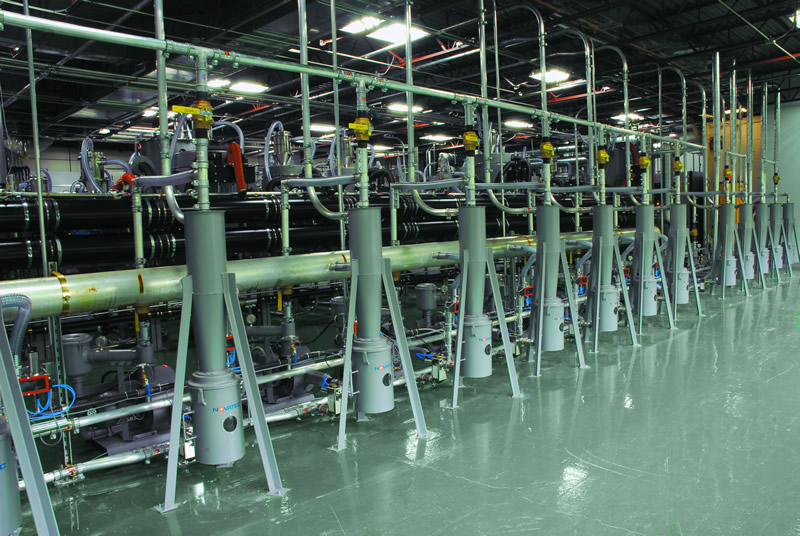
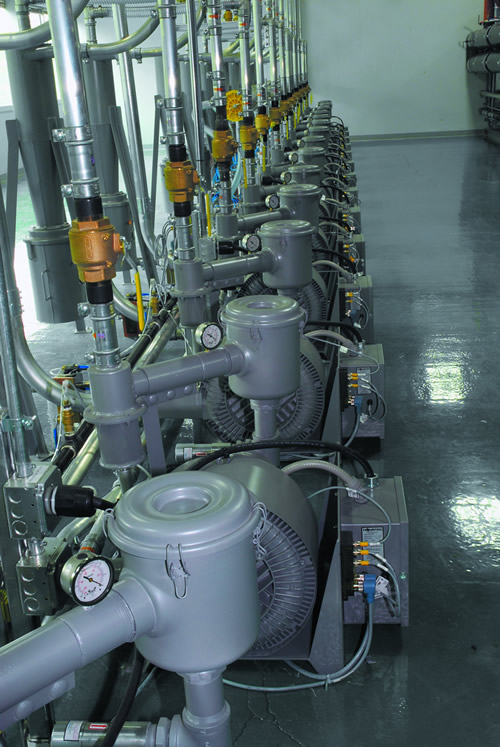
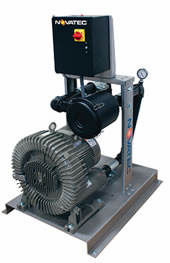
The heart of any central conveying system is the vacuum pump(s). There may be one pump or several pumps. They create the vacuum that pulls the material from the source to the destination.
There are often several pumps required and they need to be sized properly to ensure sufficient airflow.
Each pump should be connected to an efficient cyclone that removes 99% of the dust and fines from the airflow, before it gets back to the pump filter.
Vacuum pumps are sized based on “Equivalent Feet of Airflow” (see below), the line diameter and the conveying rate.
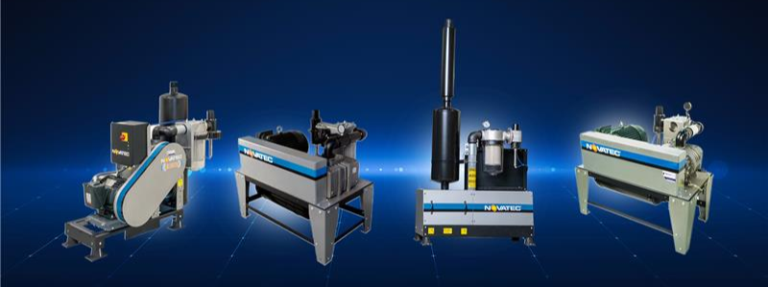
For information on the types of pumps – see Vacuum Pumps
In general:
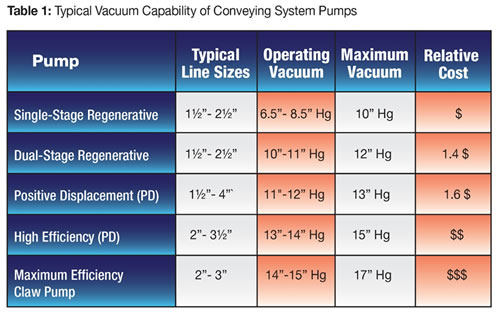
Regenerative Blower Pumps are the least efficient and are suitable for low to moderate throughputs and/or short-moderate conveying distances.
Positive Displacement Pumps moderately efficient and are are designed for moderate-high throughputs and longer conveying distances.
Ultra High Vacuum Pumps are the most efficient and best suited for high throughputs over long distances.
Each type of pump has it’s own niche.
Basic principles for sizing vacuum pumps.
Minimize the number of elbows, vertical lifts, and length of flexible hose.
Avoid up-slopes in material lines.
Avoid multiple bends after exiting a take-off box.
Do not undersize pumps…they will work harder and increase energy costs.
*Size pumps properly, according to these rules:
- 1 horizontal ft of tubing = 1 equivalent ft.
- 1 vertical ft of tubing = 2 equivalent ft.
- One 90 degree elbow = 20 equivalent ft.
- 1 ft of flex hose = 3 equivalent ft.
- Remember to consider obstacles that stand in the way of conveying and air lines – such as HVAC ducts, walls, etc.
- An average railcar is 66 ft long.
Pump Curves
There are “Pump Curves” for each size of each type of pump. The equivalent feet and required conveying rate in lb./hr. are compared to the pump curves to determine the pump size required.
TIP Keep pump filters clean and empty cyclone dust collector pan to maximize pump
efficiency.
TIP Line plugging and shorter pump life will be the result if you undersize pumps.
Frequently Asked Questions
What happens if a conveying vacuum pump is undersized?
An undersized pump has to work harder, which increases energy costs, and it leads to line plugging and shorter pump life. Sizing the pump properly from equivalent feet and the pump curves avoids this. Keeping pump filters clean and emptying the cyclone dust collector pan also helps the pump run at its best efficiency.
Which type of vacuum pump fits which conveying application?
Regenerative blower pumps are the least efficient and suit low to moderate throughputs or short to moderate conveying distances. Positive displacement pumps are moderately efficient and are designed for moderate to high throughputs and longer distances. Ultra high vacuum pumps are the most efficient and are best suited to high throughputs over long distances. Each type has its own niche.
How can conveying line layout reduce the pump size needed?
Minimize the number of elbows, vertical lifts, and the length of flexible hose, since each adds equivalent feet the pump must overcome. Avoid up-slopes in material lines and multiple bends right after a take-off box. Also account for obstacles such as HVAC ducts and walls that stand in the way of conveying and air lines.
About the Authors

Vice President of Operations, Novatec
Greg Washburn is Vice President of Operations at Novatec and has been with the company for more than three decades. He is involved in all phases of engineering design and product manufacturing, giving him a broad perspective on how resin drying and conveying equipment moves from engineering concept through production and into real-world processing environments. Greg holds a B.S. in Mechanical Engineering from the University of Maryland, Baltimore County (UMBC) and an MBA from Loyola University Maryland. His experience spans engineering, manufacturing and operations across Novatec’s material-handling technologies.

Technology Manager, Novatec
Joshua Belisle is Technology Manager at Novatec, where his work focuses on simulation and technology development for resin drying. He earned a B.S. in Mechanical Engineering with a minor in Engineering Business from the University of Virginia in 2023 and joined Novatec that same year. Joshua uses simulation tools to investigate previously difficult-to-measure aspects of the drying process, helping Novatec better understand airflow, heat transfer and other variables that influence resin-drying performance.
Related Articles
Compare vacuum pump technologies by conveying distance, throughput, efficiency, and noise.
Compare regenerative, positive displacement, high-efficiency PD, and claw pumps for resin conveying.
Understand operating vacuum, equivalent distance, and pickup velocity when selecting a conveying pump.
Ask the Expert
