By Greg Washburn and Joshua Belisle · Edited by Dana Gardner
Published August 3, 2024 · Reviewed by Greg Washburn · August 26, 2026
Summary
What does a vacuum receiver do in a conveying system?
A vacuum receiver is the holding point where conveyed resin is separated from the air stream. A sequencing valve directs vacuum to the receiver, material is drawn through the line, pellets drop to the bottom of the chamber, and the air continues up through a filter or cyclonic separation and back to the pump. A discharge valve then releases the resin to a hopper or into the machine throat.
Proper Vacuum Receiver Selection Impacts Central System Operation
Vacuum receivers are an integral part of any central conveying system. As such, it is important to understand:
- Types of receivers
- Basic receiver features
- How receivers operate
- Troubleshooting procedures
Vacuum receivers, also called vacuum chambers, vacuum stations, or just stations, are integral parts of a central conveying system. Think of them as intermediate holding points for resins conveyed by vacuum. Vacuum receivers have one primary job: separate material from air. They accept resin from a source that is pulled by vacuum, separate the material from the air flow and transfer that resin to a destination.
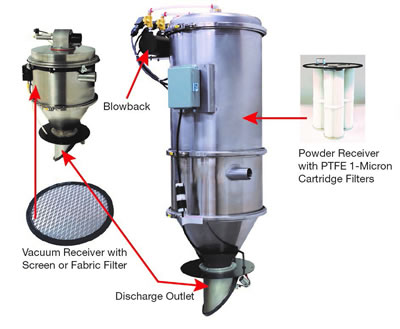
Vacuum receivers come in several designs with all sorts of features aimed at offering a variety of advantages in conveyance, maintenance, and ease of use. Some receivers are designed for pellets, some for regrind, and others for powders.
Some receivers mount atop hoppers or bins; others are mounted directly to the throat of a processing machine.
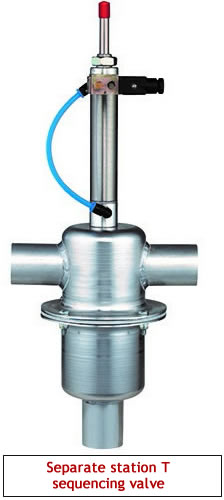
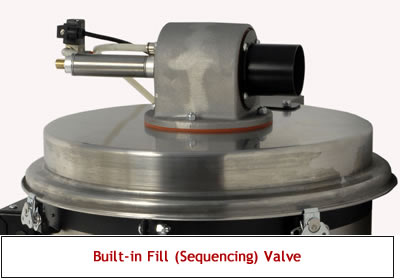
All receivers have a sequencing device. Some receivers require a separate sequencing valve to connect to the vacuum line; others have a built-in fill valve. The sequencing device allows vacuum to pull material into the receiver and while the bulk of the material falls to the bottom of the receiver, the vacuum pulls the air up through the top of the receiver and back to the vacuum pump.
Most dust and fines are trapped by a filter but there are also Filterless Receivers.
Receivers come in various capacities, from small (1.5 lb.), to medium (75 lb.), to large (114 lb. and more). The multitude of designs, capacities, and feature sets is what makes it possible to specify a vacuum receiver that perfectly matches the needs of a plastics conveying system.
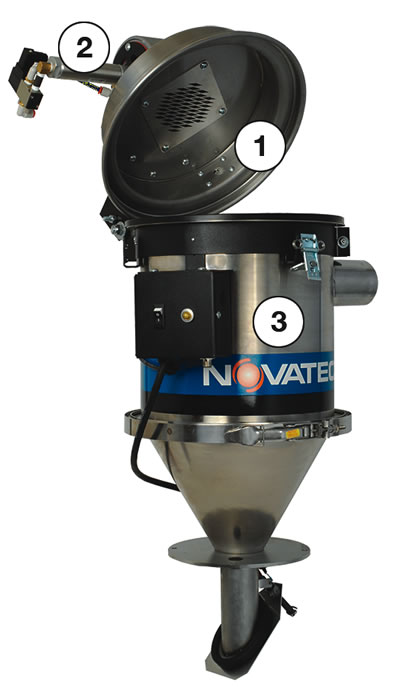
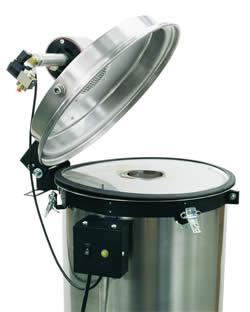
1) Receiver lid – allows access to the receiver chamber. Access is necessary to clean and/or change filters, if present, and perform other maintenance within the receiver. The lid can be hinged or completely removable, and typically can be rotated to the orientation required by the layout of the conveying system.
2) Vacuum breaker or sequencing valve – at each receiver directs vacuum to that receiver. The vacuum draws resin through the conveying lines to the vacuum receiver. Sequencing valves can be either a “T” valve located above the receiver in the vacuum line or an external fill valve (EFV) located right on the receiver lid.
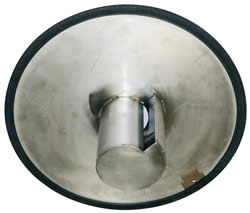
3) Receiver chamber or body – is usually a cylinder connected to cone-shaped lower section – that collects resin from the conveying system before discharge. The slant of the cone helps material slide down to the discharge valve.
4) Machine-mounted receivers – typically have a glass hopper and are connected directly to the throat of the process machine. Often referred to as J.I.T. receivers.
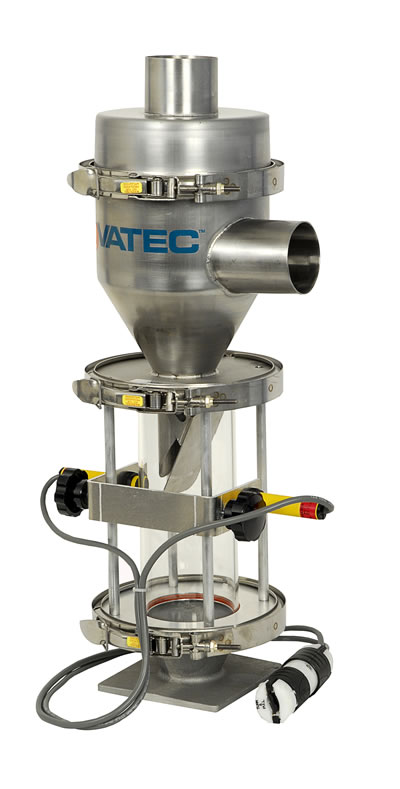
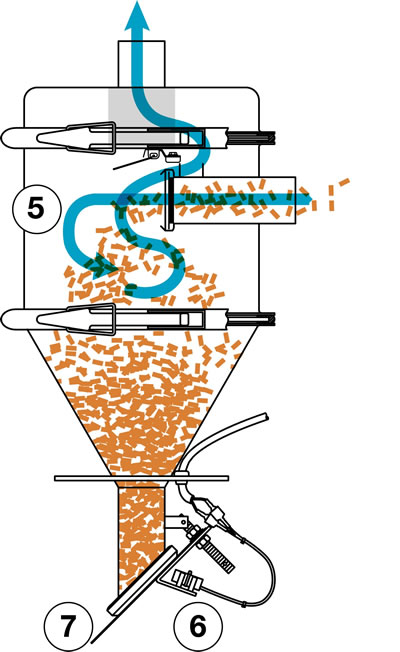
5) Filter or some type of filter-less system – separates powders, dust, fines, and other contaminates from the resin entering the receiver. The filter-less receiver shown below uses a cyclonic action to separate material from the air flow. The material is heavier than air so it falls into the body of the receiver while vacuum and cyclonic action pulls the air into the vacuum stream.
6) Material level switch – detects the amount of resin in the machine-mount receiver and controls the discharge of the resin. The mechanism to detect the level of material in the receiver can range from simple, non-automated devices to sophisticated electronically controlled sensors.
7) Discharge valve – allows collected resin exit the receiver chamber. The resin can be dispensed to a hopper or some other type of container. Machine-mount receivers typically gravity-feed directly to the throat of the process machin
More on Filterless receivers:
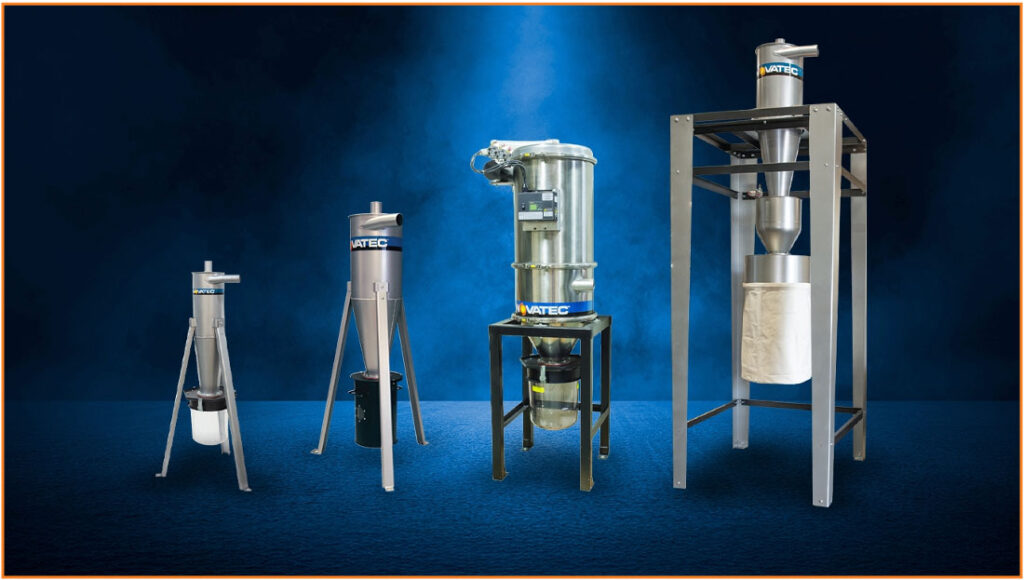
There are two distinct styles of filterless vacuum receivers. The “removeable-lid’ receivers require a separate vacuum sequencing valve (“T” valve) while the very popular hinged-lid models that have a built-in sequencing valve.
In either case, going filterless eliminates the necessity of cleaning filters and the filter replacement costs. A filter is not required because these models use a cyclonic action to separate the material from the air flow. In addition, a Blowback option is not required so that cost is eliminated.
There are other features that should be considered like; a stainless steel body which provides an attractive scratch-resistant surface; a tangential material inlet with a gasketed check valve that minimizes degradation of material while also minimizing harm to the receiver walls.
The hinged lid models are popular because the lid swings up and locks in place so the interior of the receiver can be safely cleaned after material changes. Some also have a local ON/OFF switch so the operator does not have to walk to a central control to turn the unit OFF.
When conveying particularly abrasive materials, either style is available with extended wear ceramic coated options that are bolted in place and can be replaced, when necessary.
The removable lid models are available in capacities of 1/3 to 3 ft3 while the hinged lid models are available from 1/3 to 2 ft3. Machine mount styles are available with multiple glass sizes for most models.

Frequently Asked Questions
What are the main parts of a vacuum receiver?
A lid, hinged or removable, for filter changes and cleaning; a sequencing valve, either a T valve in the vacuum line above the receiver or an external fill valve on the lid; a cylindrical chamber with a cone bottom that slides material to the outlet; a filter or filterless cyclonic separator; a material level switch on machine-mount units; and a discharge valve.
What is a filterless vacuum receiver and why use one?
A filterless receiver uses cyclonic action to separate material from the air stream: pellets are heavier than air and fall into the body while the air is pulled into the vacuum line. There is no filter to clean or replace and no blowback option to buy. Two styles exist, a removable-lid type that needs a separate T valve and a hinged-lid type with a built-in sequencing valve.
What size vacuum receivers are available?
Capacities run from small units around 1.5 lb to medium units around 75 lb and large units of 114 lb and more. Filterless removable-lid models come in 1/3 to 3 cubic feet and hinged-lid models in 1/3 to 2 cubic feet. Machine-mount receivers, often called J.I.T. receivers, sit on the machine throat with a glass hopper and are offered with several glass sizes.
About the Authors
Vice President of Operations, Novatec
Greg Washburn is Vice President of Operations at Novatec and has been with the company for more than three decades. He is involved in all phases of engineering design and product manufacturing, giving him a broad perspective on how resin drying and conveying equipment moves from engineering concept through production and into real-world processing environments. Greg holds a B.S. in Mechanical Engineering from the University of Maryland, Baltimore County (UMBC) and an MBA from Loyola University Maryland. His experience spans engineering, manufacturing and operations across Novatec’s material-handling technologies.
Technology Manager, Novatec
Joshua Belisle is Technology Manager at Novatec, where his work focuses on simulation and technology development for resin drying. He earned a B.S. in Mechanical Engineering with a minor in Engineering Business from the University of Virginia in 2023 and joined Novatec that same year. Joshua uses simulation tools to investigate previously difficult-to-measure aspects of the drying process, helping Novatec better understand airflow, heat transfer and other variables that influence resin-drying performance.
Related Articles
Compare motors, filters, discharge valves, and maintenance features to choose a self-contained loader.
Compare vacuum pump technologies, conveying distance, energy use, and material protection to choose the right pump for your plant.
Explore how cyclones, filter dust collectors, and a tiered filtration strategy protect conveying equipment from dust and fines.
Ask the Expert