By Greg Washburn and Joshua Belisle · Edited by Dana Gardner
Published August 8, 2024 · Reviewed by Greg Washburn · August 26, 2026
Summary
How does an automatic multi-material distribution valve work?
An automatic distribution valve lets an operator key a material source and destination into the conveying control; compressed-air cylinders then open one positive-seating valve at a time so the requested material flows to its destination, and the line purges automatically before the next call. A simple vertical design can serve up to 12 sources in common-line or dedicated-line systems, with bi-verter valves at each destination when several are served.
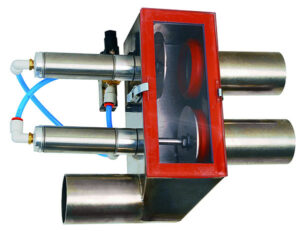
When it comes to automatic multi-material distribution valves, there is no shortage of designs. They all basically serve the same purpose but some are installed vertically, some horizontally and some can be installed in either manner. Some have relative few moving parts but others have more complex working mechanisms that may actually rotate the valve to make connections. Not only can this be problematical, but the more complex distributions can be several times the cost of simpler versions.
View short video explanation of fully automatic systems. (6 minutes)
Here, we show a design that is relatively simple. It is expandable, distributing materials from up to 12 different sources to a single or multiple destinations. It can be used in common line or dedicated line systems and lines are purged after each load of material is delivered. When serving multiple destinations, bi-verter valves are installed in the material lines at each destination. They ensure that the required material is delivered to the proper destination. See more information on diverter Valves
View short video: Basic Automatic Material Selection (5 minutes)
How It Works
1. The operator keys the material source and the material destination into a conveying
system control.
2. Compressed air cylinders react to signals from the controller to open one valve at a
time to allow the requested material to flow to its destination.
3. Line purging follows automatically and the vertical valve is ready for another signal.
4. The positive-seating valves are the only moving parts.

Frequently Asked Questions
How many material sources can a distribution valve handle?
The design described is expandable and distributes material from up to 12 different sources to a single destination or to multiple destinations. It works in either common-line or dedicated-line systems. When it serves multiple destinations, bi-verter valves installed in the material line at each destination direct the requested material to the right place.
Are simpler or more complex material selection valves better?
Distribution valves vary widely: some mount vertically, some horizontally, some either way. Designs with few moving parts are simpler, while more complex mechanisms may physically rotate the valve to make connections. That added complexity can cause problems and can cost several times as much as a simpler version. In the design described, the positive-seating valves are the only moving parts.

Do conveying lines get purged after each material change?
Yes. In the design described, lines are purged after each load of material is delivered. Once the requested material has flowed to its destination, line purging follows automatically and the vertical valve is ready for the next signal from the conveying system control.
About the Authors
Vice President of Operations, Novatec
Greg Washburn is Vice President of Operations at Novatec and has been with the company for more than three decades. He is involved in all phases of engineering design and product manufacturing, giving him a broad perspective on how resin drying and conveying equipment moves from engineering concept through production and into real-world processing environments. Greg holds a B.S. in Mechanical Engineering from the University of Maryland, Baltimore County (UMBC) and an MBA from Loyola University Maryland. His experience spans engineering, manufacturing and operations across Novatec’s material-handling technologies.
Technology Manager, Novatec
Joshua Belisle is Technology Manager at Novatec, where his work focuses on simulation and technology development for resin drying. He earned a B.S. in Mechanical Engineering with a minor in Engineering Business from the University of Virginia in 2023 and joined Novatec that same year. Joshua uses simulation tools to investigate previously difficult-to-measure aspects of the drying process, helping Novatec better understand airflow, heat transfer and other variables that influence resin-drying performance.
Related Articles
See how one shared conveying line supplies similar materials to one or more destinations.
See how take-off boxes feed resin from silos, bins, and drying hoppers into vacuum conveying lines.
Explore valve uses for alternating virgin resin and regrind or purging material lines.
Ask the Expert