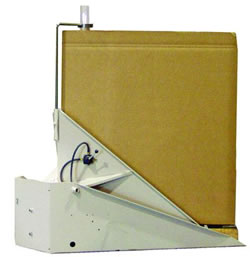
A tilt table empties a Gaylord by tipping it so material flows to one corner. The Gaylord, on its pallet, sits on a platform and a lance or pickup wand connected to a vacuum source goes into that corner. As material is drawn out, the table angles the box toward the wand so most of the material is removed, and a signal light usually shows when it is nearly empty.
There are several versions of tilt tables that are used to empty material from Gaylords. Typically, a Gaylord on a pallet is set on a platform and a lance (or pickup wand), attached to a vacuum source, is inserted into the material in one corner. As material is drawn from the Gaylord, compressed air angles the tilt table, to ensure that the material flows to the corner containing the wand. In this way, most of the material is removed. There is usually a signal light to indicate when the Gaylord is nearly empty.
Disadvantages: Tilt Tables are hydraulically operated and there are pinch points. Also a fork lift is required to raise the pallet-holding Gaylord onto the bed of the tilt table.
What are the disadvantages of a Gaylord tilt table?
Tilt tables are hydraulically operated and have pinch points, so operators need to work around them with care. A forklift is also needed to lift the pallet holding the Gaylord onto the bed of the tilt table, which adds equipment and floor traffic to the unloading area beside the process.
How do you know when a Gaylord on a tilt table is empty?
Tilt tables usually include a signal light that indicates when the Gaylord is nearly empty. Because the table keeps angling the box so material flows toward the corner holding the lance or pickup wand, most of the material is removed before the light tells the operator it is time to change the box.
Do you need a forklift to use a tilt table?
Yes. A forklift is required to raise the pallet holding the Gaylord onto the bed of the tilt table. Once the box is in place, a lance or pickup wand attached to a vacuum source is inserted into one corner, and the table tilts to keep material flowing toward that wand as it empties.
Greg Washburn is Vice President of Operations at Novatec and has been with the company for more than three decades. He is involved in all phases of engineering design and product manufacturing, giving him a broad perspective on how resin drying and conveying equipment moves from engineering concept through production and into real-world processing environments. Greg holds a B.S. in Mechanical Engineering from the University of Maryland, Baltimore County (UMBC) and an MBA from Loyola University Maryland. His experience spans engineering, manufacturing and operations across Novatec’s material-handling technologies.
Joshua Belisle is Technology Manager at Novatec, where his work focuses on simulation and technology development for resin drying. He earned a B.S. in Mechanical Engineering with a minor in Engineering Business from the University of Virginia in 2023 and joined Novatec that same year. Joshua uses simulation tools to investigate previously difficult-to-measure aspects of the drying process, helping Novatec better understand airflow, heat transfer and other variables that influence resin-drying performance.