

By Greg Washburn, Joshua Belisle and Fred Eichhorn · Edited by Dana Gardner
Published August 8, 2024 · Reviewed by Greg Washburn · July 31, 2026
Summary
What does a proportioning purge valve do in a conveying system?
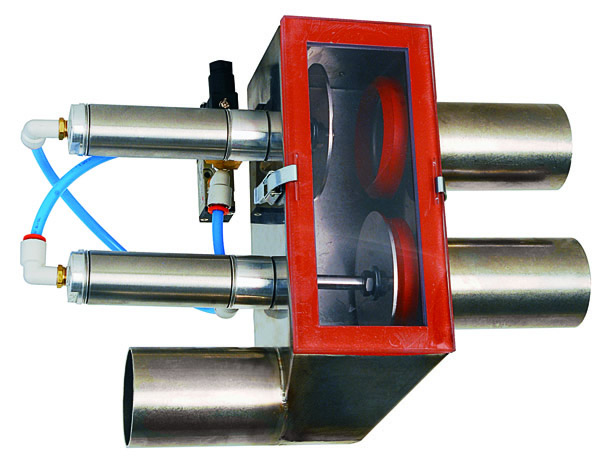
A proportioning purge valve is one air-actuated valve that serves two purposes. As a proportioning valve, it loads virgin and regrind alternately for a set number of seconds so a loader or receiver can layer them to an approximate percentage. As a purge valve, mounted on a vacuum takeoff box under a drying hopper, it conveys material and then clears the line with ambient or dry air to reduce plugging.
This single air actuated valve design serves two distinctly different purposes.
As a proportioning valve:
The proportioning signal is simply set to load virgin and regrind alternately – for a given number of seconds. The amount of each material loaded is not exact but satisfactory if It can be added to a self-contained vacuum loader or to a central system vacuum receiver when it is desirable to layer natural resin and regrind. You just need to approximate the percentage of each material required in the mix.
As a purge valve:
It can be added to a vacuum takeoff box beneath a drying hopper and it can be configured to convey material then purge material lines with either ambient or dry air. Air purging of material lines is a good way to clear out any stray pellets after each shot of resin is conveyed. This minimizes the opportunity for material to build up in conveying lines and cause line plugging.
For either application, the operational signal can come from a central control if the control is programmed for proportioning/purge. Otherwise, a separate control can be purchased to accomplish the proportioning or purge.
The inlet/outlet diameters are sized to match material line diameter.
NOTE: There is also DSV (Discharge Selection Valve) which is basically a Purge valve with relief so it can circulate dry air from the vacuum pump for Closed Loop Dry Air Conveying applications.
Features to look for:
- Stainless steel construction – for durability
- High-heat, 350° F. seals – for use with hi-temperature resins
- Stainless steel disc/seat with adjustable throw – to ensure high vacuum
- Polycarbonate window – for full view of interior
- Easy access – for cleanout
Accessories include:
- Separate control – if not centrally controlled


Frequently Asked Questions
How accurate is a proportioning valve for mixing virgin and regrind?
It is not exact. The proportioning signal alternates between virgin and regrind for a given number of seconds each, so you set the timing to approximate the percentage of each material you need. The result is satisfactory for layering natural resin and regrind in a self-contained vacuum loader or a central-system vacuum receiver.
Why purge conveying lines after each load of resin?
Air purging clears stray pellets left in the material line after each shot of resin is conveyed. That minimizes the chance of material building up in the line and causing a plug. The purge valve mounts on a vacuum takeoff box beneath a drying hopper and can be configured to purge with either ambient or dry air.
Do I need a separate control for a proportioning or purge valve?
Not always. If your central conveying control is programmed for proportioning or purge, it can send the operating signal directly. If it isn’t, a separate control can be purchased to run the valve. Either way, the valve’s inlet and outlet diameters are sized to match your material line, and features worth specifying include stainless construction, 350°F seals and a polycarbonate viewing window.
About the Authors

Vice President of Operations, Novatec
Greg Washburn is Vice President of Operations at Novatec and has been with the company for more than three decades. He is involved in all phases of engineering design and product manufacturing, giving him a broad perspective on how resin drying and conveying equipment moves from engineering concept through production and into real-world processing environments.
Greg holds a B.S. in Mechanical Engineering from the University of Maryland, Baltimore County (UMBC) and an MBA from Loyola University Maryland. He is a member of the Society of Plastics Engineers (SPE) and the American Society of Mechanical Engineers (ASME), reflecting his professional involvement in both plastics processing and mechanical engineering.

Technology Manager, Novatec
Joshua Belisle is Technology Manager at Novatec, with a focus on simulation and advanced engineering tools used to better understand the science of resin drying. Since joining Novatec in 2023, he has applied new simulation capabilities to investigate aspects of the drying process that were previously difficult to measure directly, helping turn complex process behavior into useful engineering insight.
Joshua earned a B.S. in Mechanical Engineering with a minor in Engineering Business from the University of Virginia in 2023. He is a member of the Society of Plastics Engineers (SPE) and the American Society of Mechanical Engineers (ASME), connecting his work in advanced simulation and engineering analysis with the broader plastics and mechanical engineering communities.

Engineering Manager – Electrical Controls, Novatec
Fred Eichhorn is Engineering Manager – Electrical Controls at Novatec, where he has held engineering and leadership positions since 1992. His experience spans automation, product development, electrical controls and R&D across Novatec’s resin drying and material handling technologies. Fred has also contributed to technology development at MachineSense and Opteev.
Fred holds a B.S. in Electrical Engineering from the University of Maryland, College Park, and has earned professional certifications in PLC and HMI programming, Lean business practices and ISO 9001. He is a member of the Institute of Electrical and Electronics Engineers (IEEE) and the Society of Plastics Engineers (SPE), bringing together expertise in industrial automation and plastics processing.
Related Articles

See how external proportioning valves layer virgin resin and regrind in a receiver or loader.
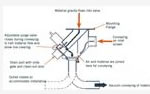
Review how a take-off purge valve conveys material and clears the line with dry or ambient air.
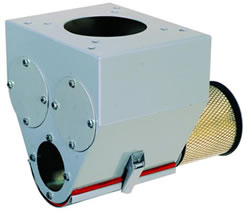
Understand how take-off boxes introduce resin into conveying lines and regulate transport airflow.
Ask the Expert