Should I use a dedicated line or common line conveying system?
Choose dedicated lines when reliable operation matters most. Dedicated lines cost more initially and somewhat reduce throughput, but they help avoid line clogs. In a just-in-time system with small vacuum receivers, dedicated lines should be used to avoid overfilling. Where those conditions don’t apply, weigh the lower initial cost of a common-line system against its higher clog risk.
Dedicated or Common Line System
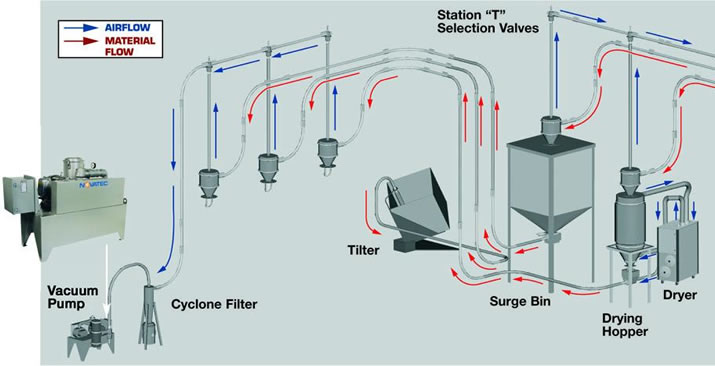
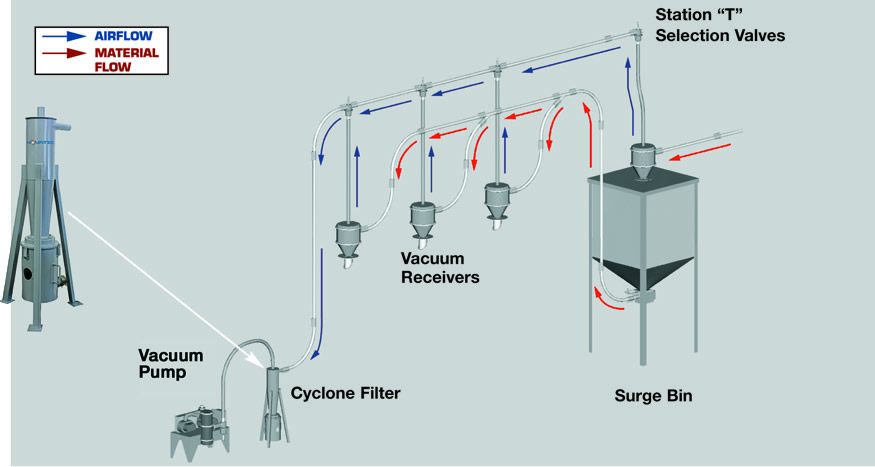
Choose carefully between a dedicated-line system and a common-line system. Dedicated lines cost more initially and somewhat reduce throughputs, but they help avoid line clogs and ensure more reliable operation. Dedicated lines should definitely be used in a “Just-In-Time” system with small vacuum receivers to avoid “overfilling.” See System Types
Frequently Asked Questions
Why use dedicated lines in a just-in-time conveying system?
In a just-in-time system with small vacuum receivers, the receivers can overfill. Dedicated lines should be used in these systems to avoid overfilling. Dedicated lines also help prevent line clogs and make operation more reliable, at a higher initial cost and with somewhat reduced throughput.
Greg Washburn is Vice President of Operations at Novatec and has been with the company for more than three decades. He is involved in all phases of engineering design and product manufacturing, giving him a broad perspective on how resin drying and conveying equipment moves from engineering concept through production and into real-world processing environments.
Greg holds a B.S. in Mechanical Engineering from the University of Maryland, Baltimore County (UMBC) and an MBA from Loyola University Maryland. He is a member of the Society of Plastics Engineers (SPE) and the American Society of Mechanical Engineers (ASME), reflecting his professional involvement in both plastics processing and mechanical engineering.
Joshua Belisle is Technology Manager at Novatec, with a focus on simulation and advanced engineering tools used to better understand the science of resin drying. Since joining Novatec in 2023, he has applied new simulation capabilities to investigate aspects of the drying process that were previously difficult to measure directly, helping turn complex process behavior into useful engineering insight.
Joshua earned a B.S. in Mechanical Engineering with a minor in Engineering Business from the University of Virginia in 2023. He is a member of the Society of Plastics Engineers (SPE) and the American Society of Mechanical Engineers (ASME), connecting his work in advanced simulation and engineering analysis with the broader plastics and mechanical engineering communities.