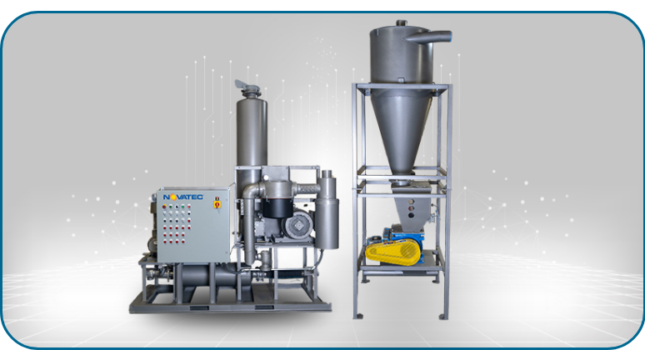
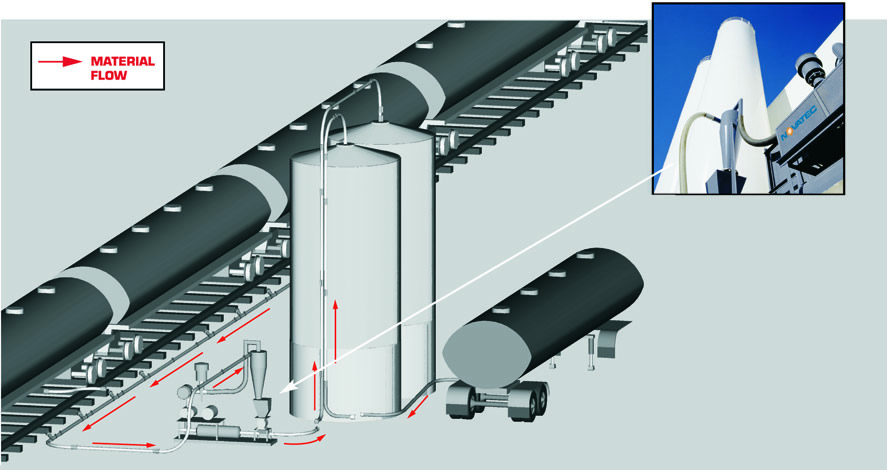
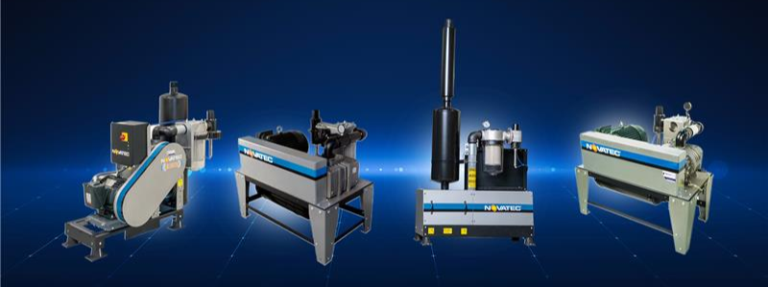
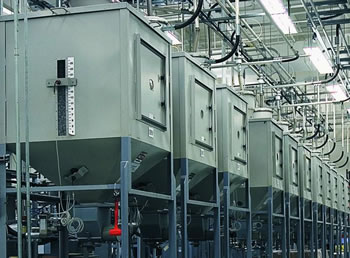
Bulk resin is unloaded from a railcar with a push-pull system, usually located outside the plant, that pulls material out of the car under vacuum and then pushes it up into a silo. Once the connection from railcar to silo is made and the pump starts, loading runs until the level sensor shuts the pump down. These systems are custom designed and normally housed in a weather enclosure.
If you purchase resin in bulk, it has to be unloaded quickly and efficiently. A bulk unloading system is typically a powerful push-pull system located outside the plant. It provides powerful vacuum to pull the material from a railcar. Then the material is pushed up into the silo.
After the connection is made from source to destination and the pump is activated, loading continues until the level sensor shuts the pump down.
These systems are custom designed based on the specifics of the application. Multiple silos are common so there must be an easy way to switch material flow. Bulk unloading systems are usually protected from the weather by an enclosure.
Note: Transfer of materials from bulk delivery trucks to silos is typically accommodated by a blower system provided on the bulk truck itself. For this application, “truck fill” lines, from the top of the silo down to ground level are provided on each silo for connection to the truck’s unloading system.
How do I fill a silo from a bulk truck instead of a railcar?
Bulk delivery trucks normally carry their own blower system, so the truck does the transfer. Each silo is fitted with a truck fill line that runs from the top of the silo down to ground level, and the truck’s unloading system connects to that line.
How does a railcar unloading system handle multiple silos?
Multiple silos are common, so the unloading system has to include an easy way to switch material flow from one silo to another. Because each installation differs, bulk unloading systems are custom designed around the specifics of the application, and they are usually protected from the weather by an enclosure since the equipment sits outside the plant.
Greg Washburn is Vice President of Operations at Novatec and has been with the company for more than three decades. He is involved in all phases of engineering design and product manufacturing, giving him a broad perspective on how resin drying and conveying equipment moves from engineering concept through production and into real-world processing environments. Greg holds a B.S. in Mechanical Engineering from the University of Maryland, Baltimore County (UMBC) and an MBA from Loyola University Maryland. His experience spans engineering, manufacturing and operations across Novatec’s material-handling technologies.
Joshua Belisle is Technology Manager at Novatec, where his work focuses on simulation and technology development for resin drying. He earned a B.S. in Mechanical Engineering with a minor in Engineering Business from the University of Virginia in 2023 and joined Novatec that same year. Joshua uses simulation tools to investigate previously difficult-to-measure aspects of the drying process, helping Novatec better understand airflow, heat transfer and other variables that influence resin-drying performance.