

Edited by Dana Gardner
Published August 6, 2024 · Reviewed by Greg Washburn · June 4, 2026
Summary
Can one vacuum pump convey resin 750 feet without staging?
Often, yes. High efficiency vacuum pumps create much higher vacuum than similarly sized positive displacement or regenerative blower pumps and can convey material up to 1,000 equivalent feet without an intermediate pump and surge bin. The article says they move 20-50% more material while using less energy, though the material and any obstacles in the line still need review.
Question:
I need to transport material from an old silo that is 750 feet from its intended destination. Do I really have to do that in two stages?
Response:
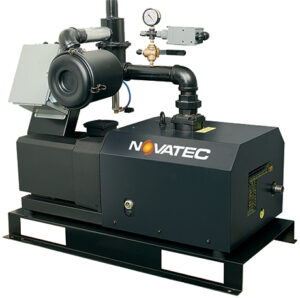
A few years ago the answer would have been yes. If you go that route today you will be spending a lot of unnecessary money for an intermediate pump and a surge bin that you probably don’t really need. We would still want to know what the material is and what obstacles might be in the way of the vacuum and material lines, but there is a high probability that there is a simple answer to your problem. There are now very high efficiency pumps that create much higher vacuum power than similarly-sized positive displacement or regenerative blower pumps. One of these pumps will transport your material up to 1000 equivalent feet without staging it. These pumps are so efficient that, while transporting 20-50% more material than PD or regenerative pumps, they use less energy. They cost a little more than conventional pumps but you will benefit from not having to buy two pumps plus a surge bin, and you will save on energy.
Question:
Is there an improvement in efficiency by eliminating the “Parallel Y” connections?
Response:
Emphatically, Yes! Each “Parallel Y” increases pressure drop by about 3%, so if you have 12 stations with 12 “parallel Y’s” in the line you are essentially increasing pressure drop by 36% and that equates to reducing your throughput capacity by an equal percentage. There are better ways to divert material as it travels through the line.
Question:
Can you give me an example of a practical replacement for “Parallel Y’s”
Response:
There are several material diverter alternatives on the market. Some are not easily purged because they have hang-up points where pellets can hide. One version that overcomes this problem and has minimal pressure drop is shown in the photo and illustration attached. This product is typically called a Two-Verter or Bi-Verter. It has a straight-through design with no crevices trap pellets so purging really clears the material line. They are typically installed in a common line above each receiver and can be used in conjunction with either manual or automatic material distribution systems.
Question:
None of my materials need to be dried. Will automating the conveying really save me anything?
Response:
Processors who install both a central drying and central conveying system save big bucks year after year. Processors who do not dry their materials see less savings but the advantages can still be substantial.
Look at some of the problems that can be solved, and costs that can be reduced by installing a proper automatic resin conveying system.
- Space needed for plant consolidation
If you can’t handle more process machines some other plant will - Congestion on the floor around machines
Slows workers, increases spillage and chance of injury - Lack of material validation/verification
Can’t bid on contracts where validation required - Wrong material going to wrong machine
Lost production time, rejects and lost material - High material spillage
- Loss of material and labor, plus safety hazard
- Material related part defects
Producing scrap instead of saleable parts - High maintenance and labor costs for self-contained loaders
Increased payroll and parts cost - High energy costs
Individual vacuum pumps are more efficient than lots of individual vacuum loaders - Frequent material changes
Lost production time - Inefficient work flow
Wastes space and labor - Lack of Automation
Adds labor costs and extends lead times - Constrained production capacity
Can’t increase revenue - Lengthy hopper cleanout times
Increased labor – lost production
When you start putting dollar values on these costs, the savings of an automatic resin conveying system speak for themselves.
Thank you to all for your questions.
Conveying questions are answered by Novatec experts
Jim Zinski, VP Systems Design
Frequently Asked Questions
Do parallel Y connections reduce conveying capacity?
Yes. Each parallel Y adds about 3% pressure drop, so 12 stations with 12 parallel Ys add roughly 36% pressure drop and reduce throughput capacity by about the same percentage. Replacing them with a lower-pressure-drop way of diverting material through the line recovers that capacity, which is why diverter choice matters when upgrading.
Why is a straight-through diverter easier to purge?
Some material diverters have hang-up points where pellets hide, so purging leaves material in the line. A straight-through design, often called a Two-Verter or Bi-Verter, has no crevices to trap pellets, so purging clears the line. These diverters typically install in a common line above each receiver and work with manual or automatic distribution.
Is central conveying worth it if I don't dry my materials?
Processors who don’t dry still see substantial advantages, though savings are smaller than with central drying and conveying together. Automatic conveying addresses floor congestion, spillage, wrong material at the wrong machine, lack of material validation, loader maintenance and energy costs, frequent material changes, and lengthy hopper cleanouts.
About the Reviewer

Vice President of Operations, Novatec
Greg Washburn is Vice President of Operations at Novatec and has been with the company for more than three decades. He is involved in all phases of engineering design and product manufacturing, giving him a broad perspective on how resin drying and conveying equipment moves from engineering concept through production and into real-world processing environments. Greg holds a B.S. in Mechanical Engineering from the University of Maryland, Baltimore County (UMBC) and an MBA from Loyola University Maryland. His experience spans engineering, manufacturing and operations across Novatec’s material-handling technologies.
Related Articles
Compare high-vacuum pump performance for large resin throughputs and long conveying distances.

See how automated distribution valves select material sources and destinations, then purge the conveying lines.

Compare central conveying with manual handling and self-contained loaders, including labor and maintenance costs.
Ask the Expert
