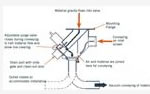
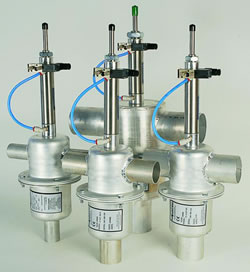
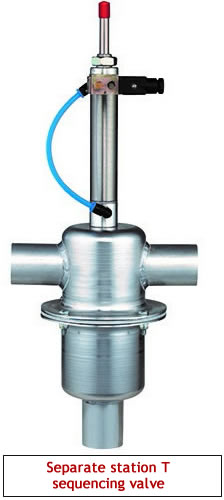
A vacuum take-off box purge valve fills its upper chamber with material by gravity, then opens a pneumatic purge valve to drop that material into the conveying line. The valve closes during conveying, so the rest of the vacuum-on time cleans the line with dry or ambient air. The unit mounts below the hopper and conveys to a single destination.
Another version of the vacuum take-off box is all stainless steel and uses a design that allows the material outlet to rotate 360° for ease of installation. It also features tool-free draining and an adjustable-stroke purge valve cylinder to optimize operation with any material.
Mounted below the hopper, the operation sequence is as follows:
Valve’s upper chamber is gravity filled with material, which is then introduced into the conveying line by opening the pneumatic purge valve.
The valve closes during conveying, allowing the remainder of “vacuum-on time” to clean the conveying line with dry or ambient air. It is designed to convey material to a single destination.
What features does a stainless steel take-off box purge valve have?
It is a version of the vacuum take-off box built entirely of stainless steel. Its material outlet rotates 360° to simplify installation, it drains without tools, and its purge valve cylinder has an adjustable stroke so operation can be tuned to the material being conveyed.
Why does a purge valve close during conveying?
Closing the purge valve during conveying stops more material from entering the line. The remainder of the vacuum-on time then draws dry or ambient air through the line, cleaning out the material already in it. This design conveys material to a single destination.
Greg Washburn is Vice President of Operations at Novatec and has been with the company for more than three decades. He is involved in all phases of engineering design and product manufacturing, giving him a broad perspective on how resin drying and conveying equipment moves from engineering concept through production and into real-world processing environments. Greg holds a B.S. in Mechanical Engineering from the University of Maryland, Baltimore County (UMBC) and an MBA from Loyola University Maryland. His experience spans engineering, manufacturing and operations across Novatec’s material-handling technologies.
Joshua Belisle is Technology Manager at Novatec, where his work focuses on simulation and technology development for resin drying. He earned a B.S. in Mechanical Engineering with a minor in Engineering Business from the University of Virginia in 2023 and joined Novatec that same year. Joshua uses simulation tools to investigate previously difficult-to-measure aspects of the drying process, helping Novatec better understand airflow, heat transfer and other variables that influence resin-drying performance.