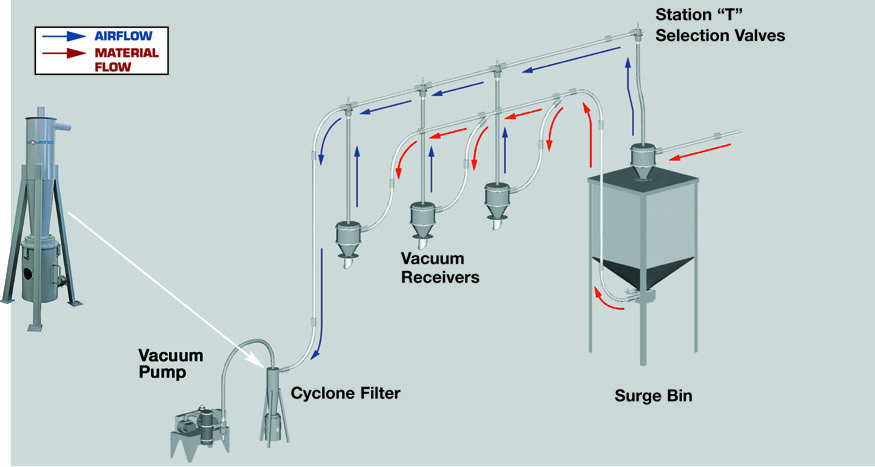
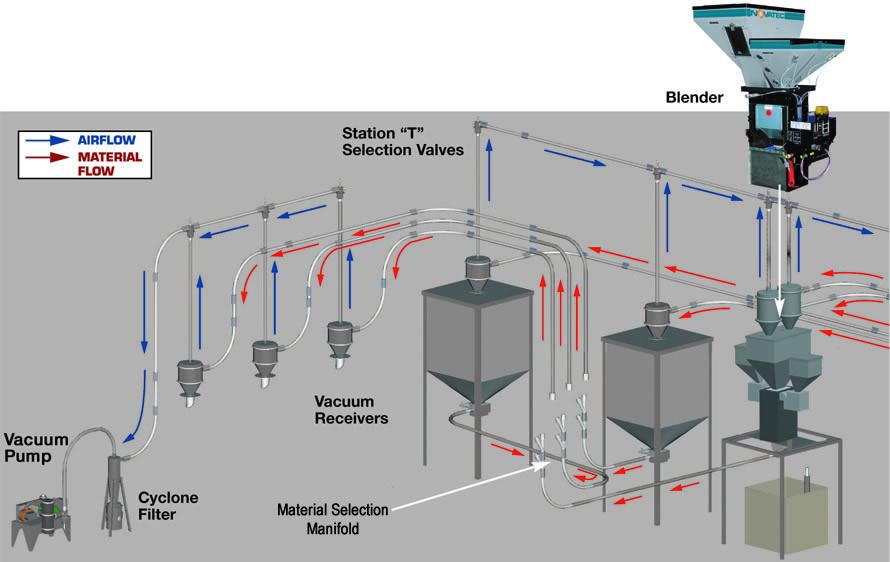
A common line system conveys a single material, or several similar materials, from one or more sources to one or more destinations through a single shared material line, with a receiver at each destination. It suits applications such as PET and extrusion where the same material runs to the machines for long periods, so there is no concern about cross-material contamination. The material may be dried or undried.
Single or Multiple Similar Materials to a Single or Multiple Destinations
Typical Application: PET and extrusion or any other application where a single material (or multiple similar materials) are fed to one or more machines for long periods. The material may be dried or un-dried.
A single common material line is practical where the same or similar material runs for a long period so there are no concerns about cross-material contamination. The common line runs from one or more sources for a single material to each destination through a receiver.
Frequently Asked Questions
When is a common line conveying system a good fit?
When the same material, or a group of similar materials, will run to one or more machines for a long period. Typical cases are PET processing and extrusion. Because the material does not change, sharing one line raises no concern about cross-material contamination, and the line can carry dried or undried material.
Can a common line feed more than one machine?
Yes. The common line runs from one or more material sources to each destination, with a receiver at each destination. A single material or multiple similar materials can be fed to one machine or several, provided the material stays the same long enough that there is no concern about cross-material contamination.
Can dried resin be conveyed on a common line?
Yes. The material on a common line may be dried or undried. PET is one typical application; the line carries dried material from the source to the receiver at each destination in the same way it carries undried material, as long as the same material runs for a long period.
Greg Washburn is Vice President of Operations at Novatec and has been with the company for more than three decades. He is involved in all phases of engineering design and product manufacturing, giving him a broad perspective on how resin drying and conveying equipment moves from engineering concept through production and into real-world processing environments. Greg holds a B.S. in Mechanical Engineering from the University of Maryland, Baltimore County (UMBC) and an MBA from Loyola University Maryland. His experience spans engineering, manufacturing and operations across Novatec’s material-handling technologies.
Joshua Belisle is Technology Manager at Novatec, where his work focuses on simulation and technology development for resin drying. He earned a B.S. in Mechanical Engineering with a minor in Engineering Business from the University of Virginia in 2023 and joined Novatec that same year. Joshua uses simulation tools to investigate previously difficult-to-measure aspects of the drying process, helping Novatec better understand airflow, heat transfer and other variables that influence resin-drying performance.