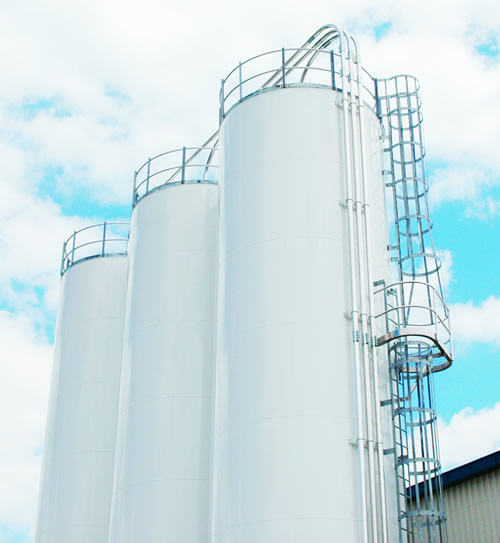
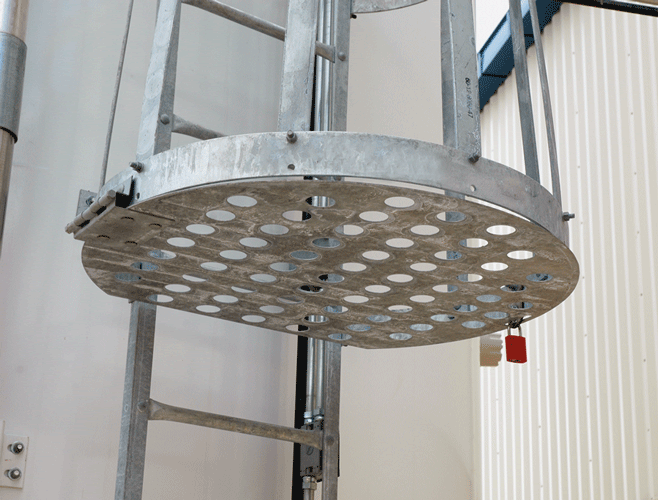
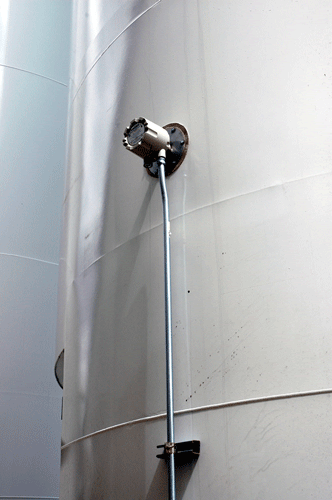
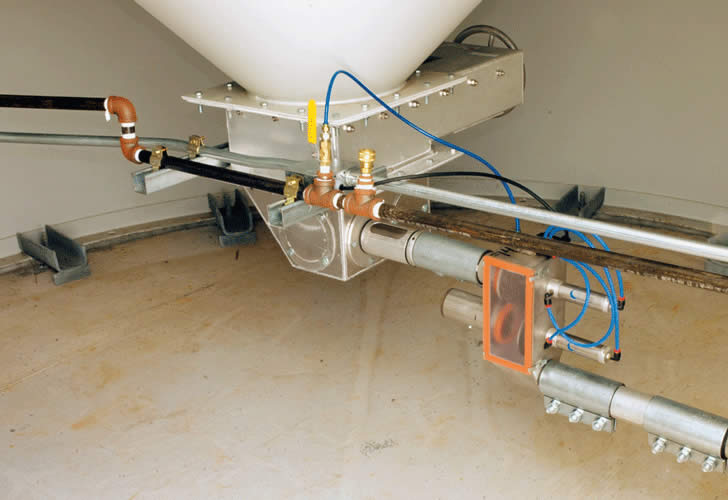
Resin storage silos are either single-piece welded steel fabrications or built on site from bolt-together steel or aluminum circular sections. The cone angle is designed for the material being stored, and options are available to minimize maintenance and give authorized personnel access. Level sensors come in several styles, and material levels can be monitored automatically to trigger reordering.
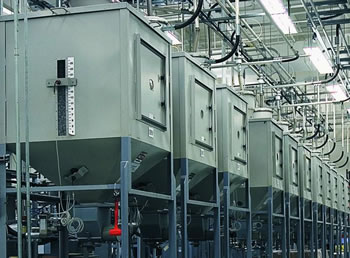
Silos may be constructed as single-piece welded steel fabrications or they may be built on-site with bolt-together steel or aluminum circular sections. The cone angle is designed for the material being stored and multiple options are available to minimize maintenance and make the silo accessible to authorized personnel. Various styles of level sensors are available and material levels can be automatically monitored to trigger re-ordering of material.
Both are used. A silo may be a single-piece welded steel fabrication, or it may be built on site from bolt-together steel or aluminum circular sections. In either case, the cone angle is designed for the material being stored.
What options and accessories come with a resin silo?
Typical options include caged ladders, railings and catwalks for access by authorized personnel, a choice of level sensors, and a vacuum take-off box. Level sensors come in several styles, and material levels can be monitored automatically to trigger reordering. Other options are available to minimize maintenance.
Greg Washburn is Vice President of Operations at Novatec and has been with the company for more than three decades. He is involved in all phases of engineering design and product manufacturing, giving him a broad perspective on how resin drying and conveying equipment moves from engineering concept through production and into real-world processing environments. Greg holds a B.S. in Mechanical Engineering from the University of Maryland, Baltimore County (UMBC) and an MBA from Loyola University Maryland. His experience spans engineering, manufacturing and operations across Novatec’s material-handling technologies.
Joshua Belisle is Technology Manager at Novatec, where his work focuses on simulation and technology development for resin drying. He earned a B.S. in Mechanical Engineering with a minor in Engineering Business from the University of Virginia in 2023 and joined Novatec that same year. Joshua uses simulation tools to investigate previously difficult-to-measure aspects of the drying process, helping Novatec better understand airflow, heat transfer and other variables that influence resin-drying performance.