

By Greg Washburn and Joshua Belisle · Edited by Dana Gardner
Published August 8, 2024 · Reviewed by Greg Washburn · August 18, 2026
Summary
What is a fantail manifold in plastics conveying?
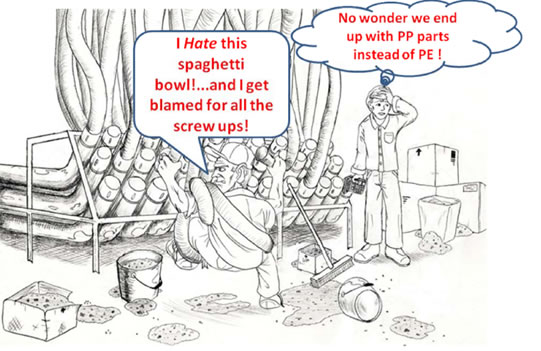
A fantail manifold presents materials from several sources in a compact space so a worker can manually connect a flexible destination hose to the right material source line, held in place by an auto-lock connection. Hose connectors are typically marked with a machine number and manifold caps with a material designation, but with 30 or more hoses the area can become a tangled spaghetti bowl.
Fantail manifolds are designed to present materials from a number of different sources in a relatively compact space so they can be connected to a material line that will convey them to their assigned destination. The basic idea is that a worker manually connects a flexible material destination hose to a material source line on the manifold. The hose is held in place by an auto-lock connection. Typically, the connector on the flexible hose is marked with a machine number and the cap on the fantail manifold is marked with a material designation. Still, this can be a tricky business. The area around an open array manifold with maybe 30 or more flexible hoses hanging down, is often referred to as ‘the spaghetti bowl’ and a mistake here can cause havoc on the production floor. The confusion is multiplied when an “open array manifold” is used because the hoses can get tangled among the manifolds.
Things to look for with any manifold system:
- Auto lock connections – to ensure that once the connection is made, it stays put
- Upright manifold lines – promotes improved purge performance
- Modular, expandable design – so additional materials/machines can be handled
- Purge capability – to minimize contamination of material
Frequently Asked Questions
What features should a resin conveying manifold system have?
Look for auto-lock connections so a connection stays put once it is made, upright manifold lines for improved purge performance, a modular and expandable design so more materials and machines can be added, and purge capability to minimize contamination of material.
Why are open array manifolds prone to material mix-ups?
Connections are made by hand, and an open array manifold can have 30 or more flexible hoses hanging down in what is often called the spaghetti bowl. Hoses can get tangled among the manifolds, and a connection made to the wrong source line can cause havoc on the production floor, even when hose connectors and caps are marked.
How are fantail manifold hoses and connections labeled?
Typically the connector on the flexible destination hose is marked with a machine number, and the cap on the fantail manifold is marked with a material designation. The labels help a worker match material to machine, but with many hoses in a small area, mistakes can still happen.
About the Authors

Vice President of Operations, Novatec
Greg Washburn is Vice President of Operations at Novatec and has been with the company for more than three decades. He is involved in all phases of engineering design and product manufacturing, giving him a broad perspective on how resin drying and conveying equipment moves from engineering concept through production and into real-world processing environments. Greg holds a B.S. in Mechanical Engineering from the University of Maryland, Baltimore County (UMBC) and an MBA from Loyola University Maryland. His experience spans engineering, manufacturing and operations across Novatec’s material-handling technologies.

Technology Manager, Novatec
Joshua Belisle is Technology Manager at Novatec, where his work focuses on simulation and technology development for resin drying. He earned a B.S. in Mechanical Engineering with a minor in Engineering Business from the University of Virginia in 2023 and joined Novatec that same year. Joshua uses simulation tools to investigate previously difficult-to-measure aspects of the drying process, helping Novatec better understand airflow, heat transfer and other variables that influence resin-drying performance.
Related Articles

Explore automatic distribution valves that route material from multiple sources to multiple destinations.
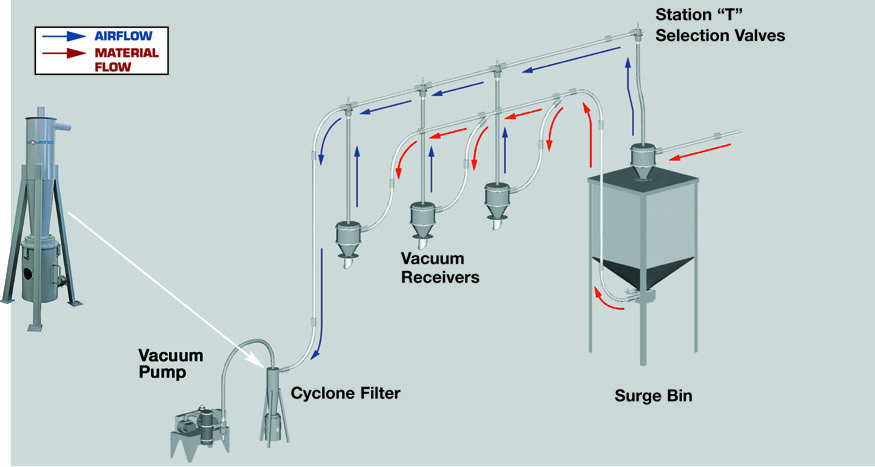
Review how a common-line conveying system distributes resin to multiple destinations.
Understand how take-off boxes introduce resin into conveying lines and regulate transport airflow.
Ask the Expert
