

By Greg Washburn and Joshua Belisle · Edited by Dana Gardner
Published August 4, 2024 · Reviewed by Greg Washburn · July 3, 2026
Summary
What are take-off box probes and how do I set them?
Take-off box probes connect a vacuum take-off box to the material lines, one probe per line, sized to the line diameter. Ambient air probes carry a pellet screen and an adjustable collar that modulates airflow; keep the collar at least 50% open so material has enough air to convey. Dry air conveying uses dry air probes plus a dry air stub.
Take-off Box Probes
Take-off Box probes are ordered for each take-off box to match the number of probes coming off the box and to match the diameter of the material line to which it’s being connected. There are ambient air probes and dry air probes. Each ambient air probe is fitted with a pellet screen and adjustable collar that modulates the airflow. The material needs sufficient airflow to be conveyed so the probe collar should always be at least 50% open.
If dry air conveying is being used, dry air probes should be ordered for each vacuum takeoff box along with a dry air stub, which is connected to the dry air return from a drying hopper. In this case, the vacuum stream pulls dry air through the take-off box to convey the material.
Frequently Asked Questions
What is the difference between ambient air and dry air take-off box probes?
Ambient air probes are fitted with a pellet screen and an adjustable collar that modulates the airflow drawn into the probe. Dry air probes are used for dry air conveying: they work with a dry air stub connected to the dry air return from a drying hopper, so the vacuum stream pulls dry air through the box.
How far open should the take-off probe collar be?
The adjustable collar on an ambient air probe modulates the airflow entering with the material. Because material needs sufficient airflow to be conveyed, the collar should be set at least 50% open. Each ambient air probe also has a pellet screen fitted to it.
How many probes does a take-off box need?
Probes are ordered for each take-off box to match the number of probes coming off the box and the diameter of the material line each one connects to. If the box will feed dry air conveying, order dry air probes for it along with a dry air stub tied to the drying hopper's dry air return.
About the Authors

Vice President of Operations, Novatec
Greg Washburn is Vice President of Operations at Novatec and has been with the company for more than three decades. He is involved in all phases of engineering design and product manufacturing, giving him a broad perspective on how resin drying and conveying equipment moves from engineering concept through production and into real-world processing environments. Greg holds a B.S. in Mechanical Engineering from the University of Maryland, Baltimore County (UMBC) and an MBA from Loyola University Maryland. His experience spans engineering, manufacturing and operations across Novatec’s material-handling technologies.

Technology Manager, Novatec
Joshua Belisle is Technology Manager at Novatec, where his work focuses on simulation and technology development for resin drying. He earned a B.S. in Mechanical Engineering with a minor in Engineering Business from the University of Virginia in 2023 and joined Novatec that same year. Joshua uses simulation tools to investigate previously difficult-to-measure aspects of the drying process, helping Novatec better understand airflow, heat transfer and other variables that influence resin-drying performance.
Related Articles
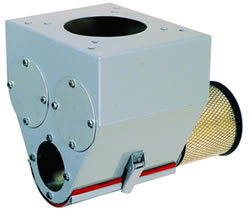
Review how vacuum take-off boxes feed conveying lines and regulate ambient or dry air at the material source.
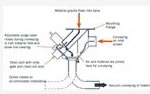
Explore a rotating material outlet, tool-free draining, and a purge valve that clears conveying lines with dry or ambient air.
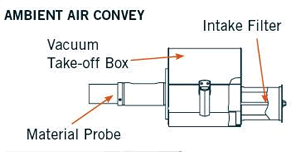
Compare ambient and dry air conveying and the role of take-off probes in controlling airflow.
Ask the Expert
