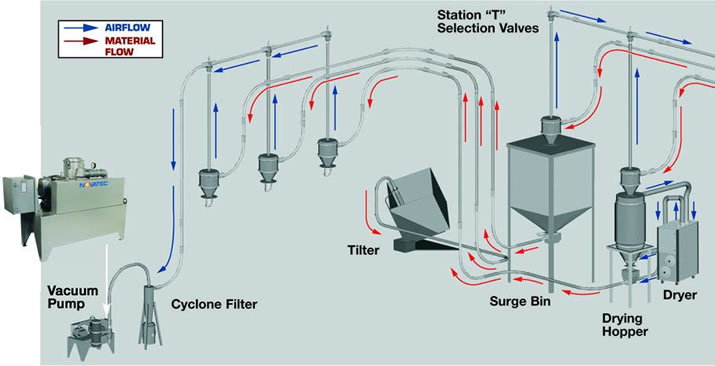
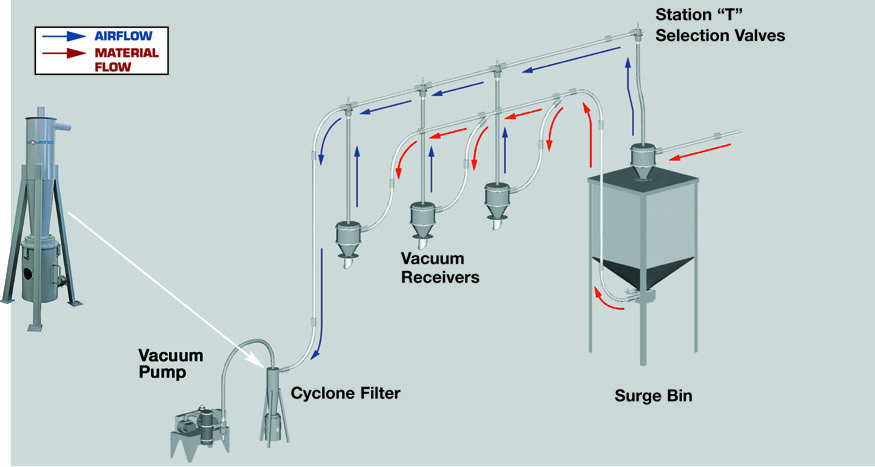
A dedicated line system gives each material its own conveying line and transfers it through receivers to one or more destinations. Because materials never share a line, the design avoids cross-material contamination. It typically suits molders conveying multiple materials, dried or un-dried, to multiple machines, and it can include line purging and a choice between dry air and ambient air conveying.
Typical Application: Molders using multiple materials being conveyed to multiple machines. The materials may be dried or un-dried.
Dedicated material line systems are designed to avoid cross material contamination by dedicating a single material line for each material and transferring each material to one or more destinations through receivers.
Line purging and a choice between dry and ambient air conveying are possible.
Can a dedicated line system use line purging and dry air conveying?
Yes. Dedicated line systems can include line purging, and the processor can choose between dry air and ambient air conveying. Because each material has its own line, that choice can follow the material, which matters when some of the materials being conveyed are dried and others are not.
Does a dedicated line system need material selection valves?
It depends on the number of materials and sources in the plant. One or more material selection valves may be used to direct each material onto its line, and those valves can be used with or without material verification and validation, depending on how tightly the plant needs to control which material reaches each machine.
How does a dedicated line system prevent cross-contamination?
A dedicated line system assigns a single conveying line to each material. Each material travels only through its own line to one or more receivers, so residue from one resin is not carried into the next. That separation is the purpose of the design when a plant conveys several materials to several machines.
Greg Washburn is Vice President of Operations at Novatec and has been with the company for more than three decades. He is involved in all phases of engineering design and product manufacturing, giving him a broad perspective on how resin drying and conveying equipment moves from engineering concept through production and into real-world processing environments. Greg holds a B.S. in Mechanical Engineering from the University of Maryland, Baltimore County (UMBC) and an MBA from Loyola University Maryland. His experience spans engineering, manufacturing and operations across Novatec’s material-handling technologies.
Joshua Belisle is Technology Manager at Novatec, where his work focuses on simulation and technology development for resin drying. He earned a B.S. in Mechanical Engineering with a minor in Engineering Business from the University of Virginia in 2023 and joined Novatec that same year. Joshua uses simulation tools to investigate previously difficult-to-measure aspects of the drying process, helping Novatec better understand airflow, heat transfer and other variables that influence resin-drying performance.