

By Greg Washburn and Joshua Belisle · Edited by Dana Gardner
Published August 8, 2024 · Reviewed by Greg Washburn · August 5, 2026
Summary
What are the basic types of resin conveying systems?
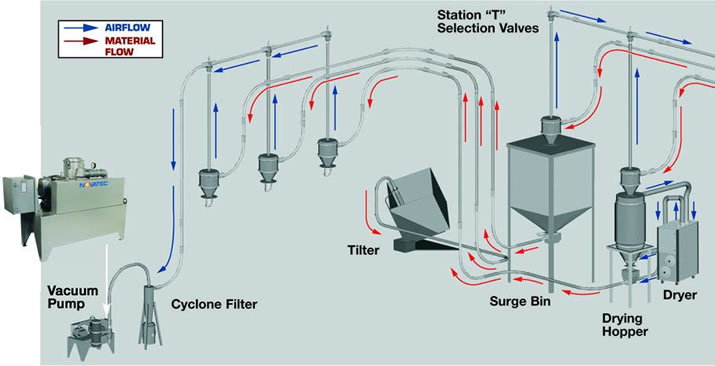
Resin conveying systems fall into four basic types: single source to single destination, single source to multiple destinations, multiple sources to single destination, and multiple sources to multiple destinations. The right type generally follows the processor’s business, from extrusion and preforms to injection molding and wire and cable, though there are many crossover situations.
We can break Vacuum Systems down into four basic types which are generally used by processors, dependant on application:
Processor Business: Extrusion, Pre-forms & Thermo Forming = basic system type: Single Source – Single Destination.
Processor Business: Caps, Containers, Containers & Extrusion= basic system type: Single Source – Multiple Destination.
Processor Business: Extrusion = basic system type: Multiple Source – Single Destination.
Processor Business: Injection Molders, Tubing, Wire & Cable = basic system type: Multiple Source – Multiple Destination.
There are many crossover situations but typically the processor listed in the businesse above will employ the resin conveying system type shown opposite their business category.
There are many questions to consider when selecting a vacuum system:
- Does the resin require drying?
- Are all multiple source materials similar…like PE and PP?
- Is a common or dedicated line for conveying preferred?
- Dry or ambient air conveying?
- Are material selection manifolds required?
- Is verification and validation of materials a factor?
- Is line purging required?
All of these questions are best discussed with the systems engineer who will help guide you through the decision making process.
There are also sub-systems which may be considered separately and can be integrated into the primary resin conveying system.
System Integration
When you consider a central resin handling system it is best to include all parts of the process if possible. Anything you can do to get declutter and simplify the production floor results in a better workflow, fewer employees and increased profits.
Frequently Asked Questions
Which conveying system type do injection molders use?
Injection molders, along with tubing and wire and cable processors, typically use a multiple source to multiple destination system. Extrusion, preform, and thermoforming operations typically use single source to single destination, and caps and containers typically use single source to multiple destinations. Crossovers are common, so these pairings are a starting point.
What should I decide before selecting a vacuum conveying system?
Consider whether the resin requires drying, whether multiple source materials are similar (such as PE and PP), whether you prefer common or dedicated conveying lines, and whether you need dry or ambient air conveying. Also decide on material selection manifolds, verification and validation of materials, and line purging. A systems engineer can guide these decisions.
Should a central conveying system cover the whole process?
When you consider a central resin handling system, it is best to include all parts of the process where possible. Sub-systems can be considered separately and integrated into the primary conveying system. Decluttering and simplifying the production floor leads to better workflow and increased profits.
About the Authors

Vice President of Operations, Novatec
Greg Washburn is Vice President of Operations at Novatec and has been with the company for more than three decades. He is involved in all phases of engineering design and product manufacturing, giving him a broad perspective on how resin drying and conveying equipment moves from engineering concept through production and into real-world processing environments. Greg holds a B.S. in Mechanical Engineering from the University of Maryland, Baltimore County (UMBC) and an MBA from Loyola University Maryland. His experience spans engineering, manufacturing and operations across Novatec’s material-handling technologies.

Technology Manager, Novatec
Joshua Belisle is Technology Manager at Novatec, where his work focuses on simulation and technology development for resin drying. He earned a B.S. in Mechanical Engineering with a minor in Engineering Business from the University of Virginia in 2023 and joined Novatec that same year. Joshua uses simulation tools to investigate previously difficult-to-measure aspects of the drying process, helping Novatec better understand airflow, heat transfer and other variables that influence resin-drying performance.
Related Articles
See how a dedicated conveying line serves each material and supports loading, purging and material changes.

Compare self-contained loader designs and features for bringing resin directly to processing machines.

Review vacuum receiver features, filters and maintenance needs when planning a resin conveying system.
Ask the Expert
