

By Greg Washburn and Joshua Belisle · Edited by Dana Gardner
Published August 6, 2024 · Reviewed by Greg Washburn · July 24, 2026
Plugged Lines, Starving Machines and you Need to Expand — What Now?
Your plan is to consolidate and add three machines to your current system, but unfortunately, your existing system seems to plug all the time and you can’t even feed your last machine. You have been told that your system is undersized and that it needs to be replaced. You have not budgeted funds for that investment. How can you bring your system to the needed capacity level at a minimal cost?
Summary
How do I fix plugged conveying lines without replacing the system?
Often the fix is the vacuum pump, not the piping. In the article’s example, a 5 Hp positive displacement pump sized for about 12″hg loses 6″hg to static pressure drop, leaving too little vacuum to move material. Replacing it with a high efficiency 7.5 Hp pump rated at 16″hg leaves 9″hg for conveying, so the existing lines can stay in place.
Let’s look at your situation and try to understand where we are.
Current System – feeding 12 machines
- Existing piping – 2” material lines = 300 ft Horizontal, 20 ft vertical with 5 elbows
- Existing piping – 2” vacuum lines = 300 ft Horizontal , 20 ft vertical with 5 elbows
- Desired capacity – 2,400 lbs/hr
- System Pump – 5 Hp Positive Displacement
- Pump operating conditions – PD blower is sized to operate at ± 12” hg
- Vacuum conditions:
– Static pressure drop (moving air only) for 600 feet of 2” diameter tube – approx. - 6”hg or 50% of pump capacity
– Pump has 6”hg of energy (vacuum) available for material conveying - Plugs and starving
– Due to insufficient vacuum from existing pump
– Vacuum relief goes off or pump burns up
– Changing sheaves and increasing pump speed brings greater air flow, more velocity and a higher static pressure drop – leading to less vacuum being available for the material
If you try to expand the existing system – to feed 15 machines you add:
- 60 ft. of Horizontal 2” OD material line, 20 ft vertical with 6 elbows
- 60 ft of horizontal 2” OD vacuum line, 20 ft vertical with 6 elbows –
- Your new vacuum conditions are worse than before:
– Estimated static pressure drop with extended distance 7”hg
– Remaining pump capacity with existing pump = 5”hg
Simply extending the current system is not the solution to your problem.
Some people may offer another very costly “solution” :
- Tear out all of your old vacuum and material lines and replace them with a larger diameter.
- Plus – replace your existing 5 Hp PD pump with a 7.5 Hp PD pump
This is a very costly solution. Not only will you spend extra thousands of dollars on replacing all the vacuum and material lines plus increase the size of pump that does not have great efficiency – your production line will be virtually shut down while the installation is completed.
There is a Better Solution – a REAL Solution – Here it is.
The vacuum pump is the heart of your system. It creates the air that moves the material and must have the vacuum capability to overcome the resistance created by moving both air and material. There is now an ultra-high efficiency pump using advanced technology to solve your conveying needs.
- Replace existing pump with high efficiency 7.5 Hp pump rated to run at 16”hg.
With a 7” hg static drop , the 16”hg UV Vacuum Pump leaves 9” hg available for material loading — an 80% increase over the existing pump.
- Leave existing vacuum and material lines in place – adding only enough new lines to accommodate the 3 new process machines.
End Result – Big Savings
- Minimal capital investment -system operates with original lines.
- Saved production time – no lost time while tearing out old and installing new.
- Lower energy and operating costs because of the new high efficiency, low maintenance vacuum pump.
Ultra-High Efficiency Vacuum Pumps
Frequently Asked Questions
Why does my central conveying system keep plugging?
Plugs and starving machines often come from insufficient vacuum at the pump. Moving air alone through long lines creates static pressure drop; in the example, 600 feet of 2-inch tube consumed about 6″hg, half of a 12″hg pump’s capacity. Speeding up the pump raises airflow and velocity but also raises pressure drop, leaving even less vacuum for material.
Can I add machines to an undersized conveying system?
Simply extending the lines makes the problem worse. Adding three machines in the example raised static pressure drop to about 7″hg, leaving only 5″hg for material with the existing pump. Replacing the pump with a higher-vacuum unit and adding only the new lines the extra machines need let the original piping stay in service.
Do I need larger diameter lines to increase conveying capacity?
Not necessarily. Tearing out every vacuum and material line for larger diameter tube and upsizing to a 7.5 Hp positive displacement pump is costly, and production is largely shut down while the work is done. The alternative in the article keeps the existing lines, reduces capital spend, and avoids lost production time during installation.
About the Authors

Vice President of Operations, Novatec
Greg Washburn is Vice President of Operations at Novatec and has been with the company for more than three decades. He is involved in all phases of engineering design and product manufacturing, giving him a broad perspective on how resin drying and conveying equipment moves from engineering concept through production and into real-world processing environments. Greg holds a B.S. in Mechanical Engineering from the University of Maryland, Baltimore County (UMBC) and an MBA from Loyola University Maryland. His experience spans engineering, manufacturing and operations across Novatec’s material-handling technologies.

Technology Manager, Novatec
Joshua Belisle is Technology Manager at Novatec, where his work focuses on simulation and technology development for resin drying. He earned a B.S. in Mechanical Engineering with a minor in Engineering Business from the University of Virginia in 2023 and joined Novatec that same year. Joshua uses simulation tools to investigate previously difficult-to-measure aspects of the drying process, helping Novatec better understand airflow, heat transfer and other variables that influence resin-drying performance.
Related Articles
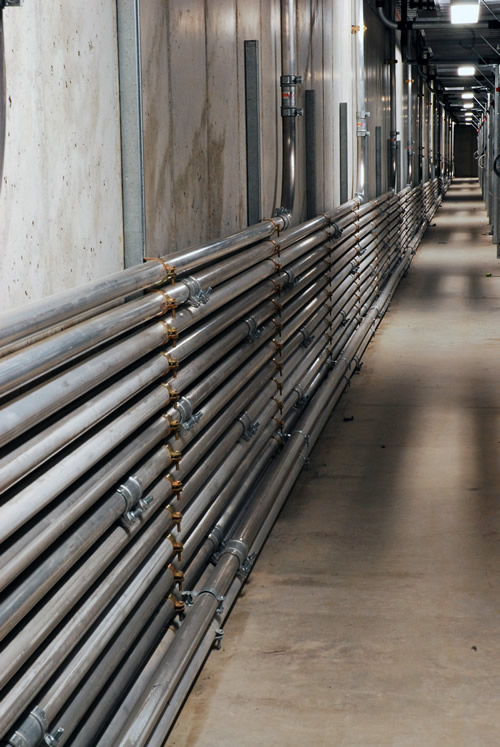
Review conveying line sizing and routing to maintain air velocity and material flow.
See how dry or ambient air can clear material from a conveying line after loading.
Estimate the economic return of a central conveying system using the ROI worksheet.
Ask the Expert
