

By Greg Washburn and Joshua Belisle · Edited by Dana Gardner
Published August 6, 2024 · Reviewed by Greg Washburn · July 17, 2026
Summary
What is a self-contained loader and how does it work?
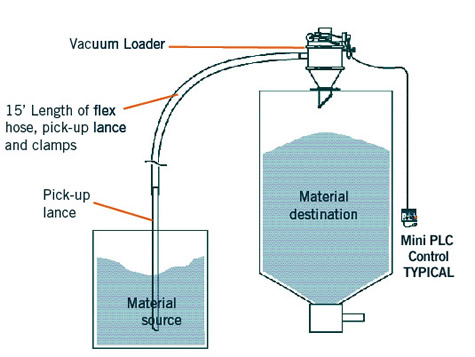
A self-contained loader is a vacuum loader with its own motor, controller, pickup wand and flexible hose, mounted on top of a drying hopper or surge bin. The wand goes into the resin source, usually a Gaylord, the controller is set for load time and dump time, and the motor pulls enough vacuum to move material about 15 feet. It is the most common loading system in use.
Self-contained loaders are the most common material loading system in use. They are typically found in smaller processing plants but also in plants with sophisticated central systems. There are often situations where the processor needs to transfer material from a Gaylord to a drying hopper or other destination.
The self-contained loader is usually supplied with a simple controller a pickup wand, a length of flexible hose and a couple of hose clamps. The loader is mounted on top of the destination container, which may be a surge bin or, more likely, a drying hopper. The wand is inserted into the resin source, the controller is programmed with the length of loading time and dump time and the loader is turned on. The powerful little self-contained motor creates enough vacuum to move material about 15 feet. A valve on the pickup wand can control the material flow.
Most small processors use this inexpensive, compact device to keep workers from climbing ladders with buckets full of resin – a labor-intensive and unsafe way of loading.
Frequently Asked Questions
How far can a self-contained loader convey material?
About 15 feet. The small self-contained motor creates enough vacuum to move material roughly that distance, and a valve on the pickup wand can control the material flow. The loader is mounted on top of the destination container, most often a drying hopper, with the wand inserted into the resin source.
What comes with a self-contained loader?
A self-contained loader is usually supplied with a simple controller, a pickup wand, a length of flexible hose and a couple of hose clamps. Setup is straightforward: mount the loader on the hopper or surge bin, insert the wand in the material, program loading time and dump time on the controller, and turn it on.
Are self-contained loaders only for small plants?
No. They are typically found in smaller processing plants, but also in plants with sophisticated central systems, because there are often situations where material has to move from a Gaylord to a drying hopper or another destination. Most small processors use this inexpensive, compact device to keep workers from climbing ladders with buckets of resin, a labor-intensive and unsafe way of loading.
About the Authors

Vice President of Operations, Novatec
Greg Washburn is Vice President of Operations at Novatec and has been with the company for more than three decades. He is involved in all phases of engineering design and product manufacturing, giving him a broad perspective on how resin drying and conveying equipment moves from engineering concept through production and into real-world processing environments. Greg holds a B.S. in Mechanical Engineering from the University of Maryland, Baltimore County (UMBC) and an MBA from Loyola University Maryland. His experience spans engineering, manufacturing and operations across Novatec’s material-handling technologies.

Technology Manager, Novatec
Joshua Belisle is Technology Manager at Novatec, where his work focuses on simulation and technology development for resin drying. He earned a B.S. in Mechanical Engineering with a minor in Engineering Business from the University of Virginia in 2023 and joined Novatec that same year. Joshua uses simulation tools to investigate previously difficult-to-measure aspects of the drying process, helping Novatec better understand airflow, heat transfer and other variables that influence resin-drying performance.
Related Articles

Explore how self-contained loaders move resin and what to consider when selecting and maintaining them.
Understand vacuum loader types, operation, and the practical differences between available designs.
Learn how compressed air loaders transfer material and the considerations for their use.
Ask the Expert
