

Edited by Dana Gardner
Published August 7, 2024 · Reviewed by Greg Washburn · August 27, 2026
Summary
How do you reduce static when vacuum conveying plastic pellets?
Static at the pickup wand and hose is reduced by grounding the conveying line. Using flex hose with static wire, strip the wire at one end and tuck it between the hose and the pickup probe. Then either tuck the other end between the hose and a grounded loader or receiver inlet stub, or add a grounding strap on the probe wired to a ground source.
Question:
How can we reduce high level static at the pick-up wand end and hose?
Response:
You can reduce static at the pickup end when conveying through grounding.
Using flex hose with static wire, strip the wire from one end of the hose helix and tuck it between the flex hose and pickup probe.
After that, you can ground the conveying process in one of two ways:
- Strip the wire from the other end of the hose and tuck it between the flex hose and loader/receiver inlet stub. NOTE: The loader body must be grounded for this to work.
- Add a grounding strap to the pickup probe and extend a grounding wire from the strap to a ground source.
NOTE: Be careful to route the grounding wire clear of your operator work space to avoid wire breakage, and tripping or overhead clearance hazards.When implemented successfully, either approach will provide the static electricity will have a path to flow out of the conveying line.
Question:
What’s the advantage of a single, high efficiency vacuum pump instead of a single, high efficiency pressure system?
Response:
The type of material and the distance you are conveying will be the main factors in determining whether a pressure or vacuum system is best for you but…if a high-capacity vacuum pump will do the job, you will save in initial cost and in maintenance costs for the life of the system.
Question:
What can be done to prevent the formation of pellet clumps in the conveying lines?
Fines amount is very low.
Response:
There are a number of reasons that plugs or clumps of material may form in a material line.
- Tight elbow bends (less than 6-8 x the tube diameter) increase pressure drop and reduce velocity
- Bends too close together (less than 10’ apart) – same as above
- Leaks in the system may be causing vacuum/velocity loss
- Clogged receiver or pump filters may be increasing pressure drop and reducing vacuum
- Too much air in the conveying line (probe tube carburetor screens should be opened about 50%) – no more.
- Finally – If you have expanded the system, the capacity you expect may be exceeding the pump capacity
Question:
What happens when air pressure is not sufficient?
Response:
Whether you are talking about a pressure system that blows material through the lines, or a vacuum system that sucks material through the lines, insufficient air results in the same kinds of problems.
- Pickup velocity may not be sufficient to get material moving
- Even if the material does move through the lines, it may start to pile up at elbows or at other places in the line, causing line plugs.
Question:
Can high vacuum systems be used to convey dry air?
Response:
Yes, but purging with dry air takes time and will somewhat reduce total conveying capacity per hour. Also, high vacuum pumps operate at higher temperatures than traditional vacuum pumps and should not be forced to move air that’s already heated above ambient, so precautions should be taken to ensure air temperature doesn’t rise above ambient.
Question:
Is vacuum or pressure better for my specific conveying needs? (We are a large East Coast U.S. processor, and we need a new, not replacement, installation in which PP and PE pellets needed to be conveyed over an installed distance of 750 horizontal feet and 35 vertical feet, including seven elbows.)
Response:
Your needs can be met by a vacuum pump and a custom designed 2.5-3-inch OD tubing system delivering a flow rate of 4500 lb/hr to satisfy a process rate of 3000 lb/hr. Spiral-grooved tubing reduces the occurrence of angel hair.
Question:
Can vacuum pumps let me use a 2-inch line OD, rather than increasing line OD? (We are a large custom molder setting up a new installation involving nylon/ABS pellets and regrind.)
Response:
Your needs can be addressed with an upgrade using twelve newly enhanced vacuum pumps, with high-temperature seals/bearings, in a 2-inch system, plus two additional vacuum pumps for maximum conveying rates across 500 horizontal feet. You could also consider a larger (2.5-inch
OD) line size, but that would be more expensive.
Question:
We are using PE pellets/regrind and our conveying system can’t keep up. What are our options?
Response:
You report that your existing three- pump system that has expanded over a 7-year period from 1500 lb/hr conveying 380 ft, to 2500 lb/hr, conveying 510 ft. Upgrading your system with high-performance vacuum pumps will immediately satisfy your system’s need to convey at a higher rate. We acknowledge your concern that you might have to rip out and replace your entire system, but that would certainly be overkill.
Question:
What is the vacuum level of a traditional vacuum system?
Response:
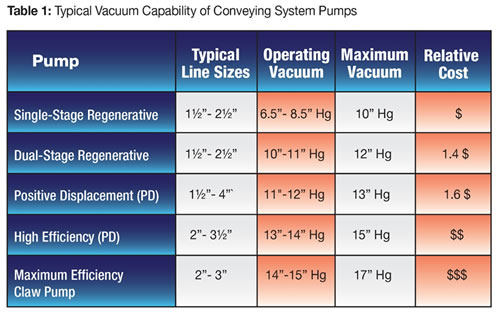
The operational vacuum, for regenerative blowers, expressed in inches of mercury (Hg) is usually around 6 to 11 inches Hg, depending on whether it’s a single or dual-stage pump.
Traditional vacuum displacement pumps generate around 10–12 inches Hg operating vacuum, compared to 14–15 inches Hg for high-vacuum pumps.
Question:
Can a traditional vacuum pump running at 12 inches Hg be converted to a high vacuum pump running at 15 inches Hg? If so, how?
Response:
It is not practical to increase the vacuum of a traditional pump, partly because high vacuum pumps do produce more heat and the internal components of a traditional pump are not designed for those higher temperatures.
Question:
Where is velocity control typically used within a high vacuum system?
Response:
The velocity is controlled from the middle to the end of the system where velocity typically
increases the most.
Question:
What is the capacity limit on a 2-inch line at 800 ft.?
Response:
To respond to this question, we need to know:
- Material type
- Bulk Density
- The equivalent distance – unless 800 feet is the equivalent distance
- Pump type and horsepower so we can use the pump curve to determine probable throughput
Thank you to all for your questions.
Conveying questions are answered by Novatec expert
Jim Zinski, VP Systems Design
Frequently Asked Questions
What causes pellet clumps and plugs in vacuum conveying lines?
Common causes include elbow bends tighter than 6 to 8 times the tube diameter, bends less than 10 feet apart, leaks that cost vacuum and velocity, and clogged receiver or pump filters. Too much air in the line also causes trouble, so probe tube carburetor screens should be open about 50%. An expanded system may also be asking more than the pump can deliver.
What vacuum level do conveying vacuum pumps operate at?
Regenerative blowers usually operate around 6 to 11 inches of mercury (Hg), depending on whether the pump is single or dual stage. Traditional vacuum displacement pumps generate around 10 to 12 inches Hg of operating vacuum, compared with 14 to 15 inches Hg for high vacuum pumps.
Can a traditional vacuum pump be converted to high vacuum?
It is not practical. High vacuum pumps produce more heat, and the internal components of a traditional pump are not designed for those higher temperatures. The same heat is why high vacuum pumps should not be forced to move air already heated above ambient, which matters when a high vacuum system is used to convey with dry air.
About the Reviewer

Vice President of Operations, Novatec
Greg Washburn is Vice President of Operations at Novatec and has been with the company for more than three decades. He is involved in all phases of engineering design and product manufacturing, giving him a broad perspective on how resin drying and conveying equipment moves from engineering concept through production and into real-world processing environments.
Greg holds a B.S. in Mechanical Engineering from the University of Maryland, Baltimore County (UMBC) and an MBA from Loyola University Maryland. He is a member of the Society of Plastics Engineers (SPE) and the American Society of Mechanical Engineers (ASME), reflecting his professional involvement in both plastics processing and mechanical engineering.
Related Articles
Compare vacuum pump technologies by conveying distance, throughput, efficiency, and noise.
Compare regenerative, positive displacement, high-efficiency PD, and claw pumps for resin conveying.
Understand operating vacuum, equivalent distance, and pickup velocity when selecting a conveying pump.
Ask the Expert