By Greg Washburn and Joshua Belisle · Edited by Dana Gardner
Published August 7, 2024 · Reviewed by Greg Washburn · July 13, 2026
Summary
What is a regenerative blower vacuum pump used for in conveying?
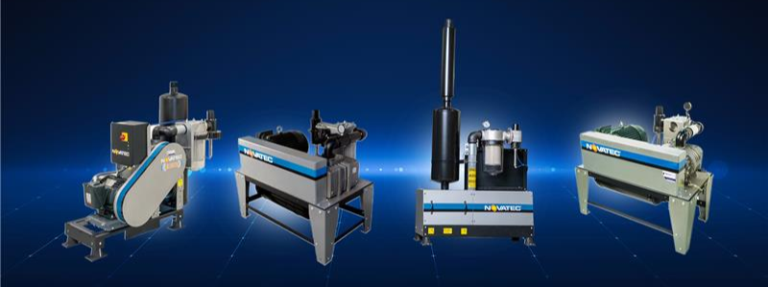
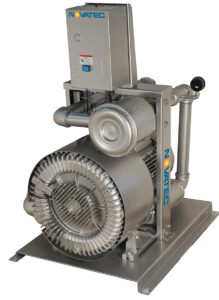
A regenerative blower vacuum pump provides compact, quiet vacuum conveying power for free-flowing pellets, powders and regrind. A 3-phase motor is direct-coupled to the blower, and the pump ships assembled on a base and permanently lubricated. Single-stage models suit 1.5 to 2.5 inch lines at 7 to 8 inches Hg; dual-stage models suit 1.5 to 3 inch lines at 10 to 11 inches Hg.
Vacuum regenerative blower pumps provide compact, quiet, maintenance-free vacuum conveying power for free flowing pellets, powders and regrind. These pumps are typically shipped fully assembled on a base and they are permanently lubricated to deliver optimum vacuum. A 3-phase motor is direct-coupled to the blower.
These pumps are usually offered as single-stage or dual-stage models. The single-stage models are typically used with 1.5” – 2.5” diameter lines and provide an operating vacuum level of 7-8” Hg. The dual stage models are use with 1.5 – 3” diameter lines and provide 10-11” Hg operating vacuum.
It is important to include a vacuum breaker valve which allows pump run-on after loading is complete to extend pump life and ensure instant vacuum on demand. A cartridge filter is typically used to trap carryover fines. These pumps are known for their quiet operation.
Some manufacturers offer an optional discharge selection valve that allows exhaust air to be recycled back to a closed-loop dry air system or discharged to atmosphere.
Compare Details of Various Vacuum Pumps for Conveying Plastic Resins

Frequently Asked Questions
What is the difference between single-stage and dual-stage regenerative blowers?
Single-stage regenerative blower pumps are typically used with 1.5 to 2.5 inch diameter conveying lines and provide an operating vacuum of 7 to 8 inches Hg. Dual-stage models handle 1.5 to 3 inch lines and provide 10 to 11 inches Hg, giving more vacuum in the same compact, direct-coupled design.
Why does a regenerative blower pump need a vacuum breaker valve?
A vacuum breaker valve lets the pump keep running after loading is complete instead of stopping and restarting each cycle. That run-on extends pump life and means vacuum is available instantly when the next load is called. A cartridge filter is also typically used to trap carryover fines.
Can regenerative blower exhaust go back to a dry air system?
Some manufacturers offer an optional discharge selection valve on regenerative blower pumps. It lets the exhaust air either be recycled back to a closed-loop dry air system or discharged to atmosphere, so the plant can choose where the pump’s exhaust goes based on how the system is set up.
About the Authors
Vice President of Operations, Novatec
Greg Washburn is Vice President of Operations at Novatec and has been with the company for more than three decades. He is involved in all phases of engineering design and product manufacturing, giving him a broad perspective on how resin drying and conveying equipment moves from engineering concept through production and into real-world processing environments. Greg holds a B.S. in Mechanical Engineering from the University of Maryland, Baltimore County (UMBC) and an MBA from Loyola University Maryland. His experience spans engineering, manufacturing and operations across Novatec’s material-handling technologies.
Technology Manager, Novatec
Joshua Belisle is Technology Manager at Novatec, where his work focuses on simulation and technology development for resin drying. He earned a B.S. in Mechanical Engineering with a minor in Engineering Business from the University of Virginia in 2023 and joined Novatec that same year. Joshua uses simulation tools to investigate previously difficult-to-measure aspects of the drying process, helping Novatec better understand airflow, heat transfer and other variables that influence resin-drying performance.
Related Articles
Compare vacuum pump options using conveying distance, throughput, material sensitivity and noise requirements.
Review the airflow and conveying-line factors used to size central system vacuum pumps.
Learn how monitoring pump condition can reveal warning signs before resin conveying stops.
Ask the Expert