

By Mark Haynie and Joshua Belisle · Edited by Dana Gardner
Published August 30, 2024 · Reviewed by Mark Haynie · July 6, 2026
Summary
Should I use press-side or central resin drying?
Press-side drying generally suits plants with fewer than 10 process machines, throughputs of about 25 to 100 lb/hr, and the same material running on the same machine daily. Central drying generally suits plants with dryers on 10 or more machines, one material dried at several machines, frequent material changes, or more material types than machines. Portable dry/convey units sit between the two.
As a plastics processor, selecting the right resin drying system is crucial to ensuring efficient production and high-quality finished products. While press-side resin dryers have been the go-to option for many processors with small-scale operations, more and more manufacturers are transitioning to centralized drying systems to meet their production requirements.
In this article, we’ll explore the differences between press-side and central resin drying systems, the benefits of each approach, and ultimately, why transitioning to a central plastic resin drying system might be the smart choice, especially if you’re looking to increase production, efficiency, and profitability.
Press-Side Resin Drying: When Is It The Right Choice?
Press-side or press-mounted resin dryers are commonly used in facilities with fewer than 10 process machines and low throughputs (between 25 – 100 lb/hr). This approach is ideal for processors who run the same material on the same machine daily, with minimal material changes.
With press-side drying, there is a vacuum loader at each drying hopper, and a bulk box or drum of resin is the source of material. While this approach is ideal for many processors, it can present some disadvantages for others. For example, this arrangement requires constant forklift traffic and room to deliver material to the presses, which can lead to contamination and wasted materials.
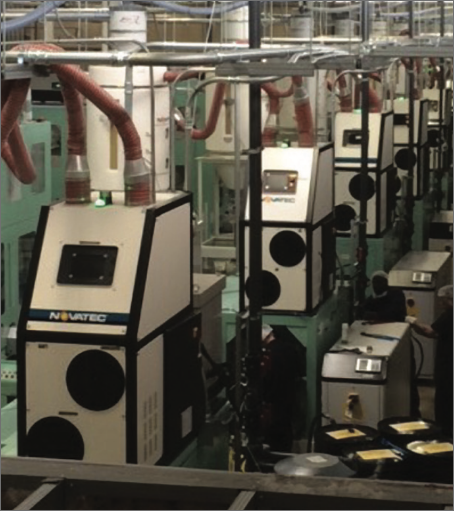
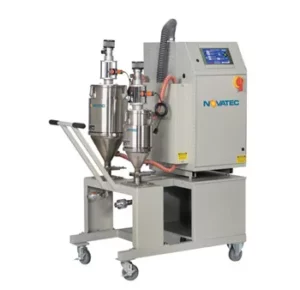
Portable dry/convey units are an interim solution for processors looking to upgrade their drying systems without making the leap to central drying. These units have throughputs of up to 200 lb./hr. and are typically mounted on a cart with a drying hopper, a loader or receiver to supply resin to the drying hopper, and a machine-mount loader or receiver to deliver material to the machine throat up to 200pph.
However, the need for bulk boxes and forklifts remains, which can cause confusion on the production floor and result in materials being left in the bulk bins and/or contaminated and wasted
Central Plastic Resin Drying: What Is a Centralized System?
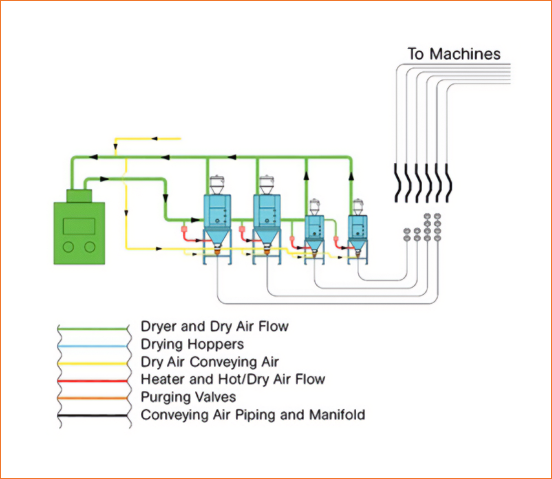
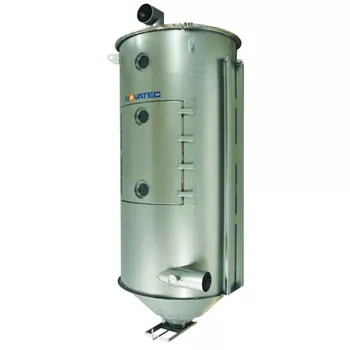
Centralized resin drying systems provide a single dryer that can provide -40°dew point air to multiple material hoppers of different sizes. An adjustable heater and blower are mounted on each hopper so the heat and air flow can be adjusted to the material in that hopper. This arrangement allows for custom drying of multiple materials from a single central dryer that is sized to match the requirements of the bank of hoppers.
Central plastic pellet dryers are available with throughputs from <200 lb/hr through 5,000 lb/hr, which meet a wide range of processor needs. Processors often have more than one central dryer – each serving a bank of hoppers with a back-up central dryer for times when a dryer may be taken offline for maintenance.
Are You a Good Candidate for Central Drying/Conveying?
If you have dryers on 10 or more machines, a single material that requires drying at multiple machines, frequent material changes on your machines, or use more material types than you have machines, then central drying is most likely the best option for you.
Additionally, centralized resin drying offers a notable advantage: the ability to pre-dry the next resin, thus curtailing non-productive time. By establishing a network that interconnects various processing machines with a centralized drying unit, processors can seamlessly sustain production while simultaneously preparing the subsequent resin for deployment.
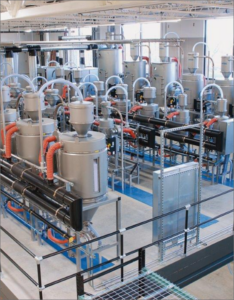
This eliminates the waiting game, slashes changeover durations, and ensures optimal drying conditions for different resin variants. The outcome? A substantial boost in productivity, minimized downtime, and a surge in operational efficiency.
Centralized resin drying systems also provide flexibility to serve the needs of your customers, reduce operating costs, and improve worker safety. If you have a justin-time objective to reduce inventory, need to reduce operating costs, or want to expand without sufficient space, then a centralized resin drying system is the perfect solution for your operation.
Frequently Asked Questions
How does a central resin drying system work?
A single central dryer supplies -40°F dew point air to multiple drying hoppers of different sizes. Each hopper has its own adjustable heater and blower, so heat and airflow can be set for the material in that hopper. The central dryer is sized to match the whole bank of hoppers, with throughputs from under 200 lb/hr to 5,000 lb/hr.
What is a portable dry/convey unit?
It is an interim step for processors upgrading from press-side drying without moving to central drying. A cart carries a drying hopper, a loader or receiver that fills it, and a machine-mount loader or receiver that delivers material to the machine throat, at throughputs up to 200 lb/hr. Bulk boxes and forklift traffic are still required.
How does central drying reduce changeover time?
With a central system, the next resin can be pre-dried in its own hopper while the current job keeps running. When the job changes, dried material is already waiting, which shortens changeovers and cuts non-productive time. Because each hopper has its own heater and blower, each material can be dried at the conditions it needs.
About the Authors

Vice President of Moisture & Drying Technologies, Novatec
Mark Haynie has designed and installed resin drying systems for more than 40 years, working in thousands of plastics plants across the industry. As Novatec’s Vice President of Moisture & Drying Technologies, he leads the company’s drying technology group, including its work on moisture measurement and predictive drying. He also serves as a technical reviewer for Novatec’s Drying Knowledge Center and has authored numerous technical articles and whitepapers on resin drying and moisture.
Mark earned a Bachelor of Science in Chemical Engineering from Virginia Tech.
Through Novatec’s Ask the Expert program, Mark regularly helps processors troubleshoot drying performance and resin-moisture challenges.

Technology Manager, Novatec
Joshua Belisle is Technology Manager at Novatec, where his work focuses on simulation and technology development for resin drying. He earned a B.S. in Mechanical Engineering with a minor in Engineering Business from the University of Virginia in 2023 and joined Novatec that same year. Joshua uses simulation tools to investigate previously difficult-to-measure aspects of the drying process, helping Novatec better understand airflow, heat transfer and other variables that influence resin-drying performance.
Related Articles
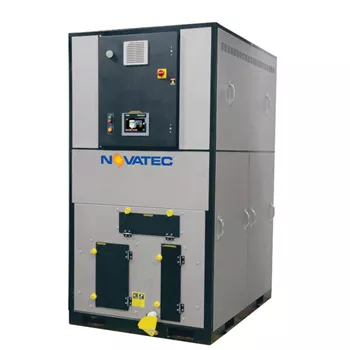
Learn how one central dryer supplies dry air to multiple hoppers with individual heaters and controls.
Compare movable dry/convey units with central drying for material changes, cleanout and plant space.
Explore drying hopper sizing, insulation and access features for an efficient resin drying system.
Ask the Expert